
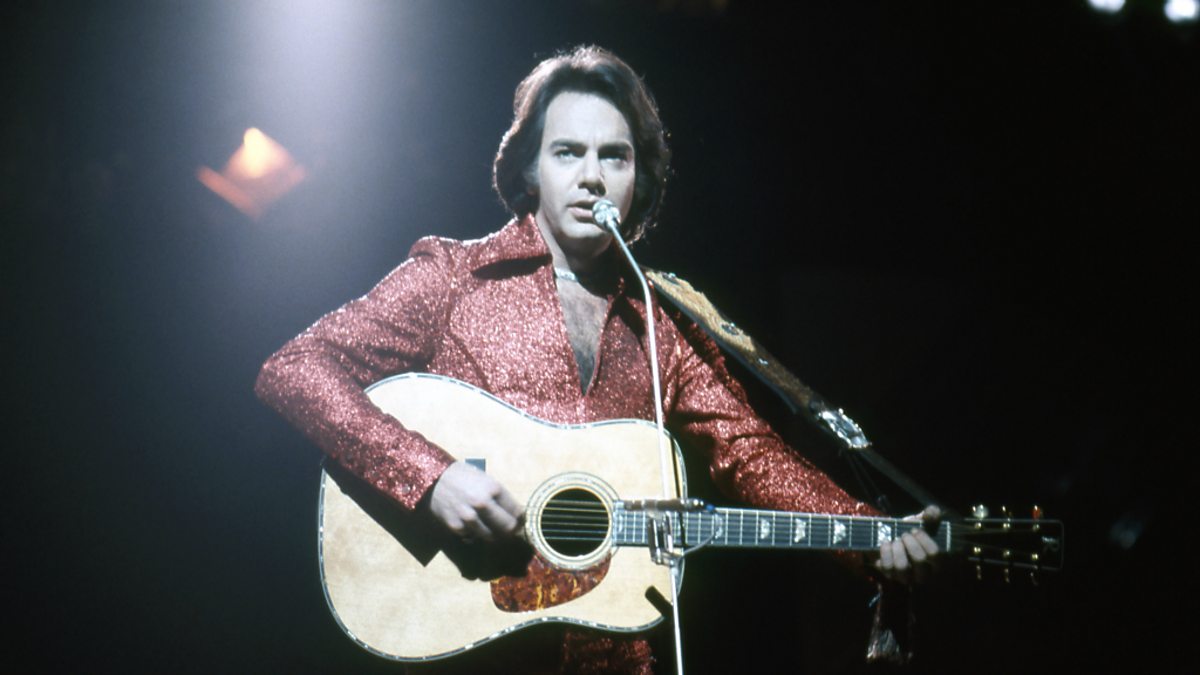
“Stones” turns heartache into something you can hold—heavy, quiet, and strangely beautiful.
When Neil Diamond released “Stones” as a single (backed with “Crunchy Granola Suite”) in late 1971, it arrived the way so many grown-up truths do: not with a shout, but with a steady weight in the hand. On the Billboard Hot 100, “Stones / Crunchy Granola Suite” first appeared on the chart dated November 13, 1971, debuting at No. 76, and it ultimately climbed to a peak of No. 14. That’s not the story of a flash of novelty—it’s the slow rise of a song people lived with, week after week, until it felt like part of their own vocabulary.
The timing matters. “Stones” is the title track of Diamond’s seventh studio album, Stones, released by Uni Records on November 5, 1971, produced by Tom Catalano—an album that would go on to reach No. 11 on the U.S. album chart. If “I Am… I Said” (also on the album) was Diamond standing in the doorway between New York and Los Angeles, naming the loneliness out loud, then “Stones” feels like what happens after you close the door and sit down in the silence.
Musically, “Stones” is one of those classic Diamond ballads that doesn’t beg for attention; it earns it. The melody moves with a patient inevitability, like footsteps in an empty hallway. The arrangement—very early-’70s in its restraint—gives the lyric room to breathe. And the lyric is where the song does its real work: it takes emotional distance, disappointment, and the ache of unsaid words, and turns them into a single, vivid object. Stones. Not flames, not storms—something colder, something that lasts. There’s a particular kind of sadness in that choice: the suggestion that what once was warm has become weighty and inert, still present, still real, but no longer alive in the way it used to be.
Contemporary industry reactions recognized exactly that kind of craft. In trade reviews at the time, Billboard described the title track as “exceptional ballad material,” and Cash Box highlighted it as a “striking image-laden ballad,” the sort of phrasing that tells you people heard the pictures in the words, not just the tune. That “image-laden” quality is key: Diamond doesn’t merely report heartbreak—he stages it, gives it props, makes it tangible enough that listeners can carry it around in their own pockets.
Part of the beauty of “Stones” is how it refuses melodrama. The song doesn’t need to accuse anyone, because the heavier truth is simpler: sometimes love doesn’t explode—it calcifies. It becomes routine, silence, resignation. And the older you get, the more you realize how often that happens without villains, without a clear ending, just a gradual turning of living feeling into something that clinks when you set it down. That’s why “Stones” keeps finding its way back into people’s lives. It names the kind of heartbreak that’s hard to explain, because it doesn’t look dramatic from the outside.
And history has been kind to it. “Stones” later appeared on Diamond’s 1974 compilation His 12 Greatest Hits, a quiet confirmation that it wasn’t just a momentary chart traveler—it belonged to the permanent set of songs audiences wanted to return to. In the long arc of Neil Diamond’s catalog, “Stones” stands as a reminder that his greatest strength wasn’t only in anthems and singalongs—it was in the hushed, honest portraits of what people endure after the applause fades.