
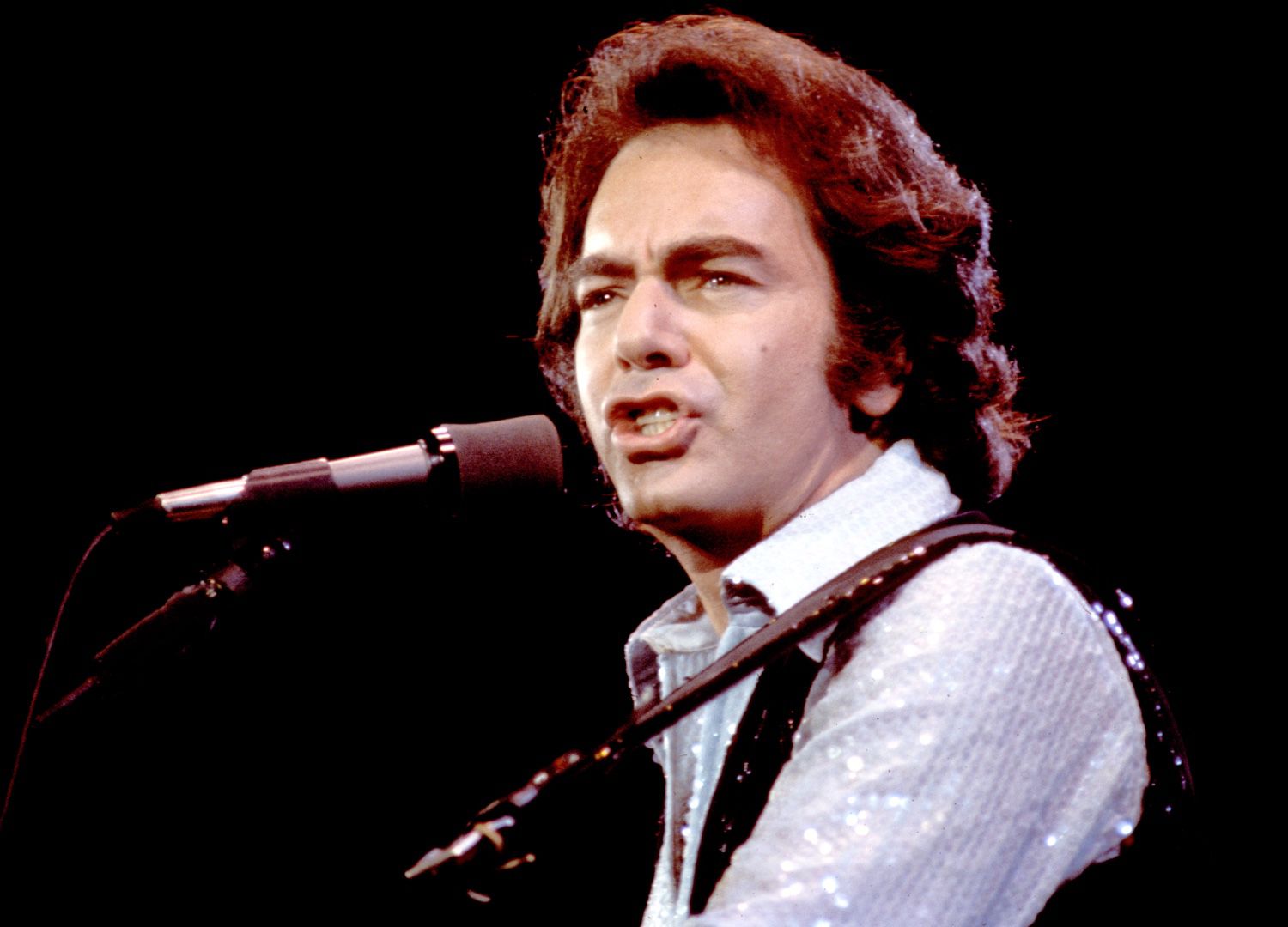
“Pretty Amazing Grace” is Neil Diamond singing gratitude like a late-evening confession—love as rescue, and mercy as something you can actually feel on your skin.
Before the mood takes over, the important signposts: “Pretty Amazing Grace” is track 2 on Neil Diamond’s Home Before Dark, released May 6, 2008, and produced by Rick Rubin—a pairing that pushed Diamond into a stark, intimate sound that still felt unmistakably his. The song clocks in at 4:53, and it was presented as the album’s first single, the one meant to open the door and say, I’m still here—older, yes, but newly awake. Commercially, it didn’t chase the pop charts the way his classic hits did; instead, it found its lane where grown-up radio lived: it peaked at No. 30 on Billboard’s Adult Contemporary chart. In the UK, it reached No. 49 on the singles chart and No. 42 on the singles download chart—and notably, it arrived on the UK chart in May 2008, a quiet transatlantic echo rather than a headline takeover.
What made the era feel so charged, though, was what happened around it. Home Before Dark debuted at No. 1 on the Billboard 200—the first chart-topping album of Diamond’s career—forty-plus years after he first entered the album chart. And in one of those beautiful, slightly unbelievable late-career twists, Diamond also premiered “Pretty Amazing Grace” on American Idol on April 30, 2008, letting millions hear this new, tender song in a context usually built for spectacle.
Now, the story behind the song isn’t one of tabloid drama or studio mythology—it’s something subtler: a writer meeting his own work with humility. In an interview, Diamond described “Pretty Amazing Grace” as, to him, “a song about the perfection of love,” while also insisting that it would mean different things to different listeners—and that he wasn’t interested in over-explaining it. That’s a telling stance from a songwriter who spent decades giving America big, cinematic choruses. Here, he seems content to let the song be what it is: a grateful breath, not a thesis.
And you can hear that gratitude immediately in the title itself—an intentional wink toward the spiritual weight of “Amazing Grace,” but turned personal and intimate: not a hymn for a congregation, but a private recognition of being saved by a person, by love, by timing, by whatever force kept you from going under. Critics heard that tone too. One review described the album’s atmosphere as a kind of battered romantic faith, with “Pretty Amazing Grace” signaling that Home Before Dark is, in part, a hymn to the redemptive power of a woman—and to the devastation that follows when that grace disappears. Another noted the song’s “clear-sighted nostalgia,” placing it near the center of the record’s emotional weather: not youthful longing, but the kind that arrives after experience has taught you what loss really costs.
Musically, Rubin’s influence is felt less as a signature sound and more as a removal of distractions. Home Before Dark was recorded in late 2007 into early 2008, and it wears that late-night studio intimacy: space around the vocal, the sense that the band is there to frame the voice, not compete with it. In that setting, Neil Diamond doesn’t have to “perform” emotion—he can simply stand inside it. “Pretty Amazing Grace” rises and opens in the chorus the way Diamond always has, but there’s less bravado here, less showman’s polish. The song feels like a man admitting, in plain language, that he once was empty—and something, or someone, filled him up again.
That’s the heart of its meaning: tender redemption without certainty. It doesn’t insist on happy endings. It doesn’t even insist on permanence. It celebrates the miracle of being restored—however briefly, however imperfectly. There’s something deeply moving about that perspective when it comes from a voice that has outlived eras, trends, and the usual expectations we place on “late” work. Diamond isn’t trying to be young. He’s trying to be honest. And honesty, at this stage of life, often sounds like thanks.
So “Pretty Amazing Grace” endures in a different way than the radio staples do. It’s not there to start a party. It’s there for the quieter hour—when you look back at the people who saved you from yourself, when you remember how close you came to becoming a stranger in your own story, and when you realize that the most dramatic turning points don’t always arrive with thunder. Sometimes they arrive like grace: unexpectedly, gently—pretty amazing, in fact.