
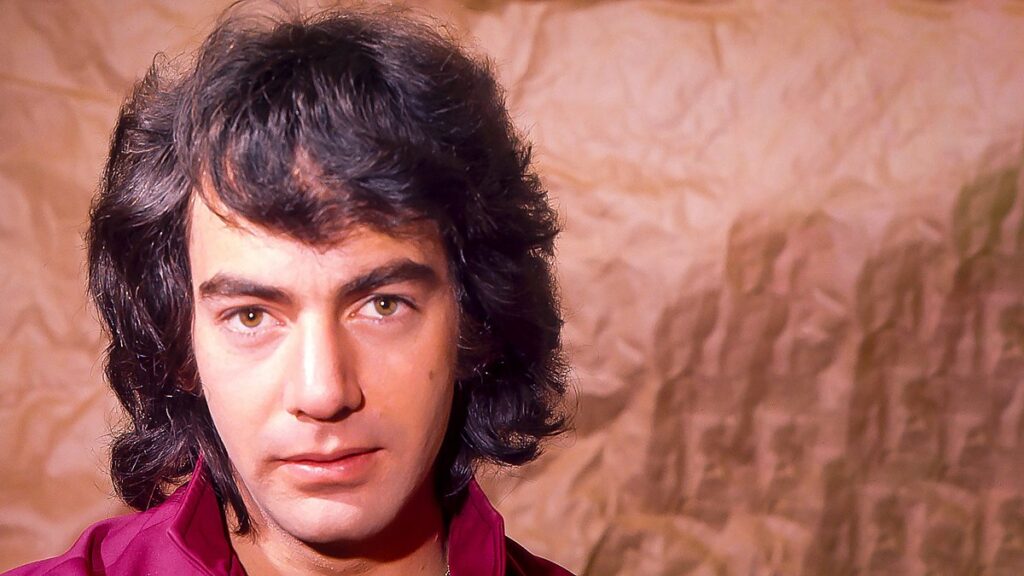
“Yesterday’s Songs” is Neil Diamond holding up a mirror to memory—showing how the music we once loved keeps loving us back, long after the room has changed.
Released in November 1981, “Yesterday’s Songs” arrived not as a youthful brag, but as a mature, clear-eyed embrace of the past—one that doesn’t sugarcoat time, yet refuses to let time steal the heart’s most faithful possessions. It was issued by Columbia Records as a single from Diamond’s album On the Way to the Sky (album released October 9, 1981). On the 45, the B-side was “Guitar Heaven,” and the single edit runs a concise 2:51—short enough to feel like a late-night thought, polished enough to sound like a promise kept.
And because you care about the numbers at launch, here are the exact chart bearings that matter most. On the Billboard Hot 100, “Yesterday’s Songs” debuted at No. 51, with a debut chart date of November 7, 1981, and it ultimately rose to a peak of No. 11. On the Billboard Adult Contemporary chart, the song became an even bigger story—spending six weeks at No. 1, a reminder that Diamond’s most loyal audience often lived where emotion, not fashion, made the rules. Billboard’s year-end accounting also reflects its staying power: it was ranked No. 77 on the 1982 U.S. Hot 100 year-end list.
But charts only tell you how far a song traveled. They don’t tell you why it stayed.
Neil Diamond wrote “Yesterday’s Songs” himself, and you can hear that solitary authorship in the lyric’s intimacy: it doesn’t sound like a committee-built “adult radio ballad.” It sounds like one man talking quietly to one other person, trying to explain a feeling that has followed him through decades—how music becomes a second memory system. We don’t just remember events; we remember what was playing when those events happened. A song can reopen a door you didn’t even know you’d closed. It can place you, instantly, back at the edge of a dance floor, or beside a kitchen sink, or in a car parked somewhere you were too young to call “nostalgia”—but old enough to feel the first faint bruise of time.
That’s the emotional engine of “Yesterday’s Songs.” It’s not merely sentimental; it’s aware. The song understands that “yesterday” isn’t a museum. It’s a living neighborhood inside the mind, full of streets you still walk down when you can’t sleep. Diamond’s narrator doesn’t reject the past, and he doesn’t worship it either. He treats it like an old friend: sometimes comforting, sometimes painful, always real.
There’s also a deeper, almost spiritual tenderness in the premise. The song suggests that love doesn’t always survive as a relationship—but it can survive as a song. That idea can sound small until you’ve lived enough life to realize how enormous it actually is. People leave. Seasons change. Houses get sold. Faces in photographs grow unfamiliar. Yet a melody can keep the shape of a feeling intact—like a pressed flower that still holds its color when you open the book years later.
Musically, “Yesterday’s Songs” carries that meaning with a kind of bright restraint: a steady beat that feels like time moving forward, and a vocal that refuses to drown in regret. Diamond sings with that characteristic mix of warmth and grit—romantic, yes, but not naïve. Even contemporary trade press caught the pull of it, praising the record’s melodic hook and Diamond’s “spirited” vocal delivery.
In the end, “Yesterday’s Songs” endures because it offers comfort without lying. It doesn’t promise you can go back. It promises something subtler: that what you lived meant something—and the proof is that music can still make you feel it. Not as a trick, not as nostalgia for nostalgia’s sake, but as a quiet reassurance that the best parts of us don’t vanish. They simply learn how to sing from a little farther away.