
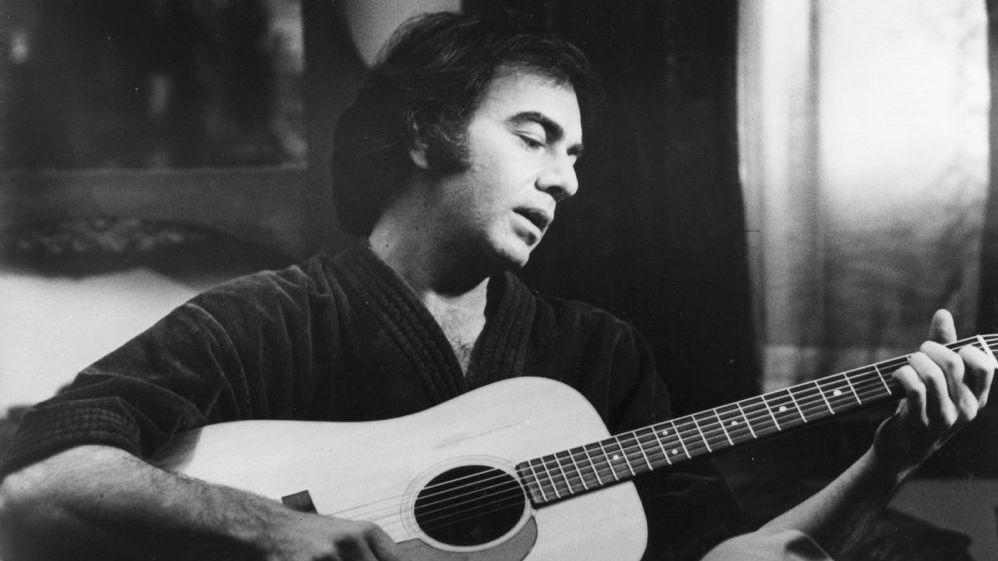
“Soolaimon” is Neil Diamond in one of his most adventurous moods—a song where rhythm, ritual, yearning, and spiritual openness come together until the music feels less like pop than a kind of invocation.
One of the most important facts to place right at the beginning is that “Soolaimon” was released in 1970 as a single from Tap Root Manuscript, one of the most unusual and ambitious albums in Neil Diamond’s catalog. The song rose to No. 30 on the Billboard Hot 100, which is an important detail because it proves this was not merely a curious album experiment hidden from the public. It was a genuine charting hit, even though it sounded unlike almost anything else on pop radio at the time. Tap Root Manuscript itself was released in 1970 and stands as one of Diamond’s boldest early records, mixing his usual songcraft with the African-influenced suite he described as a “folk ballet.”
That album context matters enormously, because “Soolaimon” belongs to a very special chapter in Diamond’s career. By 1970, he had already proven he could write and sing major hits. He had “Sweet Caroline,” “Holly Holy,” and “Brother Love’s Travelling Salvation Show” behind him. But instead of simply repeating what had worked, he reached outward. Tap Root Manuscript allowed him to explore African-inspired rhythms and imagery at a time when that kind of move was far from standard in mainstream American pop. Later commentary on the album rightly notes how early and unusual this was in the wider history of Western pop artists drawing openly on African musical atmosphere.
The title itself is one of the song’s great mysteries, and one of its great pleasures. Team Neil has explained that “Soolaimon” can mean “hello,” “welcome,” “good-bye,” or “peace be with you.” Whether one takes that as exact translation or as the broad poetic spirit Diamond was after, the emotional idea is clear enough. This is a word of greeting, blessing, passage, and peace all at once. That makes the song feel larger than ordinary narrative. It is not really telling a story in the conventional sense. It is creating a circle of feeling—day and night, welcome and farewell, trust and surrender, earthly rhythm and spiritual calm.
And that is the deepest meaning of “Soolaimon.” It sounds like a song of devotion, but not in a narrow doctrinal way. It reaches toward something more elemental. The repeated invocations of day, night, and providence give the song an almost liturgical texture, yet the rhythm keeps it moving with human warmth rather than solemn heaviness. It is a song about living inside a world that feels sacred and cyclical. Morning comes. Evening falls. Fear rises. Faith answers. The singer seems to place himself inside that ancient pattern and trust that the world, for all its uncertainty, still holds some order, some mercy, some blessing.
What makes Neil Diamond especially convincing here is that he never sounds detached from the material. He was always a songwriter unafraid of emotional largeness, and in “Soolaimon” that largeness becomes spiritual and rhythmic rather than purely romantic. He sings it not like a scholar presenting an idea, but like a man trying to feel his way toward peace through the music itself. That is why the record still has such force. It does not sound like an intellectual exercise. It sounds inhabited.
Musically, the song also stands apart. Even now, “Soolaimon” feels kinetic and ritualistic. The percussion drives it forward, while the chant-like structure gives it a communal quality. This is one reason it has endured in memory more vividly than some songs with similar chart peaks. It has identity. The moment it begins, you know you are not hearing ordinary early-1970s pop craftsmanship alone. You are hearing Diamond testing the edges of his own style and succeeding by sheer conviction.
There is also something very touching in how the song fits into Diamond’s wider body of work. So many of his most famous songs are built on intimate emotional themes—love, loneliness, memory, selfhood. “Soolaimon” reaches for something broader without losing that human center. It proves that Diamond could expand his canvas and still remain unmistakably himself. The emotional directness is still there. The yearning is still there. Only now it is carried on rhythm and invocation instead of confession.
So “Soolaimon” deserves to be heard as one of Neil Diamond’s most distinctive early triumphs: a 1970 single from Tap Root Manuscript, a Top 30 U.S. hit, and part of an album daring enough to fuse pop songwriting with African-inspired atmosphere long before that became fashionable. What remains longest, though, is the feeling the song leaves behind. It feels like greeting and farewell at once, like motion and stillness in the same breath, like a singer reaching beyond the ordinary language of pop toward something older, stranger, and more peaceful. And that is why “Soolaimon” still glows. It does not merely entertain. It blesses.