
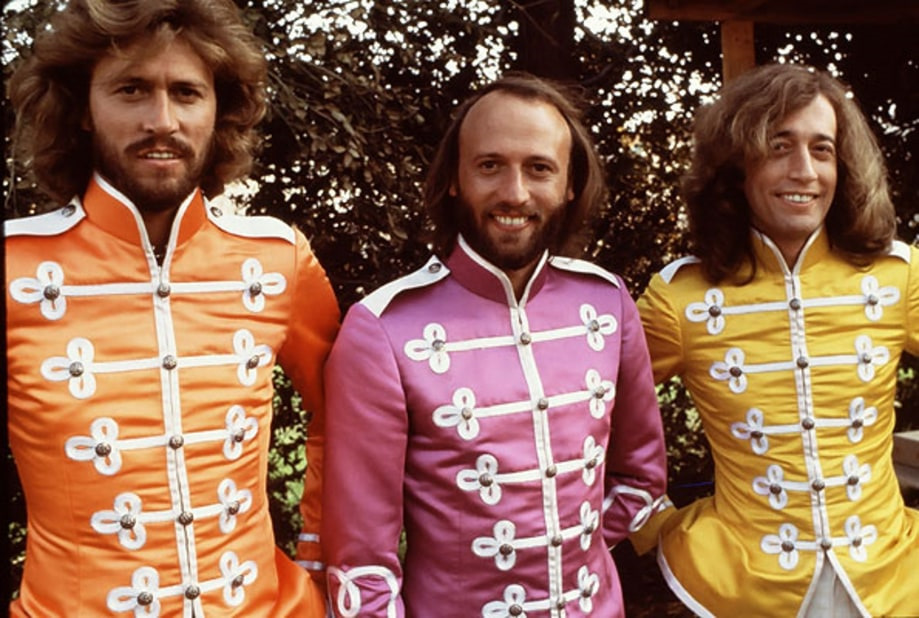
“Edge of the Universe” is the Bee Gees’ loneliest kind of orbit—where the world feels too far away, and love becomes the only signal strong enough to pull you back.
There are Bee Gees songs that sparkle like mirrorballs, and there are Bee Gees songs that stare straight into the dark. “Edge of the Universe” belongs to the second category. It’s the sound of the brothers—especially Barry Gibb and Robin Gibb—turning isolation into a melody you can hold in your hands. Even the song’s most famous image is stark rather than glamorous: the narrator alone at the “edge of the universe,” clinging to the thought of connection. It’s a pop-rock track, yes, but emotionally it feels like a late-night diary entry that somehow found its way onto vinyl.
The song’s “official” studio life begins in 1975. “Edge of the Universe” was written by Barry Gibb and Robin Gibb and recorded for the Bee Gees’ breakthrough reinvention album Main Course (1975), made with producer Arif Mardin after the group shifted their base to Miami and recorded at Criteria Studios. That Miami move matters, because Main Course is where the Bee Gees’ sound tightened into something more rhythmic, more modern—yet “Edge of the Universe” keeps a raw nerve exposed inside that slicker era. It was not pushed as a starring A-side; instead, it was released in September 1975 as the B-side of “Nights on Broadway.”
That B-side status is more revealing than it sounds. “Edge of the Universe” is the kind of track that doesn’t behave like a single: it broods, it builds, it aches. It feels made for listeners who stay after the “hit” ends—who flip the record over and discover that the back side sometimes tells the truer story. In other words, it arrived first as a secret.
Then, two years later, it had a second life that finally gave it a public chart identity.
On December 20, 1976, the Bee Gees recorded a concert at The Forum in Los Angeles, later released as their first official live album Here at Last… Bee Gees… Live in May 1977. From that show, the band issued “Edge of the Universe” (Live) as a single in summer 1977—and this time, it did chart: it reached No. 26 on the U.S. Billboard Hot 100, No. 16 in Canada, and No. 19 in New Zealand (among other listings). This is one of those rare cases where a song’s “breakthrough” comes not from the studio master, but from the stage—where adrenaline, crowd noise, and sharper tempo change the temperature of the emotion.
The contrast between versions is part of the story. Contemporary documentation notes that the studio take is slower, and that the live arrangement leans into a different texture—using synthesizer in a way that changes the feel of the riff and the overall drive. The live performance turns loneliness into motion: the same ache, but now it runs.
And what is the ache, exactly?
At its core, “Edge of the Universe” is about emotional exile—the feeling that you’ve drifted so far from the ordinary warmth of life that even love feels like a distant planet. It’s a song about needing someone not as an accessory, but as oxygen. The narrator’s world has narrowed down to essentials—one small companion, one overwhelming emptiness, one stubborn hope that another human being might still reach back. The Bee Gees were always masters of romantic intensity, but here the intensity isn’t seduction; it’s survival.
That’s why the song hits differently when you know where it sits in their timeline. In 1975, Main Course was the pivot that carried them from early-’70s uncertainty into the confident groove era that would eventually lead to Saturday Night Fever. Yet “Edge of the Universe” insists on showing the vulnerability underneath the reinvention—the private fear that even success can’t fix: the fear of being alone with your thoughts, too far out to be rescued by anything except love.
So if you’re listening today, don’t treat “Edge of the Universe” as a footnote to “Nights on Broadway.” Treat it as one of the Bee Gees’ most human moments: a song that admits how frightening it can be to feel unmoored—and how one remembered voice can become the rope that pulls you back from the edge.