
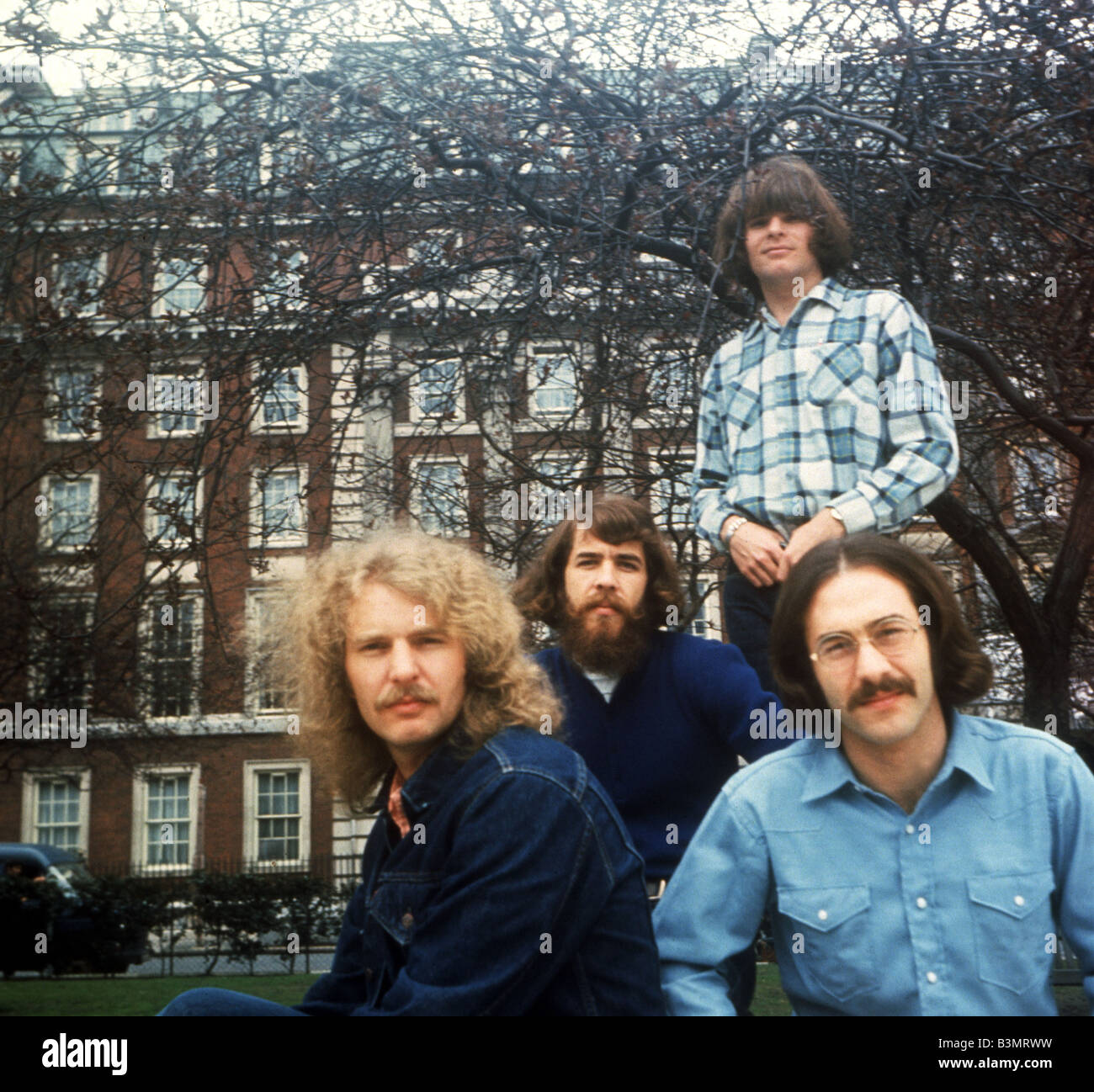
“Who’ll Stop the Rain” is a weary prayer in plain clothes—an acoustic sigh that asks, with gentle fury, when the long storm over ordinary people will finally break.
Released in January 1970 as a double-sided single with “Travelin’ Band”, “Who’ll Stop the Rain” marked another peak moment for Creedence Clearwater Revival at their commercial and creative height. On the U.S. Billboard Hot 100, the record rose to No. 2 (with both sides widely played), continuing CCR’s uncanny habit of dominating radio without quite capturing the No. 1 spot. In the UK, the release is commonly charted under “Travelin’ Band,” which reached No. 8—a reminder that, overseas too, this pairing landed as a major event.
Yet the song’s real “debut” is not a chart statistic. It is the moment that opening acoustic figure begins—like a curtain lifting on a country that can’t sleep. John Fogerty wrote and produced it, and he shaped it deliberately as a contrast to the wild, Little Richard-style sprint of “Travelin’ Band.” Where the A-side shouts and laughs, “Who’ll Stop the Rain” watches the horizon and quietly counts the years.
The track later appeared on CCR’s landmark 1970 album Cosmo’s Factory, released July 8, 1970—an album so successful it spent nine consecutive weeks at No. 1 on the Billboard 200. But “Who’ll Stop the Rain” arrived before the LP, while the era was still unfolding in real time: Vietnam on television, politics in turmoil, the idealism of the late ’60s hardening into something more exhausted. That’s why the song felt immediate. It didn’t sound like a history lesson. It sounded like yesterday’s newspaper left open on the kitchen table.
Lyrically, Fogerty builds the song in three verses that move through generations—“good men through the ages,” the promise of grand plans and reforms, and finally the youth culture itself—each one failing to stop the downpour. Many listeners have heard it as a thinly veiled protest song, a weary commentary on the Vietnam War and the broader sense of national malaise. And then there’s the image that sticks like damp clothes: the final verse’s crowd, the music, the rain, the struggle to keep warm—often linked to Woodstock in August 1969, not because CCR played it (they didn’t), but because Fogerty later described attending and watching the mud, the rain, the sheer mass of people. He even joked later about the “fable” that he performed it there, then explained he went home and wrote it afterward.
One of the most human pieces of the song’s backstory is smaller and more intimate than any festival: Fogerty recalled playing the finished recording at home, and his young son responded with the simple plea, “Daddy stop the rain”—a child’s literal hearing of a metaphor the adult world had complicated beyond measure. It’s a detail that hits hard because it reveals what this song really is beneath its historical references: not ideology, not slogans, but a father’s helplessness in the face of a world he cannot fix with his hands.
Musically, “Who’ll Stop the Rain” is built like a folk song that wandered into a rock band’s rehearsal room and decided to stay. The acoustic strum rings clean; the melody moves with steady inevitability; the chorus asks its question without ornament, as if the answer might arrive only if we speak plainly enough. And that is why it endures: the song refuses to posture. It doesn’t “win” an argument. It simply tells the truth of a feeling—that sensation, familiar in any decade, that the sky has been gray for too long and every promised solution sounds like another speech in the rain.
Decades later, the song’s meaning has widened. It can still evoke Vietnam-era unrest, but it also fits any period when people feel trapped in systems too large to move, when “plans” and “deals” and bright announcements fail to dry the streets. That’s the quiet genius of Creedence Clearwater Revival at their best: they made the specific feel universal, and they made the universal feel like a place you’ve actually stood—shoulders hunched, listening for thunder to pass.
In the end, “Who’ll Stop the Rain” isn’t asking for optimism. It’s asking for mercy. And maybe that’s why, when it plays, it still feels like an old friend putting a hand on your back and saying: Yes. I noticed the storm too.