
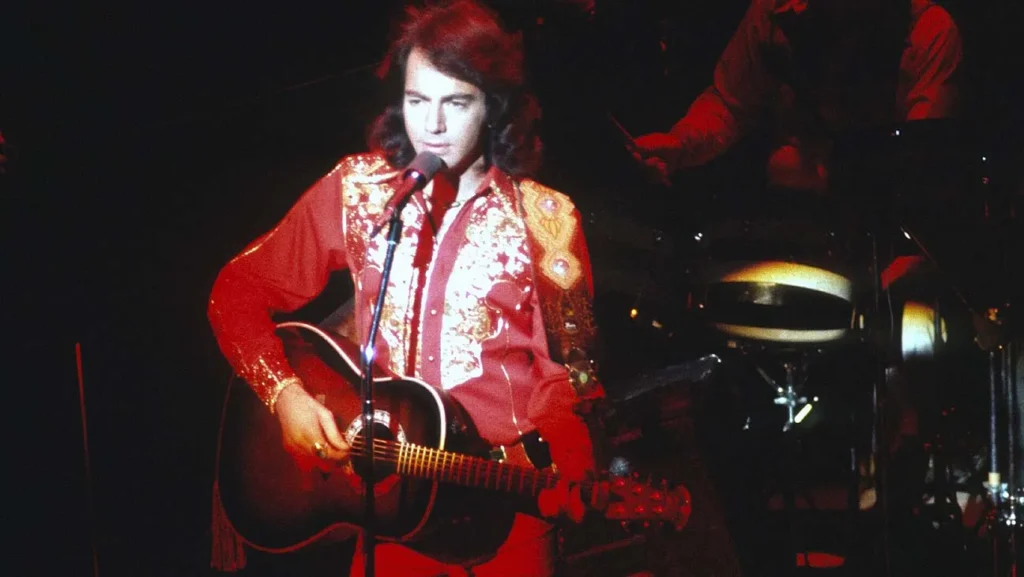
A Quiet Reckoning Between Time, Memory, and the Music That Outlives Us
When Neil Diamond released “The Story of My Life” on his 1986 album Headed for the Future, it arrived as a deeply personal reflection from an artist whose voice had already become a fixture in the emotional architecture of popular music. Though the single did not ascend to the upper reaches of the charts like his earlier triumphs — it peaked modestly on the Adult Contemporary listings — its resonance was never intended for fleeting radio play. Rather, it served as a meditation on legacy, on the quiet aftermath of fame, and on the tender ache that comes when an artist takes stock of his own journey. In many ways, “The Story of My Life” was less a commercial moment than a confessional one — an introspective chapter written by a man who had given so much of himself to melody and memory.
By 1986, Neil Diamond had already traversed decades of musical evolution — from the Brill Building craftsmanship that shaped his early pop gems to the grand theatricality of his ’70s ballads. Headed for the Future, his sixteenth studio album, found him grappling with modern production textures while maintaining that inimitable Diamond warmth: a baritone carved from both gravel and gold. Within that sonic landscape, “The Story of My Life” emerged as one of its most poignant entries — not because it sought reinvention, but because it acknowledged endurance. It is the sound of an artist looking back without regret, writing his autobiography in verse and chord.
At its heart, “The Story of My Life” is a song about authorship — not just of songs, but of self. Its lyrics trace the arc of a man examining how love, loss, ambition, and resilience have composed him. There’s an implicit understanding that every line sung is both confession and creation; every chorus is another page turned. The melody itself mirrors that introspection: steady yet swelling, grounded yet luminous. Diamond’s vocal delivery — that singular combination of sincerity and grit — transforms what might have been sentimentality into something quietly profound. It’s as if he’s reading aloud from an old journal no one was meant to hear.
There’s also an undercurrent of reconciliation woven through its structure. By this period in his career, Diamond was no longer chasing youth or novelty; he was embracing reflection as artistry. The production carries a mid-’80s sheen — synthesizers hum gently behind his voice — but beneath the polish lies something timeless: one man’s reckoning with what remains after the applause fades. The song becomes both mirror and monument, a gentle acceptance that every note sung has been part of something larger — a lifetime translated into music.
In retrospect, “The Story of My Life” stands as one of Neil Diamond’s most sincere declarations: an acknowledgment that behind every hit record lies a human being still searching for meaning in the echoes. It is not merely a love song or even an autobiographical piece; it is an elegy for moments lived fully and remembered honestly. Through it, Diamond invites us to listen not only to his story but to recognize our own within its verses — proof that even in quiet reflection, music remains the truest form of remembrance.