
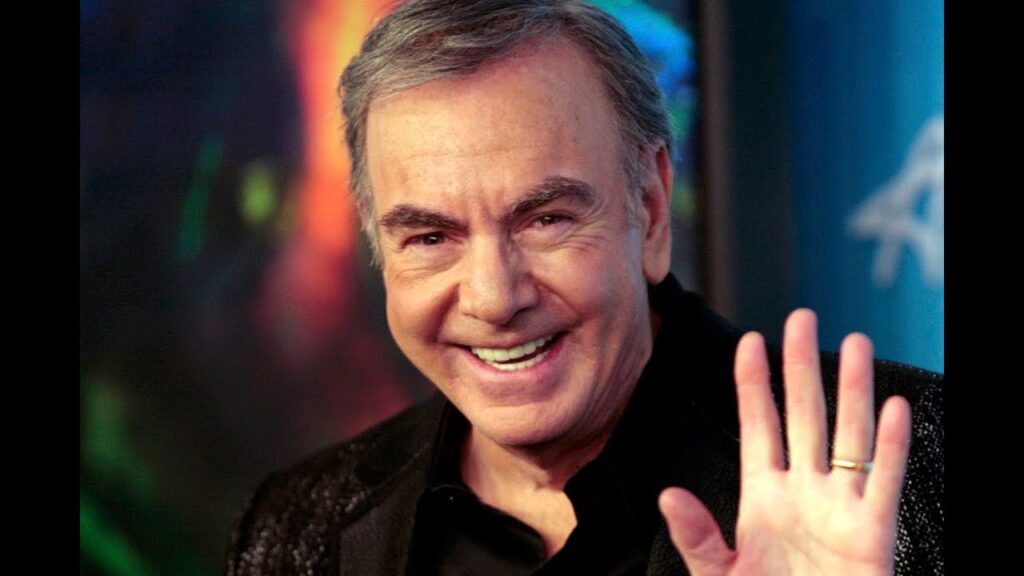
“Hallelujah” in Neil Diamond’s voice feels like a late-night prayer spoken without certainty—a confession that love and loss can share the same breath, and neither one cancels the other.
The key facts matter here, because they explain why Neil Diamond singing “Hallelujah” lands with such a particular weight. His recording is a cover of Leonard Cohen’s song, included on Diamond’s 2010 studio album of favorites, Dreams (released November 2, 2010 on Columbia, produced by Diamond himself). In the United States, Dreams debuted and peaked at No. 8 on the Billboard 200, a notable late-career statement: not a nostalgia package, but a living artist choosing other writers’ songs as if he were curating a personal bookshelf. In the UK, the album likewise hit a peak of No. 8, and the official chart listing shows it sitting at No. 18 in its second week with Peak: 8—evidence that it arrived with genuine momentum.
Inside that album, “Hallelujah” is credited, correctly and plainly, to Leonard Cohen—and Diamond doesn’t treat that credit like a formality. He treats it like a responsibility.
By the time Diamond recorded it, “Hallelujah” already carried a long, complicated life. Cohen first released it in 1984 on Various Positions, a song famously shaped through years of work and many drafts—eventually becoming less a “religious” song than a deeply human one, where sacred language is used to describe imperfect love, spiritual doubt, and the stubbornness of desire. That tension—holy words, unholy wounds—is the engine that keeps the song from ever becoming wallpaper. It’s not a victory anthem. It’s a hymn with scuffed shoes.
So why does Neil Diamond fit it so well?
Because Diamond has always sounded like someone who believes emotion should be big enough to fill a room—yet old enough to know that filling a room doesn’t solve anything. On Dreams, he recorded with a band built for warmth rather than flash, tracking at studios including Arch Angel and EastWest in Los Angeles, with longtime collaborator Hadley Hockensmith on guitars among the core personnel. That matters, because Diamond’s “Hallelujah” isn’t about decorating the melody; it’s about letting the song’s weary backbone show. He leans into the grain of his voice—no longer the youthful shine of the early hits, but something burnished, lived-in, quietly authoritative.
There’s also a deeper thread that makes this choice feel like destiny rather than novelty: Diamond had been in conversation with Cohen’s writing for decades. Back in 1971, Diamond recorded Cohen’s “Suzanne” on his album Stones—an early sign that he wasn’t merely a hitmaker with a golden hook, but an interpreter drawn to literate melancholy. When he returns to Cohen in 2010 for “Hallelujah,” it doesn’t feel like jumping on a famous title. It feels like picking up a book he’d marked long ago, coming back to a passage that reads differently now that time has had its say.
And—just so the record is clean—there’s a small discography twist that can confuse even devoted fans: Neil Diamond also released an entirely different song titled “Hallelujah” in the 1980s (linked in European chart listings to his 1984 era). The 2010 track people seek out on Dreams, however, is Cohen’s composition.
What does Diamond mean when he sings it?
He sounds like a man standing at the edge of memory, looking down—not to punish himself, but because the view is honest. Where some versions make “Hallelujah” sparkle, Diamond’s reading is earthier, heavier, closer to a slow exhale. He doesn’t perform “mystery.” He performs recognition: the recognition that love can be both blessing and bruise; that you can say “hallelujah” not because everything turned out well, but because you’re still here to say anything at all.
That’s the quiet gift of Neil Diamond – “Hallelujah.” It doesn’t try to out-sing the world’s many famous renditions. It simply adds one more voice to the candlelit line of people who have needed this song—not as a showpiece, but as a companion. And when Diamond, late in a long career, chooses to carry Cohen’s words into his own weathered register, you can hear something tender beneath the grandeur: a songwriter paying respect to another songwriter’s truth… and, in the process, telling us his own.