
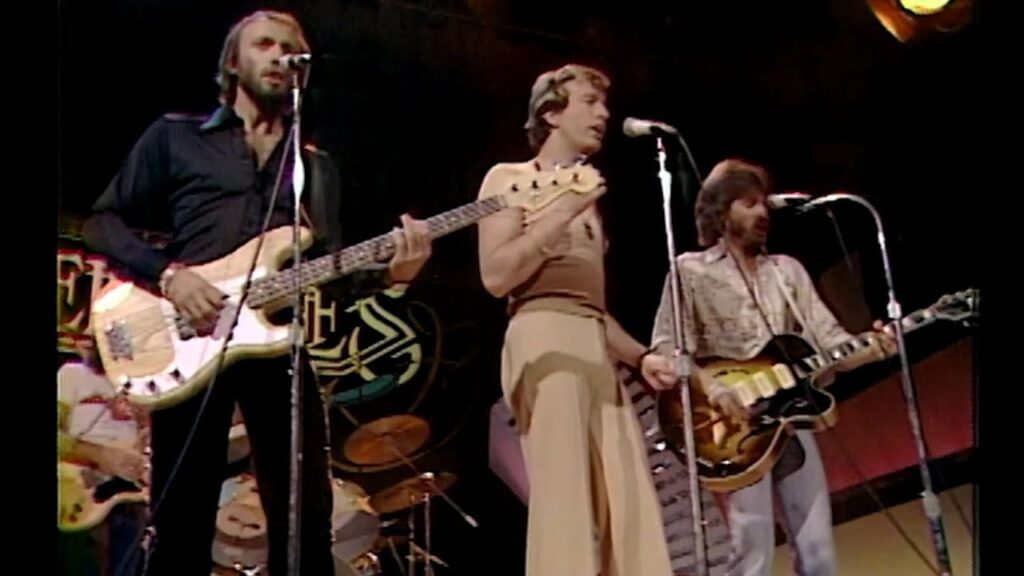
“Nights on Broadway” is the moment the Bee Gees turned heartbreak into a midnight dance—where loneliness walks the city streets, and the voice suddenly learns how to fly.
If you want a single song that captures the Bee Gees’ great mid-’70s transformation—away from their earlier, ornate pop balladry and toward the pulse of the dance floor—“Nights on Broadway” is the doorway. Released as the second single from Main Course in September 1975, it didn’t just extend the momentum of “Jive Talkin’.” It sharpened the band’s identity, giving them a darker, tougher urban silhouette—three brothers writing from inside the neon glare.
Its chart “arrival” tells a story of steady ignition rather than instant explosion. Contemporary chart listings show the single entering the Billboard Hot 100 at No. 82 (its first week on the survey), before climbing into the upper reaches and ultimately peaking at No. 7 in the U.S. In hindsight, that Top 10 peak feels almost inevitable, because the record carries two kinds of propulsion at once: the physical push of its rhythm, and the emotional push of its narrative—the ache of someone chasing a love that won’t return his devotion, then blaming the whole mess on “the nights on Broadway.”
The “behind the song” story is legendary for a reason, because it marks a turning point not only for the track, but for popular music. Arif Mardin, producing the session at Criteria Studios in Miami (recorded January 20 and 30, 1975), asked for something simple: could one of them “scream” during the chorus to lift the intensity? What happened next was an accident that became a signature. Barry Gibb kept pushing higher, higher—until the scream turned into a falsetto he didn’t fully know he possessed. That discovery became the sound the world would soon associate with the Bee Gees’ greatest era.
That context changes how the “Remastered Album Version” feels today. The “album version” of “Nights on Broadway” runs about 4:32, longer than the radio edit (which fades earlier and trims a slower section). Remastering doesn’t rewrite the performance—it simply presents that original album mix with updated mastering for clarity on modern formats, letting the night air around the instruments and voices feel a little closer to your ear.
What’s easy to miss, if you only remember the groove, is how bruised this song really is. “Nights on Broadway” is not a victory lap; it’s a man confessing that the city has taught him a cruel lesson. He isn’t serenading love in a sunlit room—he’s wandering through strangers and darkness, trying to keep dignity intact while desire keeps pulling him back. The chorus doesn’t celebrate Broadway; it indicts it. It’s as if the street itself has become a temptation, a habit, a place where you go when your heart doesn’t have anywhere else to sit.
And that is why the record endures: it understands a very adult kind of loneliness. Not the dramatic loneliness of being abandoned once, but the repetitive loneliness of chasing what won’t choose you—then pretending you’re fine because the beat is strong and the night is young. The Bee Gees make that contradiction sound beautiful: pain dressed in motion, regret carried by harmony, and a vocal leap that feels like a soul trying to climb out of its own circumstances.
Placed within Main Course—an album that reached No. 14 on the Billboard 200 and stayed on the chart for an exceptionally long run—“Nights on Broadway” becomes more than a hit. It’s a hinge in the Bee Gees’ story: the moment craft, risk, and reinvention met in the same room, and the future answered back in falsetto.