
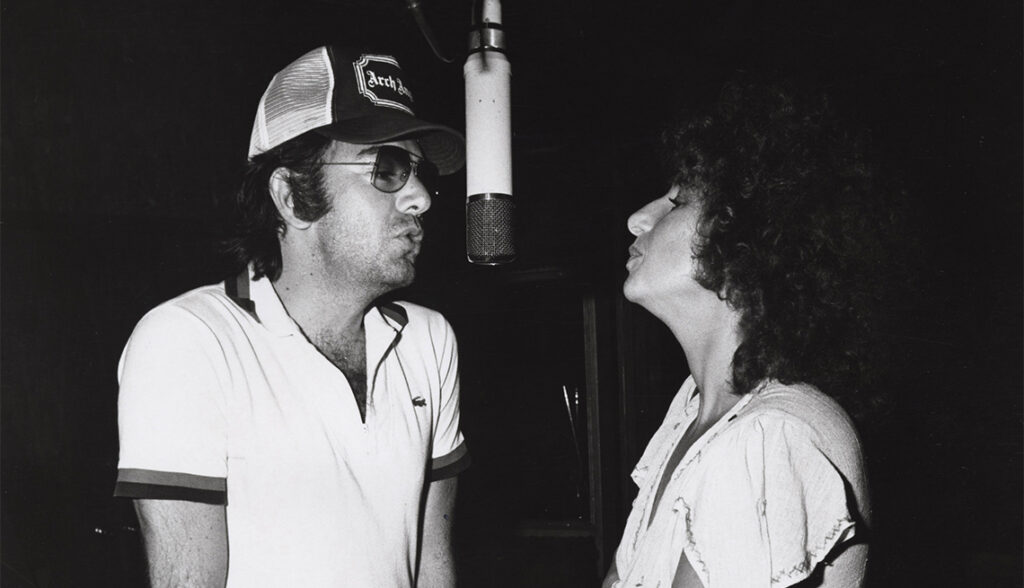
“You Don’t Bring Me Flowers” is the sound of love cooling into routine—a duet where two beautiful voices refuse to romanticize the silence, and instead name it.
When Neil Diamond and Barbra Streisand stepped into the spotlight to sing “You Don’t Bring Me Flowers” at the 22nd Annual GRAMMY Awards—held February 27, 1980 at the Shrine Auditorium in Los Angeles—it wasn’t just “another performance.” It felt like a private conversation, suddenly made public, with millions listening in. That night mattered because the song itself had already become a pop event: the official duet single had debuted at No. 48 on the Billboard Hot 100 dated October 28, 1978, then rose to No. 1 (first hitting the summit the week of December 2, 1978). By the time they sang it live on GRAMMY night, it had graduated from radio phenomenon to something closer to modern standard—a heartbreak narrative you could almost recite by heart, because the details felt so ordinary they became universal.
The GRAMMY context adds another layer of gravity. At that same ceremony, “You Don’t Bring Me Flowers” was listed among the Record of the Year nominees, right there in the year’s biggest pop conversation. And the Recording Academy has since framed Streisand’s appearance with Diamond as one of those early, signature GRAMMY-stage “moments,” the kind people remember not for choreography, but for the hush it puts in the room.
What makes the 1980 performance especially poignant is how improbably the duet was born in the first place. The song was written by Neil Diamond with lyricists Alan Bergman and Marilyn Bergman, initially intended as a theme for Norman Lear’s daily TV series All That Glitters—a job assignment, not a destined classic. When the theme idea was dropped, Diamond expanded the piece into a full song. He released his solo version on I’m Glad You’re Here with Me Tonight (1977), and Streisand recorded her own solo take for Songbird (1978). Then came the twist that still feels like radio folklore: DJs began splicing the two solo recordings together into an “unofficial duet,” and audiences reacted as if the song had always been meant to be a two-person reckoning. That grassroots alchemy pushed them into the studio for an “official” duet—recorded at Cherokee Studios in Hollywood, produced by Bob Gaudio, and released in October 1978.
All of that history pours into the live GRAMMY rendition. On paper, it’s simply two stars singing a hit. In the heart, it’s something else: a dramatization of emotional drift, performed with the restraint of people who know that the cruelest breakups aren’t always loud. The lyric doesn’t accuse with fireworks; it indicts with absence—no flowers, no love songs, hardly any talk when the door opens at the end of the day.
And that’s the enduring meaning of “You Don’t Bring Me Flowers”—not “you don’t love me,” but you don’t notice me. Romance doesn’t die from one betrayal; it erodes from a thousand small omissions, each one easy to explain away, until explanation becomes the only intimacy left. In the duet format, the song turns into a mirror held between two people: each line answered, each memory corrected, each disappointment returned like unopened mail. The power is in the balance—Diamond bringing that gravel-and-glow weariness, Streisand shaping each phrase with a kind of surgical clarity, as if she’s refusing to let the truth blur.
By February 27, 1980, at the Shrine Auditorium, the hit had already proven itself on the charts. What the live performance proved was something harder: that a pop song can be an entire relationship compressed into three minutes—two people standing close, singing about distance, and letting the audience feel the chill that arrives when affection becomes habit, and habit becomes silence.