
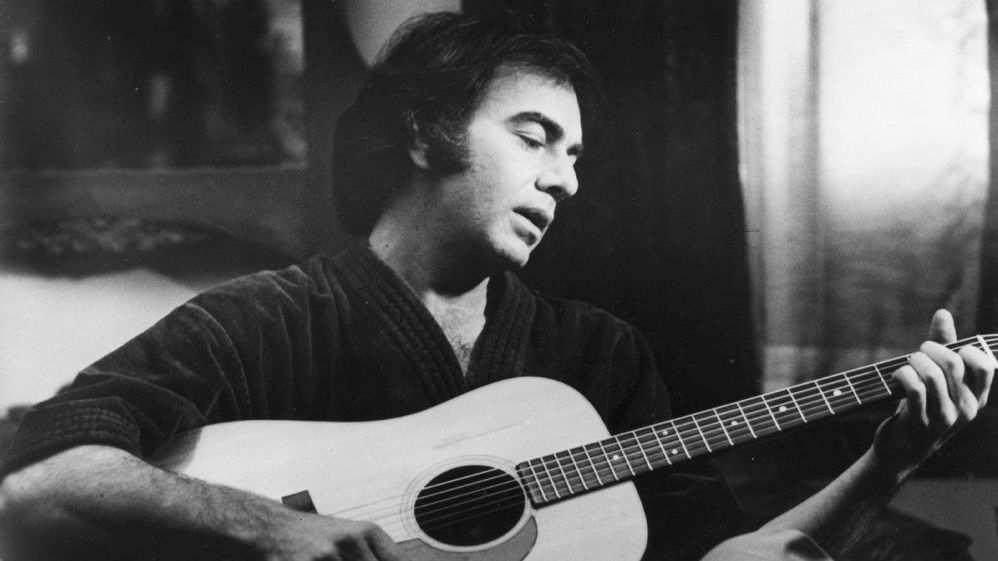
“Don’t Go There” is Neil Diamond putting a hand on your shoulder and gently steering you away from the edge—where desire looks irresistible, but the consequences are already waiting in the dark.
By the time Neil Diamond recorded “Don’t Go There,” he wasn’t writing from youthful swagger or the easy certainty of a hitmaker on autopilot. He was writing like a man who’d lived long enough to recognize the dangerous turnings—the moments when a single decision can quietly rearrange the rest of your life. The song is track 3 on Home Before Dark (released May 6, 2008), produced by the unlikely but inspired pairing of Diamond with Rick Rubin. It runs a long, unhurried 6:04, giving Diamond enough room to deliver the warning not as a scolding, but as a story you can’t stop listening to once it begins.
That record’s arrival was more than respectable—it was historic in Diamond’s career. Home Before Dark debuted at No. 1 on the Billboard 200, giving him his first-ever chart-topping album there. In the UK, it also entered at No. 1 on the week of May 18, 2008, his first studio album to do so. And it topped national album charts in the United States, the United Kingdom, and New Zealand, confirming that this wasn’t a nostalgia victory lap—it was a late-career creative surge. Billboard’s report even noted the album’s strong opening sales (a 146,000 first-week start), the kind of figure that makes the industry look up and say, almost in disbelief: he still matters.
Inside that success story, “Don’t Go There” plays a special role: it’s one of the album’s slyest, most streetwise moments. Rubin’s approach across Home Before Dark was famously stripped down—rooted in feel, not polish—and one contemporary album feature points out a crucial detail: there are no drums anywhere on the album. So when “Don’t Go There” moves, it doesn’t march; it prowls. It leans on acoustic pulse, on that dry, close-mic immediacy Rubin loved, as if Diamond is singing right at the edge of your personal space because the message is urgent. The same feature highlights a wonderful, almost mischievous touch: on “Don’t Go There,” the “big guitar solo” is sung, not played—a choice that turns bravado into something human and oddly vulnerable, like the voice itself has to carry what an instrument usually would.
And what is the message? In plain terms, “Don’t Go There” is a warning about choosing the wrong partner—about stepping into a situation that feels exciting, maybe even inevitable, but carries a cost you don’t want to pay. The brilliance is how Diamond frames that warning. He doesn’t sound like a moral policeman. He sounds like someone who knows how temptation works: it doesn’t announce itself with horns; it whispers with a smile. The title phrase—“Don’t Go There”—is the language of a friend who’s seen the movie before, who knows the ending, who is trying to save you from yourself without humiliating you.
That tone fits the album’s larger emotional architecture. Home Before Dark is full of late-night reflections, songs that feel like they were written after the crowd goes home and the mind starts telling the truth. In that context, “Don’t Go There” becomes more than “a cautionary track.” It becomes a meditation on boundaries—how grown-up life is often defined not by what you do, but by what you refuse to do, even when the door is open and the room is warm.
There’s also a deeper ache under the warning: the sense that the narrator is talking to himself as much as anyone else. That’s what makes Diamond’s best later work quietly devastating—he can sound authoritative while still sounding haunted. The song doesn’t deny desire; it acknowledges it, then asks for restraint. And restraint, in this song, isn’t coldness. It’s self-respect. It’s survival. It’s the wisdom of turning away before the night takes its price.
So when Neil Diamond sings “Don’t Go There,” you don’t just hear a veteran songwriter offering advice. You hear a man who understands how a single step can become a long walk—and how hard it is to turn back once you’ve gone too far. In a career built on big emotions, this is one of his most quietly powerful statements: the bravest love songs aren’t always about going toward someone. Sometimes they’re about knowing when to stop—and getting yourself home before dark.