
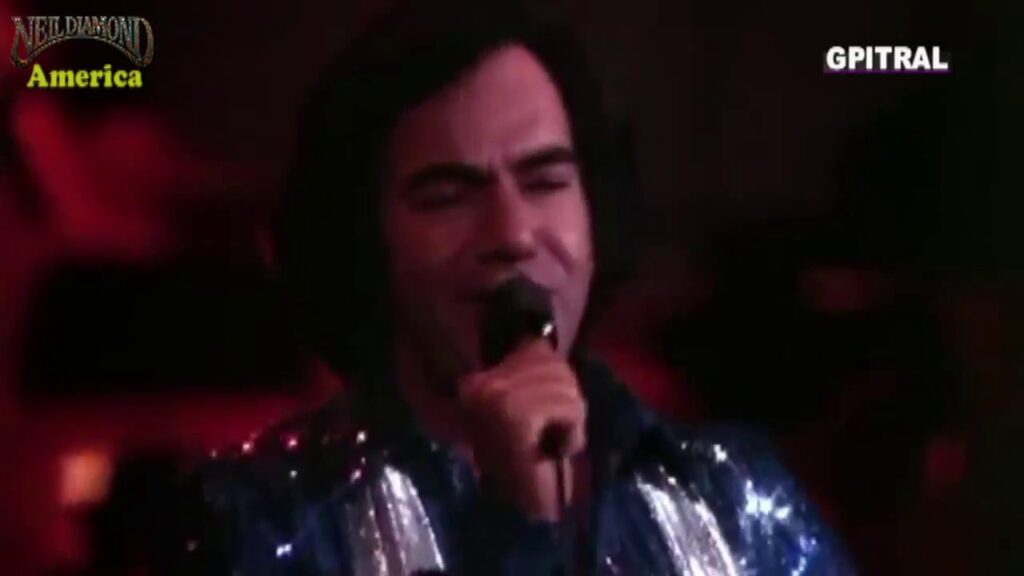
A Triumphant Ode to Hope, Heritage, and the Endless Pursuit of the American Dream
When Neil Diamond released “America”—often remembered by its refrain, “They’re coming to America”—in 1980 as part of the soundtrack to his film The Jazz Singer, it became one of the defining anthems of his career. The single climbed to No. 8 on the Billboard Hot 100 chart in early 1981, reaffirming Diamond’s enduring power to connect with listeners through songs that were both grandly orchestrated and deeply personal. While The Jazz Singer itself divided critics, its lead single transcended cinematic context; “America” stood alone as a rousing celebration of immigration, identity, and faith in renewal—a theme that had always pulsed beneath the surface of Diamond’s songwriting.
Beneath its stirring brass and swelling strings lies a narrative woven from Diamond’s own cultural memory: the child of Jewish immigrants from Eastern Europe, he understood instinctively that “coming to America” was not merely a voyage across oceans but a spiritual pilgrimage toward possibility. The song’s heartbeat—its steady, martial rhythm—mirrors the determined stride of generations leaving behind hardship for hope. When he performed it live, Diamond often introduced it not as a patriotic anthem but as a love song to all who dream; in that framing lies the song’s universality. It does not glorify nationalism—it glorifies aspiration.
Musically, “America” is quintessential late‑20th‑century pop grandeur. The arrangement begins with hushed reverence—gentle acoustic guitar lines underscored by a cinematic pulse—before erupting into full orchestral splendor. Each crescendo feels like a sunrise over a new coast. Diamond’s baritone carries both grit and grace; it’s a voice weathered by experience yet still capable of wonder. His phrasing gives the song its emotional architecture: each verse rising from quiet reflection to exuberant declaration, capturing the immigrant spirit’s blend of nostalgia and defiance.
At its core, “America” is about belonging—the longing for a place that accepts you not for who you were, but for who you might become. It acknowledges exile and loss even as it celebrates arrival. In this way, it echoes the timeless mythology of the United States as refuge and reinvention—a myth complicated yet undeniably powerful. When Diamond performed it in concert during moments of national unease or tragedy, audiences responded instinctively: standing, singing, sometimes weeping. The song’s emotional voltage endures because it speaks to something beyond borders—the eternal human yearning for freedom and dignity.
Today, more than four decades after its debut on The Jazz Singer, “America” remains one of Neil Diamond’s most beloved works—a fusion of pop spectacle and sincere storytelling that captures both the promise and paradox of the American experiment. It is at once a hymn and a homecoming, forever sailing toward that distant shore where hope meets history in a single resonant chord.