
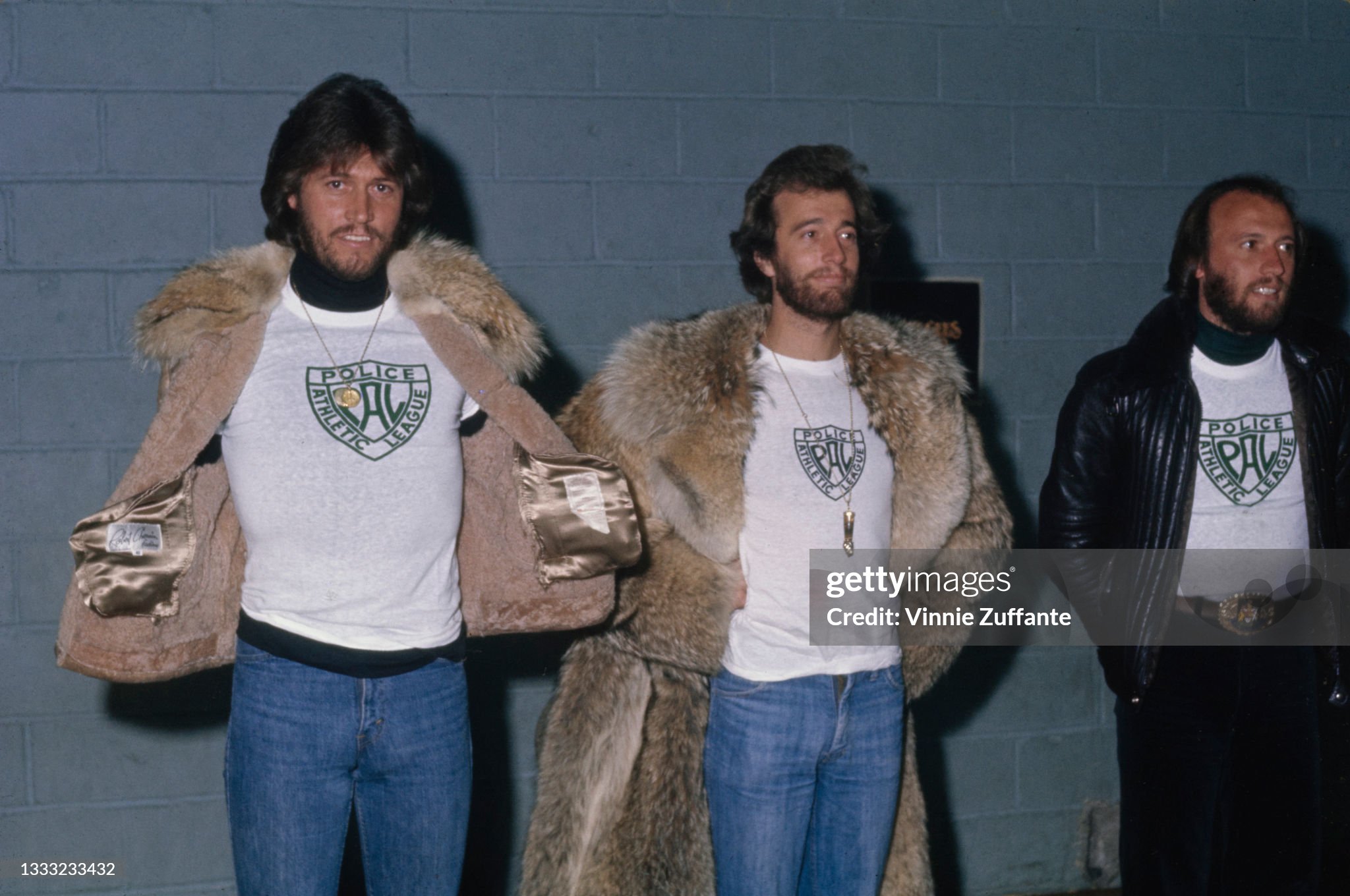
“I Lay Down and Die” is the Bee Gees’ quiet catastrophe—love reduced to a single, trembling choice: surrender, not as melodrama, but as the last honest sentence the heart can still speak.
By the time Bee Gees recorded “I Lay Down and Die”, the group was living inside a turning point. The song was cut during the 7 May–26 September 1969 sessions at IBC Studios, London, a period defined by upheaval and reinvention—most notably, Robin Gibb’s absence, making Cucumber Castle the only Bee Gees studio album without his recorded participation. In that context, “I Lay Down and Die” doesn’t feel like a “track.” It feels like evidence: proof that even as the band’s public identity was shifting, their private emotional language was sharpening into something stark and adult.
The song appears as track 6 on Cucumber Castle (released around April 1970), credited to Barry Gibb and Maurice Gibb, with Barry on lead vocal. The album’s production credit tells you how closely this era was controlled from within: Robert Stigwood and the Bee Gees themselves are listed as producers. In chart terms, “I Lay Down and Die” was not promoted as a major chart single, so it has no standalone debut position; the “ranking at release” story belongs to the album. Cucumber Castle reached No. 94 on the US Billboard 200 and No. 57 on the UK Albums Chart (with other notable peaks including No. 10 in Australia).
And yet, the song had a kind of shadow-life around the singles of the era. The Bee Gees’ “Don’t Forget to Remember” was released in August 1969, officially backed with “The Lord.” But Bee Gees sessionographer Joseph Brennan notes that “I Lay Down and Die” was associated with the single as a B-side in early tape circulation, with Atlantic receiving tape of both sides on July 11—a small archival detail that hints at how songs could drift through labels and territories before the final commercial “decision” hardened. Either way, it’s telling that “I Lay Down and Die” hovered near the surface of their 1969–70 transition: it belongs to the same emotional weather as those records—smoke in the air, the feeling of endings approaching, the ache of trying to keep something beautiful from slipping away.
What gives “I Lay Down and Die” its lasting sting is how absolute the title is. It doesn’t say “I might.” It doesn’t say “I could.” It’s spoken like a vow—too dramatic to be literal, too honest to be dismissed. In the Bee Gees’ late-’60s world, melodrama wasn’t a costume; it was a way of telling the truth at full volume when ordinary language failed. The phrase “lay down” carries surrender, exhaustion, and tenderness all at once—like someone finally setting down the weight they’ve been carrying through the rooms of their own mind. And “die,” in pop’s symbolic grammar, often means the end of a self you used to be—the version that still believed love would be returned in equal measure.
Musically, this era of the Bee Gees often leaned into folk-rock and country-folk colors, and Cucumber Castle is explicitly described in those stylistic terms. That matters because it changes the emotional temperature. This is not the later Bee Gees of glitter and nightclubs; this is the Bee Gees as storytellers in softer light—voices pressed close to the microphone, instruments arranged to leave space for regret. When Barry Gibb sings here, you can hear that he’s not performing “cool.” He’s performing vulnerability—controlled, musical, but unmistakably vulnerable.
The deeper meaning of “I Lay Down and Die” is not self-destruction. It’s the terrible honesty of a person admitting that love can become an identity—so that when love disappears, the self feels briefly unmoored. The song captures that specific moment when pride stops working, when anger is too tiring, when even explanations feel like dust—leaving only the naked fact of longing. It’s heartbreak without decoration, sung by a band that—ironically—was itself learning how to carry on after a fracture.
In the end, “I Lay Down and Die” endures because it’s a small, cinematic tragedy set inside an album made during real-world uncertainty. Bee Gees were changing shape; the decade was turning; the future was unclear. And out of that, they offered this song—private, intense, and strangely consoling—because it tells you something you might not want to admit, but recognize instantly: sometimes the heart doesn’t “move on” in a straight line. Sometimes it lies down in the dark for a while… and then, somehow, learns to stand again.