
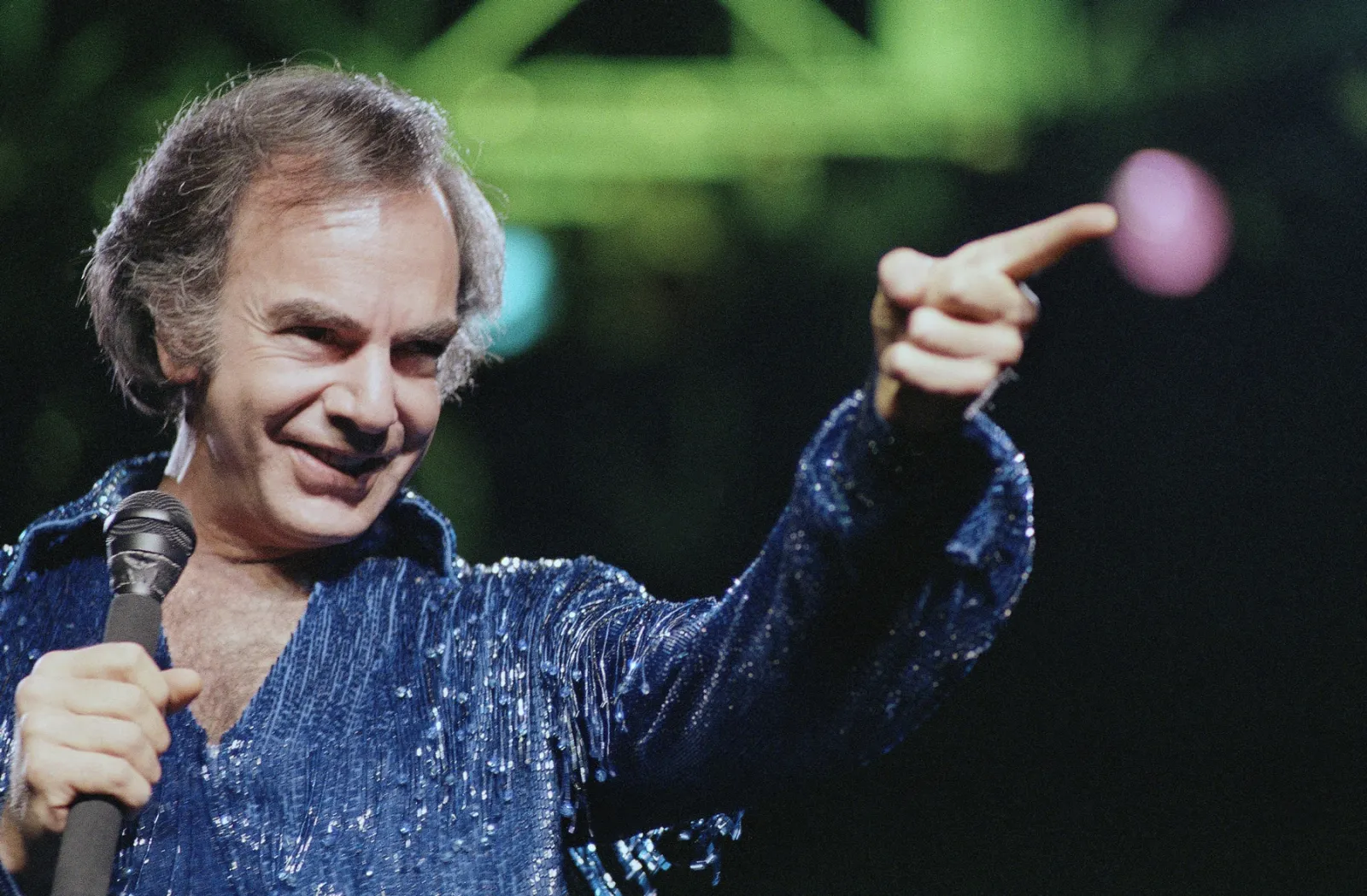
“Sweet Caroline” in its Greek Theatre 1972 roar is more than a singalong—it’s a communal spell, turning a private love song into a stadium-sized memory where “good times” feel briefly immortal.
By the time Neil Diamond stepped onto the stage at the Greek Theatre, Los Angeles on August 24, 1972, the song “Sweet Caroline” had already lived two lives: first as a 1969 radio hit, then as a cultural password—something people didn’t merely hear, but claimed. That night became canon because it was captured for the double live album Hot August Night, a recording of that very concert from Diamond’s celebrated run of ten sold-out shows at the Greek.
The original single “Sweet Caroline” was released on May 28, 1969 (Uni/MCA), recorded at American Sound Studio in Memphis, and written by Neil Diamond himself. It climbed to No. 4 on the Billboard Hot 100 (week ending August 16, 1969) and also reached No. 3 on the U.S. Easy Listening chart; it was certified Gold by the RIAA on August 18, 1969 (then reflecting one million units sold). Those are the “numbers,” yes—but what matters is what the song became: a tune that people lean into together, as if the chorus were a handrail in a crowded room.
Then comes the 1972 transformation. On Hot August Night, Diamond doesn’t sing “Sweet Caroline” like a man revisiting a hit—he sings it like a man watching his own past come back to him, magnified by thousands of voices. The album itself went on to peak at No. 5 on the Billboard 200, proof that the public didn’t just tolerate the live spectacle—they wanted to live inside it. And that’s the real “debut” of the Greek Theatre version: not a new chart entry so much as a rebirth—“Sweet Caroline” as ritual.
The story behind the song’s name has always carried that faint, intriguing shimmer of mystery. Diamond has offered different accounts over the years: he said in 2007 that it was inspired by Caroline Kennedy, and later explained a childhood photo of her on a horse lodged in his imagination; in 2014, he said it was actually about his then-wife Marcia Murphey, but he needed a three-syllable name that fit the melody. The contradiction isn’t a problem—it’s part of the song’s strange magic. It suggests what great pop often does: it starts as one person’s picture, then becomes everyone’s mirror.
Musically, “Sweet Caroline” is built on a deceptively simple emotional engine: the narrator can’t quite explain where it began, but he knows what it feels like now—that surge of gratitude when love breaks through routine. In the studio version, that feeling is bright and radio-ready. In the 1972 live version, the feeling turns physical. You can almost sense the amphitheatre air, the warm-night electricity, the way the crowd’s response makes each pause feel loaded with anticipation. Even the famous “so good, so good, so good” doesn’t land like a lyric anymore—it lands like a shared reflex, a chant people use to reassure themselves that joy is still possible.
This is why the song’s meaning deepens with age. “Sweet Caroline” isn’t merely nostalgia; it’s the ache that nostalgia tries to soothe. It’s the recognition that good times don’t last—and the stubborn human impulse to sing them back into existence anyway. That’s what the Greek Theatre performance captures: the moment when a crowd and a singer agree, without discussing it, to suspend the ordinary world for four minutes and keep a small, bright feeling alive.
And perhaps that’s the most enduring truth of Neil Diamond at the Greek in 1972: the “solitary” songwriter of the ’60s had become something else—not because fame fixed loneliness, but because songs like “Sweet Caroline” created a temporary home where nobody had to feel alone. Good times never seemed so good not because life was perfect, but because—right there, together—people chose to believe it.