
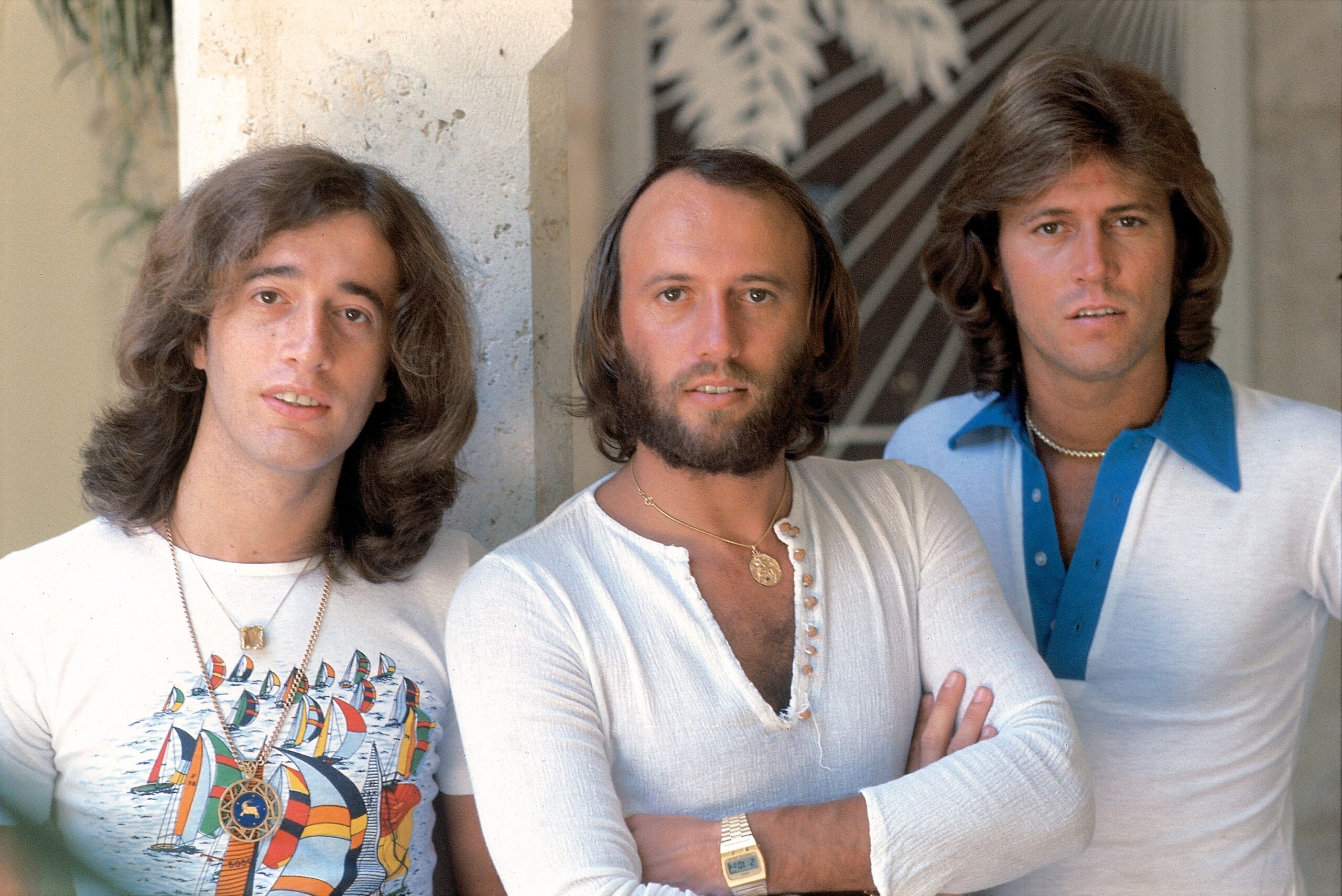
“Never Say Never Again” is the Bee Gees in their baroque-pop prime—where a bruised goodbye sparks a strangely noble defiance, as if love itself could “declare war” on whatever turns it ugly.
There’s a particular kind of late-’60s Bee Gees song that doesn’t simply tell a story—it creates an atmosphere, thick with velvet curtains, private vows, and language that feels too dramatic to be casual but too sincere to be ironic. “Never Say Never Again” is one of the finest examples of that sensibility. It belongs to Odessa—the group’s ambitious 1969 double album released by Polydor in the UK and Atco in the U.S.—a record that arrived wrapped in opulent red flocking, like a romance novel made physical.
For the practical “chart position at release,” the important truth is simple: “Never Say Never Again” was not released as a single, so it had no separate singles-chart debut of its own. Its public life came as an album track—one of the deep, inward rooms inside Odessa. The album itself did reach the Top 10 in the UK and the Top 20 in the U.S. (often cited as No. 10 UK / No. 20 US), which means this song was heard widely—just not spotlighted by radio as a headline event.
What makes “Never Say Never Again” feel so alive, even now, is the little story behind its writing—an argument, really, between poetic impulse and everyday language. Robin Gibb remembered wanting to write around the line “I declared war on Spain,” seeing it as the most natural expression of a lover’s sudden, irrational nobility: if love is threatened, you want to declare war on anything that feels “unlovely.” Barry Gibb, by Robin’s account, pushed back—wanting something so ordinary it was “ridiculous,” calling Robin’s words unromantic. That tension—between grand gesture and plain speech—ends up becoming the song’s emotional signature. It’s heartbreak trying to remain dignified, even as it slips into dramatic metaphors because plainness isn’t large enough to hold the pain.
Recorded in October 1968 and released with Odessa in 1969, the track is credited—properly—to Barry, Robin, and Maurice Gibb, produced by Robert Stigwood and the Bee Gees. The personnel reads like the classic late-’60s lineup: Barry leading vocally (and on guitar), Robin in harmony, Maurice moving between bass, guitar, and piano, with Colin Petersen on drums and Bill Shepherd providing orchestral arrangement—the same Shepherd who helped the Bee Gees turn pop songs into miniature films.
In the architecture of Odessa, “Never Say Never Again” arrives late—near the end of the album’s original sequence—like the moment in a long night when the party noise has thinned and the real thoughts start speaking. Lyrically, it’s built on those wonderfully ambiguous Bee Gees fragments—“You said goodbye” standing beside the almost absurdly romantic “I declared war on Spain.” The juxtaposition is the point: goodbye is small and final; the inner response is huge and ridiculous and heartfelt. Love doesn’t always react proportionally. Sometimes it reacts poetically, because poetry is the only language that can match the scale of what’s been lost.
There’s also a fascinating second life to this recording that deepens the nostalgia. The 2009 deluxe reissue of Odessa included a “Sketches for Odessa” disc with alternate mixes, and “Never Say Never Again” appears there in an alternate form—evidence that even in 1968, the Bee Gees were chasing shades of mood, different vocal takes, different textures, as if they knew a song like this could be lit from more than one angle.
Ultimately, “Never Say Never Again” is not just a breakup song—it’s a portrait of the mind’s last defense against finality. We say we accept endings, but the heart often tries one more spell: a vow, a grand statement, a theatrical refusal to let the door close cleanly. The Bee Gees understood that contradiction early. They turned it into music that feels both youthful and strangely wise—because it admits the truth most of us learn slowly: that pride and tenderness can live in the same sentence, and that sometimes, in the quiet aftermath of “goodbye,” the only thing left to sing is a defiant, trembling promise—never say never again.