
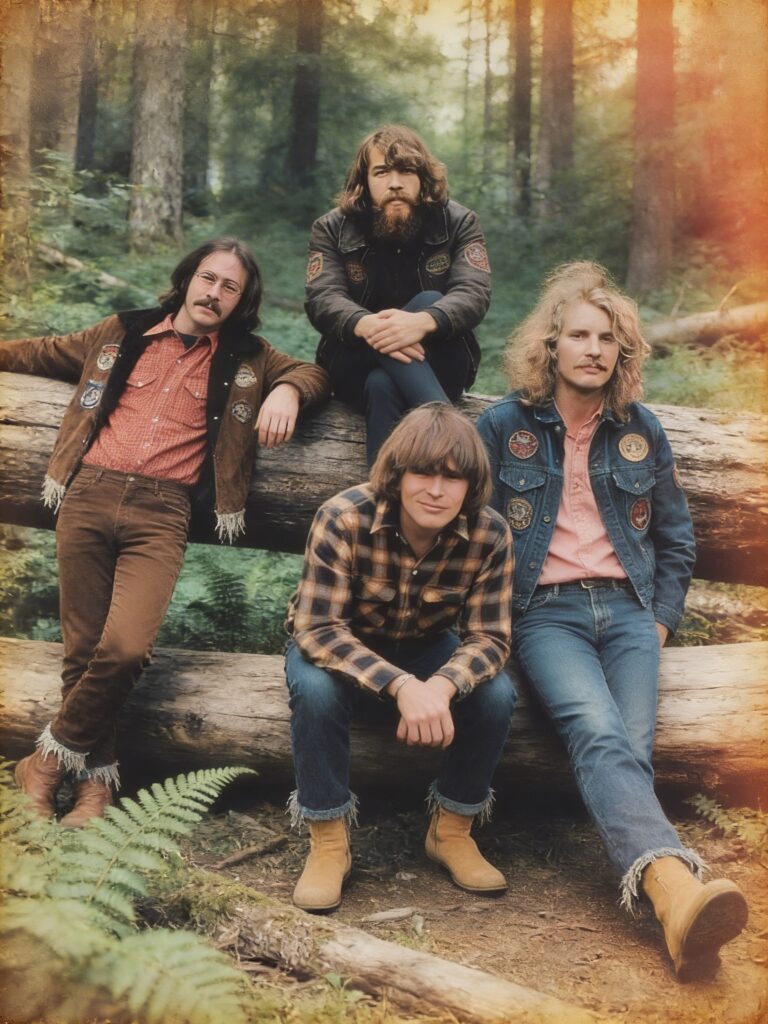
Glory Be lives in the world around Creedence Clearwater Revival like a half-remembered radio signal—familiar in spirit, elusive in fact, and strangely powerful because it seems as if it should have been real.
If you have gone searching for “Glory Be” under the name Creedence Clearwater Revival, the first important thing to know is this: there is no commonly accepted official CCR release in the band’s core 1968-1972 catalog under that exact title. It does not appear on the original studio albums Creedence Clearwater Revival, Bayou Country, Green River, Willy and the Poor Boys, Cosmo’s Factory, Pendulum, or Mardi Gras. It also has no documented run on the Billboard Hot 100 as a CCR single. For that reason alone, “Glory Be” belongs less to the clear, charted history of the band and more to the shadowy corners where collector memory, mislabeled uploads, and fan folklore often meet.
And yet, the reason the title keeps catching attention is easy to understand. Creedence Clearwater Revival built a sound so rooted in American gospel echoes, back-road rhythm, Southern imagery, and plainspoken urgency that a title like “Glory Be” feels immediately believable. It sounds like something John Fogerty could have barked, whispered, or driven home over a swampy riff. That is part of the mystery. Even when the exact song cannot be pinned down in the official discography, the phrase itself fits the emotional weather of CCR so perfectly that many listeners assume it must be there somewhere—on a B-side, an outtake, a rehearsal tape, an early acetate, or a forgotten compilation note from years ago.
This kind of confusion is not unusual with artists whose catalogs have traveled across radio, bootlegs, reissues, fan-made uploads, and pre-fame recordings. Before the name Creedence Clearwater Revival became permanent, the group existed in earlier forms, most notably as The Golliwogs. Those early years produced material that has long tempted collectors and curious listeners, and over time, song titles and artist credits have often been mixed up online. Add to that the fact that CCR songs are frequently reposted with incomplete or inaccurate labeling, and you have the perfect conditions for a phantom title to survive. In other words, “Glory Be” may not be an official cornerstone of the band’s catalog, but it survives because it sounds like it belongs in that world.
What makes this especially fascinating is how different that is from the neatly documented path of the group’s biggest records. When “Proud Mary” arrived in 1969, it climbed to No. 2 on the Billboard Hot 100. “Bad Moon Rising” also reached No. 2 later that same year. “Green River” became another major hit, and “Lookin’ Out My Back Door” likewise rose to No. 2 in 1970. Those songs live in the historical record with firm dates, chart positions, session histories, and album homes. “Glory Be”, by contrast, has none of that stable furniture around it. No settled release narrative. No widely recognized session details. No original album placement. No reliable chart history. That absence is not a flaw in the story; it is the story.
There is also something deeply human about the way listeners hold on to titles like this. Not every musical memory is kept in perfect archival order. Sometimes a phrase survives when the melody has gone hazy. Sometimes a song title is inherited from an old cassette note, a friend’s handwritten list, or a radio introduction remembered only in fragments. With a band like Creedence Clearwater Revival, whose music felt instantly lived-in from the moment it was recorded, those fragments can become especially persuasive. Their records never sounded distant or decorative. They sounded used, weathered, and true, as if they had already belonged to people for years. So when a title like “Glory Be” drifts into conversation, it does not feel invented. It feels misplaced, which is a very different thing.
If we read the phrase itself as a clue, it becomes even more evocative. “Glory Be” carries a rustic, almost devotional cadence—half exclamation, half release. That tonal blend would have sat naturally beside CCR’s gift for turning simple words into something bigger than they looked on paper. John Fogerty had a rare instinct for songs that sounded both immediate and timeless, whether he was writing about rivers, weather, travel, working people, or the strange electricity of ordinary American life. A title like this seems to promise uplift, grit, and motion all at once. Perhaps that is why it has lingered. It speaks the language of the band, even if the official books do not place it there.
So the most honest way to introduce “Glory Be” in relation to Creedence Clearwater Revival is not as a confirmed hit, nor as a charting single, nor as a lost classic with a tidy backstory, but as a small and enduring mystery in the orbit of one of America’s most beloved bands. It reminds us that music history is not made only of fixed facts and gold records. It is also made of searches, misremembered titles, collector lore, and the songs people keep hoping to find again. In that sense, “Glory Be” says something beautiful about CCR itself. Even an uncertain title can feel alive when it is attached to a band whose sound was so vivid that listeners still believe there may be one more great song waiting just beyond the edge of the catalog.
And maybe that is the final charm of it. Some songs are famous because everyone knows exactly where to place them. Others endure because they remain just out of reach. “Glory Be” belongs to that second category—a title that continues to stir curiosity not because it dominated the charts, but because it sounds like a missing piece from a musical world people never stopped loving. For fans of Creedence Clearwater Revival, even that kind of uncertainty carries its own warmth. It keeps the door open. It keeps the turntable spinning a little longer. It keeps the search alive.