
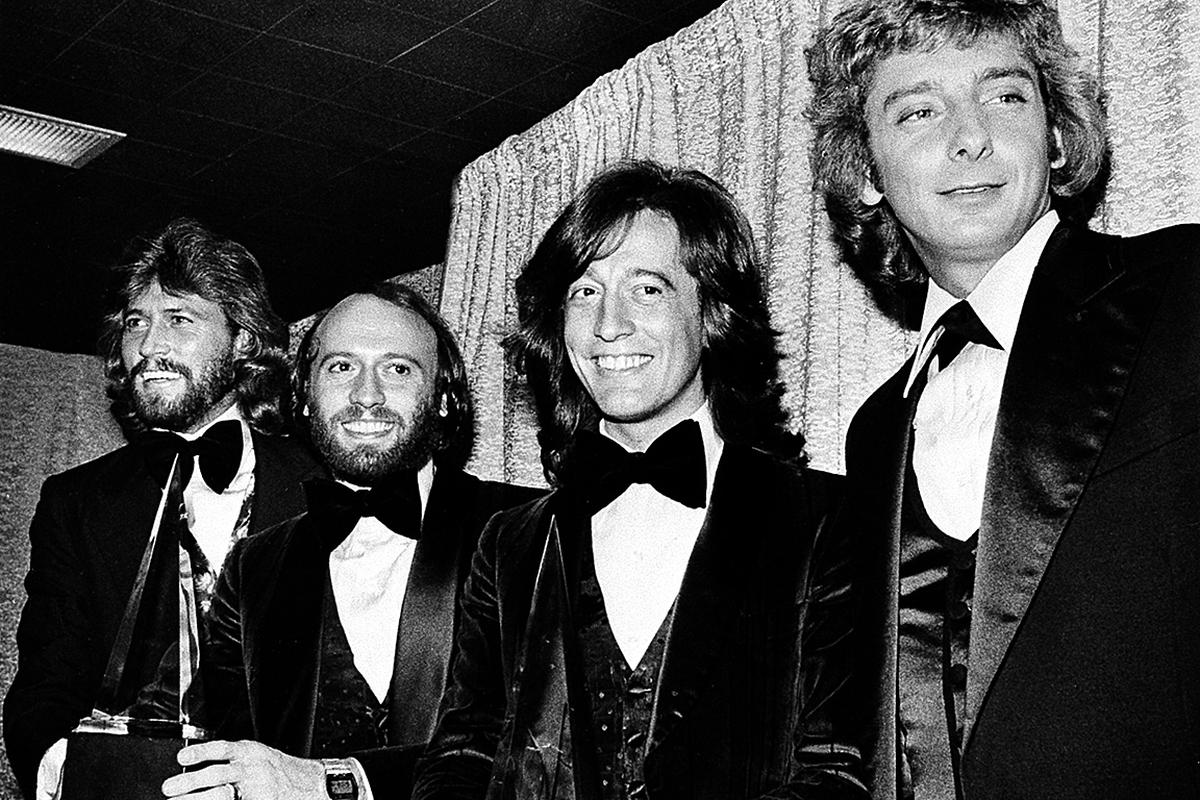
“Whisper Whisper” caught the Bee Gees in a fascinating moment: still masters of melody, but already leaning toward something more shadowed, theatrical, and emotionally unsettled.
There are songs that become towering hits, and then there are songs that linger in a different way—less celebrated, perhaps, but deeply revealing. “Whisper Whisper” belongs to that second category. Released by the Bee Gees in 1969 during the troubled and ambitious Odessa era, it remains one of the group’s most curious recordings: dramatic, uneasy, elegant, and quietly experimental. In the United States, the single reached No. 45 on the Billboard Hot 100, which made it a modest chart entry rather than a major smash. Yet chart numbers tell only part of the story. What makes this record endure is the way it captures the Gibbs at a crossroads—artistically restless, emotionally intense, and far less simple than the soft-focus image many listeners later attached to them.
By the time “Whisper Whisper” arrived, the Bee Gees had already proven they were far more than hitmakers with pretty harmonies. The late 1960s had given them remarkable success through songs such as “Massachusetts”, “Words”, and “I Started a Joke”, but it had also brought mounting pressure. Their music was becoming more ornate, more literary, and more emotionally layered. The album Odessa, released in 1969, was the grandest expression of that ambition—a sweeping, richly arranged, often melancholic double album that showed just how far they wanted to push beyond pop convention. “Whisper Whisper”, drawn from that period, stands as one of its most intriguing side roads.
Written by Barry, Robin, and Maurice Gibb, the song begins with a mood that feels almost secretive. It does not burst forward in the manner of a straightforward pop single. Instead, it pulls the listener inward. There is tension in the arrangement, a theatrical hush in the verses, and then a sudden force when the song opens up. One of the most striking details about “Whisper Whisper” is the way it plays with contrast: soft against loud, invitation against warning, intimacy against instability. The title suggests gentleness, but the record is not gentle for long. It swells, presses, and turns unexpectedly, creating a sense that something unsettled lives beneath the melody.
That quality is precisely what makes the song so memorable. The Bee Gees were always gifted melodists, but here they sound fascinated by atmosphere. The harmonies do not simply decorate the track—they deepen its mystery. The rhythm and arrangement carry a faintly uneasy pulse, while the vocal delivery gives the song a dramatic edge that feels closer to chamber-pop or baroque psych than conventional late-1960s radio fare. This was not an accidental experiment. The group was, at that moment, stretching their identity, testing how far emotion and arrangement could carry a song before it stopped behaving like a hit single and started behaving like a miniature drama.
There is also a story in how the song was presented. The single version of “Whisper Whisper” is notably different in feel from the more subdued album performance associated with Odessa. The single was given extra punch and dynamic force, almost as if the group or the label understood that the song needed a stronger surface to compete on radio. Even so, it remained an unusual choice. This was never the easiest entry point into the Bee Gees catalog. It lacked the immediate singalong tenderness of their best-known ballads, and it did not offer the clean emotional clarity of some of their biggest records. What it offered instead was mood, tension, and sophistication.
That may be why the song has aged so well among devoted listeners. Over time, “Whisper Whisper” has come to feel like an important clue to the Bee Gees story. It reminds us that they were never confined to one style. Long before the dance-floor brilliance of the 1970s remade them in the public imagination, they were songwriters of remarkable curiosity. They could be ornate, haunted, eccentric, and bold. They could make a song feel inward and theatrical at once. And in a period when internal strain was beginning to show—most notably around the making and release of Odessa, shortly before Robin Gibb temporarily left the group—their music often carried a sense of fracture beneath its beauty. “Whisper Whisper” seems to hear that fracture in advance.
Lyrically, the song suggests secrecy, persuasion, and emotional uncertainty. It is not as direct as some of the Bee Gees’ most beloved storytelling songs, which is part of its fascination. The meaning feels atmospheric rather than literal. A whisper can be seductive, manipulative, comforting, or destabilizing. The song never fully resolves that ambiguity. Instead, it lets the listener remain in that dim emotional room, where tone matters as much as narrative. That ambiguity gives the record a mature resonance. It does not explain itself too neatly. It leaves a shadow behind.
For listeners who know the Bee Gees primarily through their most famous eras, hearing “Whisper Whisper” can be a revelation. It is a reminder that the band’s journey was never a straight line from balladry to disco. There were detours, risks, and beautifully odd records along the way. This song may not have become one of their defining hits, but it reveals something just as valuable: the courage to sound complicated at a moment when complication was not always rewarded.
And perhaps that is why “Whisper Whisper” still deserves to be revisited. It captures the Bee Gees in one of their most artistically vulnerable and interesting phases—when harmony met tension, when melody met unease, and when a whisper carried more weight than a shout. It is not merely a forgotten single from 1969. It is a portrait of a great group standing in the half-light, making music that asked to be listened to more closely.