
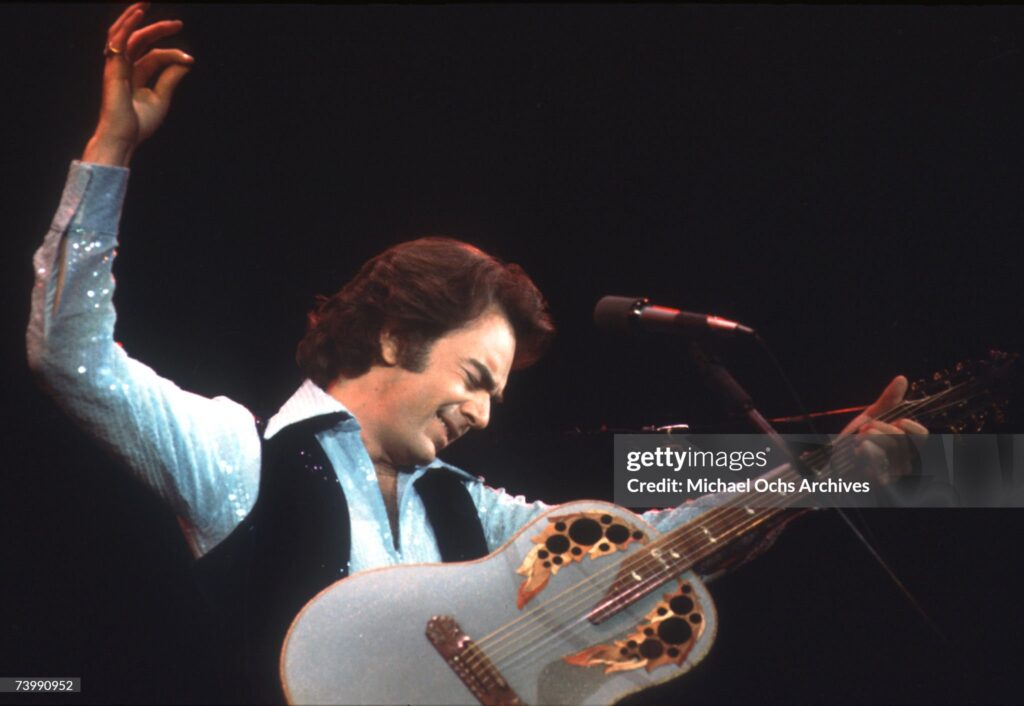
“Man of God” sounds searching from the very first breath, as if Neil Diamond already knows the song is not about certainty at all, but about one man standing before faith, doubt, and desire with no easy way to separate them.
There is something immediately arresting about “Man of God” because it does not enter like a settled confession. It enters like a struggle already in progress. Before the story fully unfolds, before the lyric has shown all its cards, Neil Diamond already sounds like a man wrestling with something larger than himself—some mix of conscience, longing, memory, and spiritual unease that refuses to be reduced to a neat moral lesson. That is what gives the song its gravity. It is not singing from the safety of clear answers. It is singing from the tension between what a man hopes to be and what he knows about his own frailty.
The song appears on 12 Songs, released on November 8, 2005, the album that marked one of the most admired late-career returns of Diamond’s life in music. It was produced by Rick Rubin, all of its core songs were written by Neil Diamond, and “Man of God” appears as track nine on the standard edition. The album itself debuted at No. 4 on the Billboard 200, which mattered because it signaled that this was not merely a nostalgic release from a veteran name. It was heard, rightly, as a serious artistic renewal.
That context matters deeply for “Man of God.” By the time Diamond made 12 Songs, his voice had changed. It carried more wear, more grain, more lived-in weight than in his youth. On a song like this, that weathering becomes part of the meaning. A younger singer can sound spiritual and intense. An older singer, when he sounds troubled, brings the evidence of time with him. That is why “Man of God” feels less like a declaration than an inward reckoning. It is not the voice of innocence. It is the voice of someone who has lived long enough to know that belief, desire, pride, and failure often stand much closer together than we like to admit.
What has always made Neil Diamond compelling in his best serious songs is that he does not flatten inner conflict into slogans. Even when he reaches toward large ideas—love, faith, identity, purpose—he usually does so through the emotional life of one fallible human being. That is exactly why “Man of God” lands so strongly. The title could have led to something stiff or preachy in lesser hands. Instead, it feels ironic, aspirational, burdened, and vulnerable all at once. To call a song “Man of God” is to invoke purity, obedience, and spiritual clarity. But Diamond’s delivery suggests how difficult those things are to inhabit honestly. The phrase feels less like a badge than a question: what does it really mean to be such a man, and who among us ever fully is?
That questioning spirit fits the wider atmosphere of 12 Songs beautifully. Rubin’s production on the album was intentionally stripped back, built around Diamond’s songwriting rather than around grand polish, and the personnel included players such as Mike Campbell, Benmont Tench, and Billy Preston, whose organ appears on several tracks including track 9. The result is a record that gives emotional ideas room to breathe. On “Man of God,” that sparseness helps. The song is not crowded by excess arrangement. It has space around it, and in that space the inner wrestling becomes more audible.
There is also something deeply characteristic about placing a song like this so late in the album. By the time “Man of God” arrives, 12 Songs has already moved through bruised pieces like “Captain of a Shipwreck,” “Evermore,” and “Save Me a Saturday Night.” So when this song appears, it does not feel isolated. It feels like part of a larger late-life conversation Diamond is having with himself—about survival, memory, weakness, endurance, and what remains when the louder myths of a public career begin to fall away. In that company, “Man of God” sounds even more human. It does not stand above the album morally. It stands inside it, wrestling.
What lingers most, though, is the emotional contradiction in Diamond’s performance. He sounds drawn upward and weighed down at the same time. That doubleness is what makes the song so persuasive. The best spiritual songs are rarely the ones most certain of themselves. They are often the ones that let us hear the distance between aspiration and reality, between the life one wants to lead and the life one has actually lived. “Man of God” seems to understand that perfectly. It is not about sainthood. It is about the strain of reaching toward something sacred while still feeling unmistakably human.
So yes, before the story fully unfolds, “Man of God” already sounds like a man wrestling with something bigger than himself. That is its first power, and perhaps its lasting one. Neil Diamond does not sing as though he has conquered the struggle. He sings as though he has survived long enough to name it. And sometimes that is what makes a song stay with you—not certainty, but the sound of someone standing honestly inside uncertainty, still reaching for meaning anyway.