
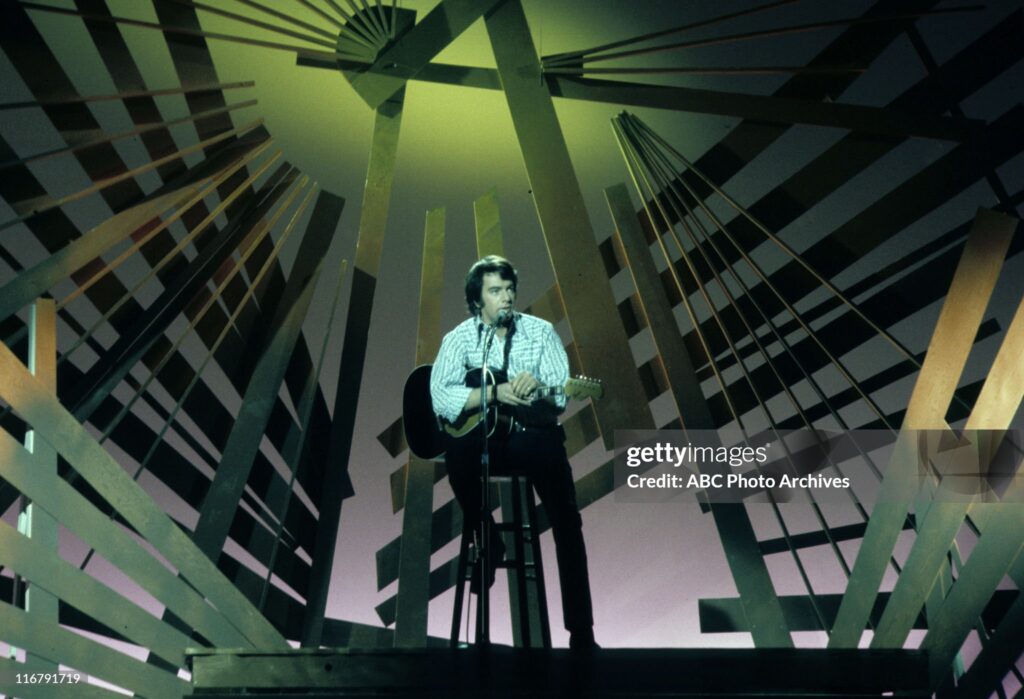
NEIL DIAMOND
“If I Don’t See You Again” turns farewell into something heavier than sadness: a moment when love is still alive, yet already speaking in the grammar of loss.
The title alone carries a wound. “If I Don’t See You Again” does not sound like a casual parting, or even the temporary sorrow of two people who fully expect another meeting. It sounds terminal. It sounds like someone standing at the edge of a shared life, trying to speak with dignity while already feeling the cold of separation. That is exactly why Neil Diamond gives the song such uncommon force. Released in 2008 as the opening track on Home Before Dark, the song did not arrive as a major charting single of its own, but it came attached to an album that mattered greatly in Diamond’s late career: Home Before Dark reached No. 1 on the Billboard 200 in the United States and No. 1 on the UK album chart, a remarkable achievement that gave this song an unusually important place at the front door of a triumphant, deeply reflective record.
That matters, because “If I Don’t See You Again” is not merely another track in the sequence. At 7 minutes and 13 seconds, it is an opening statement, and a bold one. The official album page places it first for a reason: before the listener reaches anything else on Home Before Dark, Diamond insists on beginning with distance, regret, memory, and the terrible grace of almost letting go.
The story behind the song is inseparable from the story behind the album. Home Before Dark was Diamond’s second major collaboration with producer Rick Rubin, following 12 Songs. Critics at the time noted the album’s stripped, drumless, intimate sound, with Diamond’s voice and rhythm guitar set in unusually clear relief. That sparseness is essential to why “If I Don’t See You Again” hurts the way it does. Rubin does not crowd the song with sentiment. He leaves room around Diamond’s voice, and in that room the lyrics sound less performed than confessed. Billboard’s own interview around the album emphasized that drumless, voice-forward approach, while later reviews singled out the opener as one of the record’s emotional peaks.
And what a devastating way to begin a record. Many farewell songs are about what has already ended. “If I Don’t See You Again” is more unsettling because it lives in the moment just before the final break becomes official. That is where its power lies. The singer is not speaking from healed distance. He is still inside the feeling. He is still bargaining with memory, still measuring what was real, still imagining the silence that will come after the last look, the last call, the last chance to turn back. The title becomes a sentence of emotional self-protection, but one hears immediately that it is protection destined to fail.
That is what makes the goodbye feel so final. Not anger. Not melodrama. Resignation. Diamond understands, as few songwriters do, that the saddest departures are often the ones spoken softly. There is no need for theatrical collapse here. The devastation comes from the awareness that a great attachment may be ending while love itself has not fully died. In that sense, the song is not about absence alone. It is about being left with feeling after the future has already begun to close. Reviews of the album repeatedly described “If I Don’t See You Again” as epic, sprawling, and emotionally powerful, and those words fit because the song allows heartbreak to unfold in stages rather than in slogans.
There is also something deeply moving about where this song stands in Neil Diamond’s long career. By 2008, he was not singing from the impatience of youth. Home Before Dark was received as a mature, personal work, and its chart success carried symbolic weight: Billboard reported it as Diamond’s first No. 1 album in America, while other coverage noted the historical significance of that achievement at age 67. So when he opens the album with “If I Don’t See You Again,” the song carries the gravity of an artist who knows that leave-taking is not a literary idea but one of life’s recurring truths.
Musically, the song refuses haste. That may be its secret. It does not rush toward a hook meant to reassure the listener. It lingers, circles back, and lets the ache deepen. The result is almost cinematic, but never artificial. You hear a man trying to remain composed while language keeps betraying how much is at stake. That tension—between dignity and desperation—is pure Neil Diamond. He has always known how to sound both strong and wounded at the same time, and here that gift reaches one of its most affecting late-career expressions.
So yes, the title alone hurts. But “If I Don’t See You Again” goes further than the title promises. It turns goodbye into a final reckoning with love, memory, pride, and loneliness. It reminds us that some partings are not loud at all. They arrive quietly, with a steady voice and a breaking heart. And because Neil Diamond sings it not as a gesture but as lived emotional knowledge, the song leaves behind something more lasting than sadness. It leaves that hollow, echoing feeling that comes when the door is still open, yet one already knows it is about to close.