
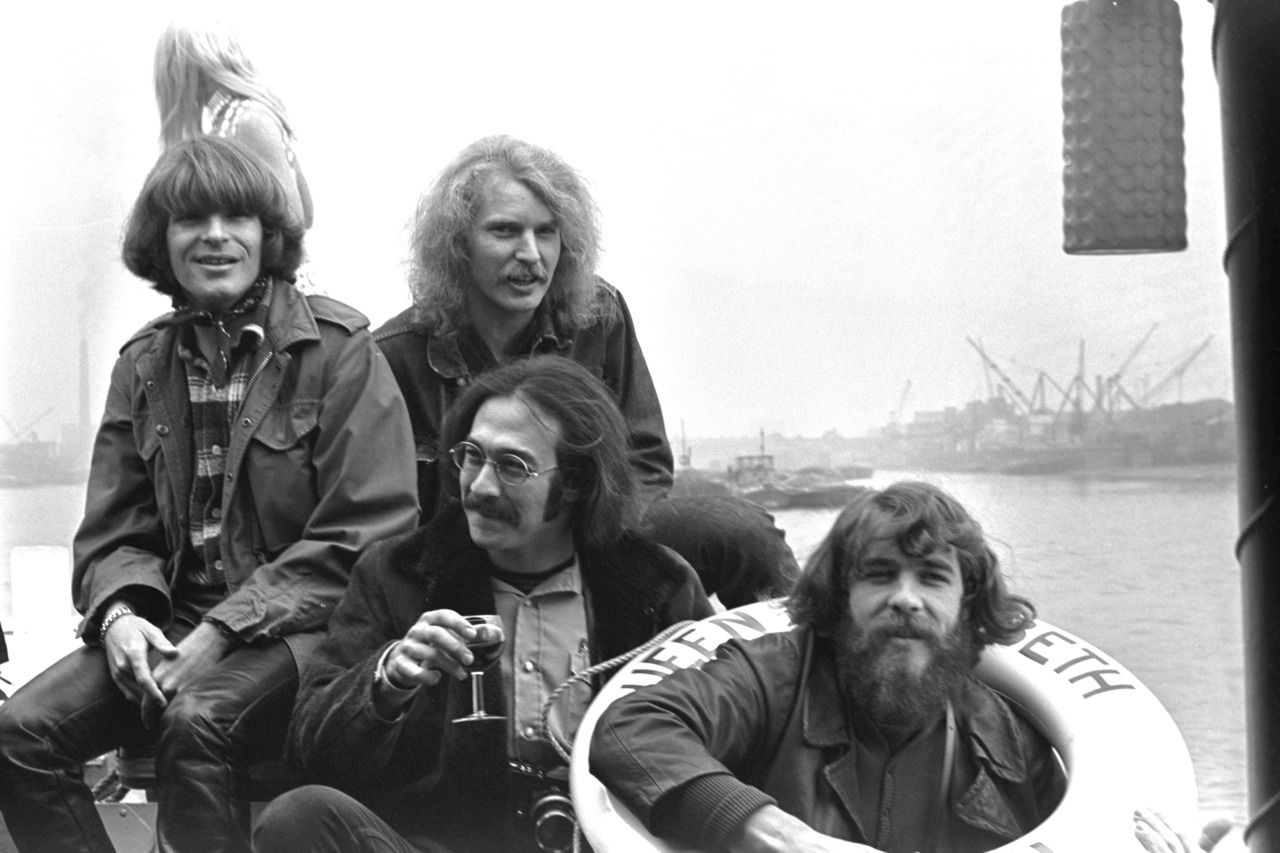
“Sinister Purpose” is Creedence Clearwater Revival turning the lights down on their swamp-rock porch—letting temptation, dread, and desire knock softly at the door until you can’t tell fear from fascination.
If Creedence Clearwater Revival built their legend on songs that sounded like radio signals from a mythic American backroad, “Sinister Purpose” is one of the moments where that road slips into shadow. It isn’t their biggest title, and it was never designed to be. Instead, it lives where the best album cuts often live: in the late-night space between certainty and unease, when a familiar band suddenly feels unfamiliar—almost dangerous.
“Sinister Purpose” appears on Green River, CCR’s third studio album, released in August 1969 (commonly cited as August 7, 1969) on Fantasy Records. The song is credited to John Fogerty, and on the original LP it arrives near the end of side two—track time 3:23—right after “Cross-Tie Walker,” as if Fogerty wants you fully settled into the album’s gritty groove before he opens a trapdoor beneath it.
Here’s the chart reality at the time, placed plainly: “Sinister Purpose” itself was not released as a single, so it did not have an individual Hot 100 debut. Its “chart moment” is inseparable from the album that carried it—and that album’s moment was enormous. Green River climbed to No. 1 on the Billboard 200, becoming CCR’s first U.S. chart-topping LP. Even better, we can put a date on the peak: October 4, 1969 is listed as the week it reached No. 1, and it held the summit across the following weeks shown on the Billboard 200 No. 1 list for 1969. So when you hear “Sinister Purpose,” you’re hearing a deep cut from a record that, at its height, essentially owned the American listening room.
The behind-the-scenes story is the classic CCR story: efficiency, focus, and a band that sounded like it had lived a hundred lives in a few short years. The album was recorded at Wally Heider Studios in San Francisco, across March–June 1969, with John Fogerty producing. And while album sessions can feel abstract, one small detail makes “Sinister Purpose” feel more tangible: it was first recorded in June 1969, right in the thick of those sessions—late enough that it carries the snap of a band already in full stride.
So what is this song saying? Even without footnotes, the lyric makes its intent clear: weather turns hostile, the earth shakes, and something comes calling—“Sinister purpose / knockin’ at your door.” It’s written like a gothic blues fable, but the emotional hook is more intimate than horror-movie scenery. The voice isn’t describing a monster from far away; it’s describing a force that knows your name, that understands how to speak in the language of longing. That’s why the track can feel oddly seductive: the “sinister” thing isn’t only fear—it’s invitation.
Some listeners and CCR chroniclers have framed the song bluntly as Fogerty “doing the devil” in musical form—an “evil” vignette nestled among Green River’s darker undercurrents. Whether you take that literally or metaphorically, the emotional truth holds: “Sinister Purpose” dramatizes the moment a person realizes that not every hand reaching out is there to save you—some hands want to claim you.
Musically, CCR make the menace feel casual, almost effortless. The groove doesn’t rush. The riff doesn’t grandstand. Everything moves with that band’s gift for restraint—like they know that true dread rarely arrives with thunder; it often arrives with a steady rhythm, a familiar voice, and the creeping sense that you’ve heard this story before… perhaps inside yourself.
And that is why “Sinister Purpose” endures for those who return to the album again and again. It reminds you that Green River wasn’t only hits and bright choruses—it was atmosphere. A whole world. And sometimes, in that world, the river runs dark for a while, reflecting a face you don’t quite recognize—until the song ends, the spell breaks, and you’re left with the uneasy comfort of having been told the truth in three minutes and twenty-three seconds.