
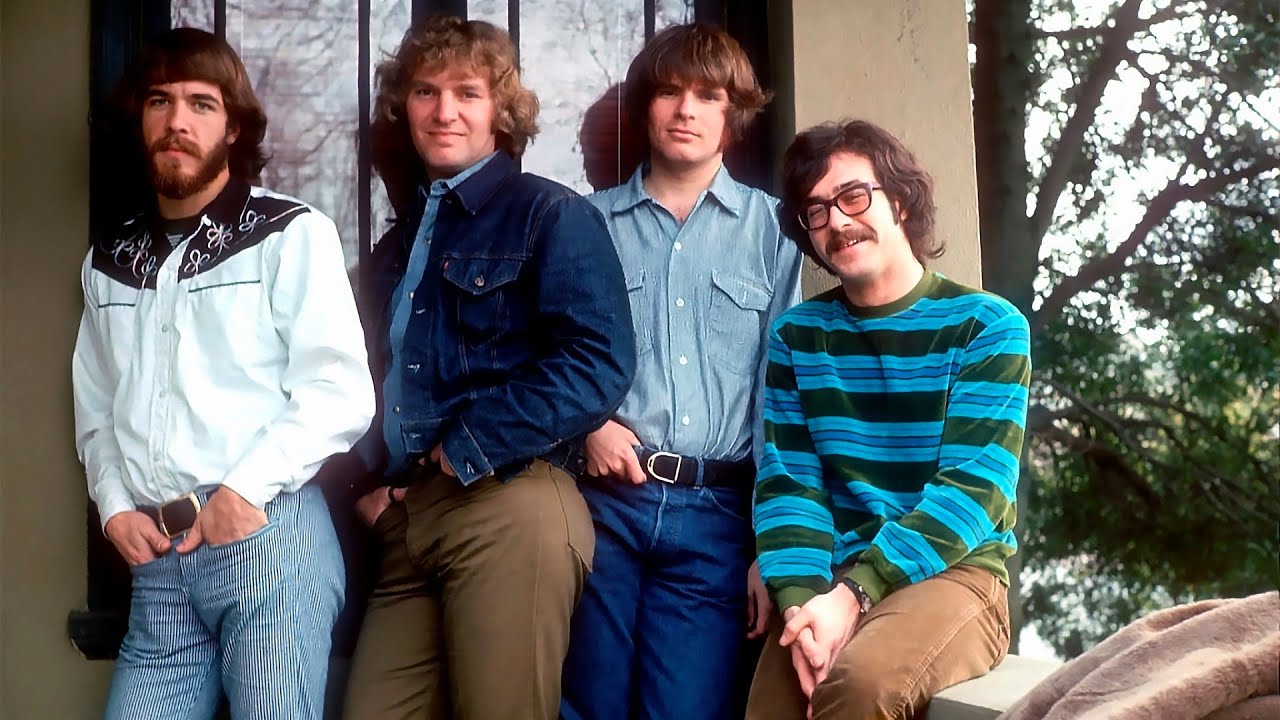
“Sweet Hitch-Hiker” is CCR’s last great grin on the highway—three minutes of restless motion where freedom feels intoxicating, and the end of an era is already visible in the rear-view mirror.
To place the essentials where they belong: “Sweet Hitch-Hiker” was first released as a single in July 1971 on Fantasy Records, written by John Fogerty, with “Door to Door” on the B-side. It made a swift, unmistakable entrance on the Billboard Hot 100 dated July 17, 1971, debuting at No. 68. From there it surged to a peak of No. 6, becoming Creedence Clearwater Revival’s ninth—and final—Top 10 hit in the U.S. Later, it was folded into the band’s final studio album, Mardi Gras, released April 11, 1972.
Those dates matter, because “Sweet Hitch-Hiker” doesn’t just sound like the open road—it arrived at a moment when the road ahead for CCR was narrowing. By the time the song was cut (the album sessions are documented as spanning spring 1971 and January 1972), the band was already living with the tension of being a powerhouse that could feel, privately, like it was coming apart at the seams. And that’s the strange emotional magic of the track: it barrels forward with a smile, yet it also reads like a postcard mailed from the edge of a goodbye.
Musically, “Sweet Hitch-Hiker” is classic CCR—lean, unpretentious, built to move. It carries that familiar Fogerty engine: a riff that feels like tires catching rhythm on imperfect pavement, a vocal that sounds half-command, half-testimony. There’s boogie in it, yes, but it isn’t the carefree boogie of a band with endless tomorrows. It’s the boogie of someone who has learned that momentum can be both joy and escape.
The “story behind” “Sweet Hitch-Hiker” is therefore two stories at once. On the surface, it’s a spirited vignette: a narrator in motion, eyes forward, appetite for the next mile. The hitch-hiker figure becomes a symbol—less a literal stranger on the roadside than a flash of possibility, the way youth tends to appear: sudden, bright, and gone before you can properly name it. On another level, the song’s place in the timeline gives it an unintended poignancy. It was a late-period CCR single that still reached the Top 10, yet it also marked the last time the group would stand that high on the American pop summit.
When you listen closely, the meaning isn’t “love conquers all” or “the party never ends.” It’s something more honest, and perhaps more adult: desire is often restless, and freedom—real freedom—rarely sits still long enough to be kept. A hitch-hiker is, by nature, temporary. You share a ride, a moment, a story, and then you’re back to your separate distances. In that sense, the song becomes a small parable about the road itself: how it gives you everything while refusing to promise you anything.
And then there is the larger frame: Mardi Gras, the album that would eventually house the track, arrived as CCR’s recorded farewell. Even sources close to the catalog describe it plainly as their final studio album, born amid creative strain and an altered band dynamic. Against that backdrop, “Sweet Hitch-Hiker” feels like one last burst of the band’s original instinct—direct, physical, uncomplicated—before the lights began to go out.
That’s why the song still hits with a particular kind of nostalgia. Not the nostalgia of pure innocence, but the nostalgia of remembering how fast good things move. “Sweet Hitch-Hiker” doesn’t ask you to mourn. It asks you to ride—windows down, engine warm—while quietly admitting what all roads eventually teach: even the brightest stretch of highway is already becoming memory as you drive it.