
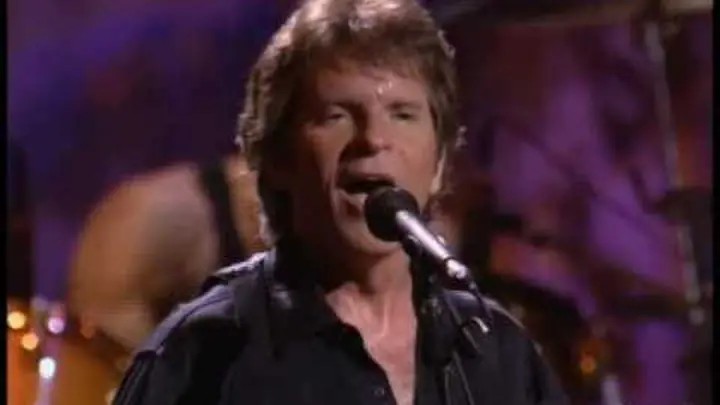
A “garden” in this song isn’t a place of comfort—it’s a doorway into old time, where the night sky and the human soul meet, and you feel history watching back.
The most important thing to know about “In the Garden” is that it isn’t a stray B-side or a casual jam tossed onto an album for pacing—it’s the closing track of Deja Vu All Over Again, released September 21, 2004, after a long seven-year gap since Fogerty’s previous studio record. It runs 3:50, and it’s built with almost stubborn simplicity: John Fogerty on guitars and lead vocal, with Paul Bushnell on bass and Kenny Aronoff on drums. The album itself charted strongly in several countries—peaking at No. 23 on the U.S. Billboard 200 and reaching No. 1 in Sweden—which matters because it tells you this late-career chapter wasn’t a footnote; it was heard, and widely.
But numbers don’t explain why “In the Garden” lingers. The song feels like Fogerty stepping away from headlines and street noise and walking into a more symbolic landscape—moon, sun, “temple,” “ancient one”—the kind of imagery that suggests he’s not describing a backyard, but a threshold. Even the phrase “in the garden” repeats like a chant, as if the mind is trying to keep hold of a vision that keeps slipping at the edges. (It’s easy to hear why listeners sometimes describe the track as more psychedelic-blues than country-rock—less a tidy story, more an atmosphere you enter.)
This was the season when Fogerty’s writing often carried a watchful edge. Blue Moon Swamp had been his last studio statement before this, and it’s no small thing that he waited until 2004 to come back with a full set of new songs. When an artist returns after that kind of silence, you tend to listen differently: you don’t just listen for hooks—you listen for what time has done to the voice, for what it has taught the songwriter to leave unsaid.
And here, what’s unsaid is as loud as the instruments. “In the Garden” doesn’t lecture. It doesn’t frame its mystery with explanations. It simply points—upward and inward—toward something older than the daily argument. The “ancient one” in the lyric can be heard as God, fate, conscience, time itself, or the hard-earned wisdom that watches us repeat our mistakes with the patience of stone. The beauty is that the song never forces a single interpretation; it lets the listener bring their own history to the doorway.
Musically, the track’s power comes from its repetition and drive. The rhythm section doesn’t wander; it pushes, steady as a heartbeat you can’t talk down. Fogerty’s guitar sits in that familiar place where his career has always lived: bright, biting, immediate—rock ’n’ roll as a kind of plain truth. And because it closes the album, it behaves like a final scene after the conversation has ended: the lights are lower, the room is emptier, and what’s left is the one question you couldn’t answer while everyone was talking.
Even the production context supports that feeling. Fogerty produced the album himself, with mixing by Bob Clearmountain (except for one track). That’s a particular kind of control: not control for perfection’s sake, but control so the song can feel intentional—so the space around the instruments is shaped, not accidental. A “garden,” after all, is never wild nature; it’s nature arranged with meaning. And in this song, you hear arrangement not just in sound, but in symbolism: the heavens overhead, the ancient presence, the sense of being observed by something that does not hurry.
If you’ve ever had that midnight feeling—when the world goes quiet enough that your own life becomes audible—“In the Garden” understands it. It doesn’t promise rescue. It offers recognition. It suggests that beyond the day’s noise there is still a place—call it memory, call it spirit, call it the old moral law inside the ribs—where the questions are older than we are, and yet somehow welcoming. Not comforting in a sentimental way… comforting in the way a steady star can be: distant, unblinking, and real.
And when the final echoes fade, the song leaves you with an aftertaste that only certain records can leave: the sense that you’ve been standing at a gate, and for a moment—just a moment—you saw through it.