
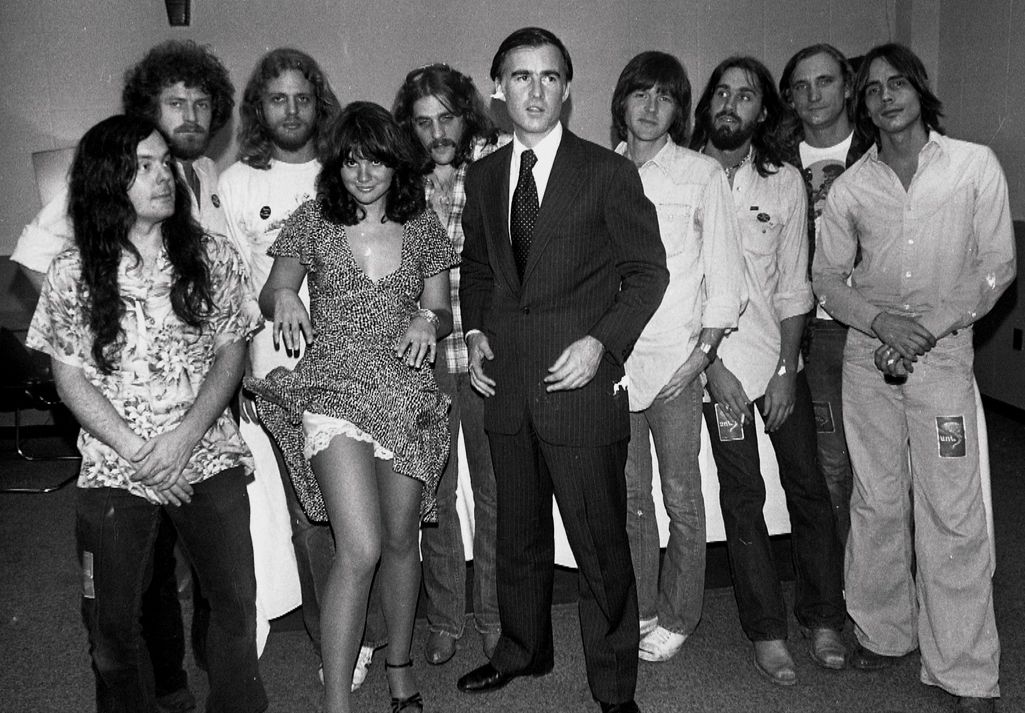
A bright old-country standard, reborn on a rock TV stage—“Silver Threads & Golden Needles” becomes a shared memory when Linda Ronstadt sings it with the Eagles, turning harmony into homecoming.
There’s a special kind of charm in that 1974 Don Kirshner’s Rock Concert clip: the camera doesn’t need tricks, because the story is already standing there in plain view—Linda Ronstadt up front, and behind her the Eagles, not as distant “special guests,” but as musicians who belonged in her orbit long before the world learned their names. The performance survives today in broadcast-quality circulation with a clear production note: it was recorded in Los Angeles by Viacom, dated July 19, 1974, and the set list on that tape places “Silver Threads and Golden Needles” right in the middle of a larger Eagles-focused show that also includes “Desperado” with Ronstadt.
Because Don Kirshner’s Rock Concert was syndicated—airing on different local stations on different dates—episode “air dates” can look inconsistent in different databases. One commonly cited guide lists an April 13, 1974 airing for the Eagles/Ronstadt/Browne episode, while the preserved Viacom tape indicates a July 19, 1974 recording date in Los Angeles. The simplest, most honest way to hold both facts is this: the performance belongs to 1974, taped for syndication, and remembered less for the calendar than for the feeling of seeing a musical family tree in motion.
That family tree is real, not romantic mythology. The original lineup of the Eagles—Glenn Frey, Don Henley, Bernie Leadon, Randy Meisner—had all been recruited as part of Ronstadt’s band in the early 1970s, with members touring with her and appearing on her 1972 self-titled album before launching the Eagles as their own group. So when they lean into those harmonies behind her, it doesn’t sound like a guest spot arranged by management; it sounds like the afterglow of shared vans, shared stages, shared hunger—those early years when everybody is still proving they’re real.
The song they choose is equally meaningful. “Silver Threads and Golden Needles” is a country song written by Dick Reynolds and Jack Rhodes, first recorded by Wanda Jackson in 1956. It traveled quickly across scenes and decades; a key early pop breakthrough came when the Springfields (with Dusty Springfield) hit the U.S. Top 20 with it in 1962. By the time Ronstadt took it up, it already carried a particular kind of American wisdom—sweet on the surface, steel underneath: love that refuses to be bought, dazzled, or cornered into a life it doesn’t want.
Ronstadt had a long relationship with the tune. She recorded an earlier, more traditional country reading on her 1969 solo debut Hand Sown… Home Grown, then cut a country-rock crossover version for her 1973 album Don’t Cry Now—and it was that later version that became a single in January 1974, giving her a real career milestone: her first hit on Billboard’s country chart, reaching No. 20, and also entering the Hot 100 (peaking at No. 67). That’s the kind of detail that changes the way you watch the TV performance: you’re not seeing her “try out” a classic—she’s stepping onstage with a song that had just become proof of her widening reach.
So what’s the “meaning” when it’s sung live with the Eagles? The lyric is a boundary line—no “silver threads,” no “golden needles,” no expensive persuasion will replace sincerity. In a way, it’s a grown-up principle disguised as a singable hook: affection isn’t a transaction; it’s a choice. And on that 1974 stage, the message deepens. You can hear it in the way the band supports her—steady, unshowy, committed to the groove. It turns the song into something more than a warning to a suitor. It becomes a small declaration of selfhood: I know what I’m worth, and I’m not bargaining it away.
The real sweetness of this performance, though, is not defiance—it’s belonging. Those stacked harmonies, so clean and familiar, feel like hands finding each other in the dark. You’re watching a moment from the Laurel Canyon era where careers are crossing like flight paths: Ronstadt already rising into her imperial years, the Eagles about to become a commercial force, and a television show capturing it before time hardens it into legend.
In the end, “Silver Threads & Golden Needles” (Don Kirshner’s Rock Concert, 1974) endures because it’s two stories at once: a timeless country song about refusing the wrong kind of love, and a snapshot of musicians who knew each other—close enough to blend their voices like they’d been doing it for years, because, in truth, they had.