
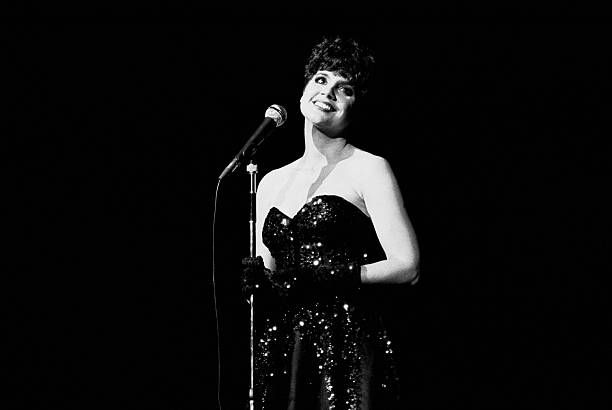
“Party Girl” is Linda Ronstadt’s sly self-portrait-by-proxy—bright lipstick and sharp nerves, a confession that fame can feel like a costume you’re praised for wearing.
In “Party Girl,” Linda Ronstadt steps into a song that already carries a sting in its smile. It was written by Elvis Costello —and before Ronstadt ever sang a note of it, it lived in Costello’s own world as a track on Elvis Costello & The Attractions’ 1979 album Armed Forces. That origin matters, because you can feel the songwriter’s trademark ambivalence in the lyric: attraction mixed with judgment, glamour mixed with loneliness, a chorus that sounds catchy until you realize it’s also a bruise. Ronstadt didn’t “soften” that bruise. She held it up to the light, turned it, and made it gleam.
Her recording of “Party Girl” appears on Mad Love, released February 26, 1980, produced by Peter Asher—an album that deliberately pivoted her sound toward the nervous energy of punk-adjacent pop and new wave. The track itself wasn’t rolled out as a single, so it has no clean “debut week” on the Hot 100 to recite. But its impact is tied to the album’s arrival, and that arrival was anything but quiet: Mad Love debuted at No. 5 on the Billboard album chart and went on to peak at No. 3 on the Billboard 200. In other words, millions came for the familiar force of Linda Ronstadt—and then found her wearing sharper edges.
That context turns “Party Girl” into something deeper than a clever cover. By 1980, Ronstadt had already been crowned, repeatedly, as a kind of mainstream ideal: golden voice, immaculate phrasing, hits that sounded like they’d always existed. Mad Love was the moment she tested the crown’s weight. The album famously includes three Costello songs—“Party Girl,” “Girls Talk,” and “Talking in the Dark”—and frames them inside a deliberately contemporary aesthetic. Choosing “Party Girl” for track-list real estate was a pointed move: it’s a song about being seen as a type instead of a person, about the fatigue behind the glitter, about the way crowds can turn someone into a rumor and then blame her for living up to it.
Listen to the title phrase—“Party Girl”—and you can almost hear how it would follow a famous woman through rooms. Not a name, not a story, but a label. The lyric’s sting is that it pretends to be casual while it cuts: they say I’m nothing but a party girl… The voice in the song knows the accusation is unfair, but also knows how easy it is to start performing the part just to keep the night moving. Ronstadt sings it with that rare combination she possessed in abundance: absolute vocal control and an emotional openness that never feels “acted.” She doesn’t plead her innocence. She simply lets the listener feel the ache of being reduced.
There’s also a delicious irony in how well her voice fits the song. Ronstadt’s tone—big, clean, undeniably “star”—becomes the very spotlight the lyric is wrestling with. She is singing about the trap while standing in the trap’s brightest light. And that tension is exactly why the performance lasts. It’s not just new-wave dabbling; it’s character work. It’s a woman with nothing left to prove daring herself to be misunderstood on purpose.
Years later, critics looking back at Mad Love often describe it as a risk that still sounds bracing—partly because it captured Ronstadt refusing to stay frozen in the version of herself the public found easiest to love. And “Party Girl” sits at the emotional center of that refusal: catchy enough to hum, sharp enough to haunt.
If you come to “Party Girl” hoping for the tidy triumph of a charting single, it won’t give you that. What it offers is more intimate and, in its way, more grown: the recognition that glamour can be lonely, that confidence can be a mask, and that sometimes the bravest thing a singer can do is step into a song that doesn’t flatter her—then make it feel, impossibly, like the truth.