
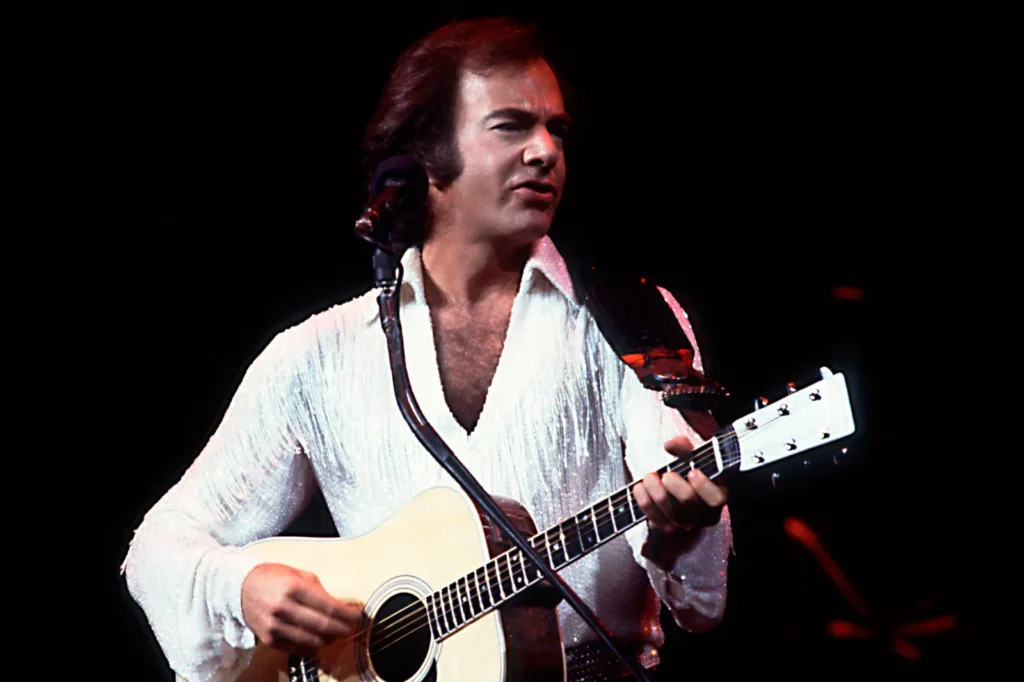
“Evermore” is Neil Diamond’s late-life love elegy—when devotion meets disillusion, and the heart whispers that some goodbyes began long before the door closed.
“Evermore” sits at the emotional center of Neil Diamond’s quietly radical 2005 return-to-essentials album, 12 Songs—released November 8, 2005 and produced by Rick Rubin. The album debuted at No. 4 on the Billboard 200, a remarkable late-career peak that announced Diamond hadn’t come back to replay old glory; he’d come back to tell the truth in a lower voice. And right there, as track 4, “Evermore” arrives like the first honest breath after a long week of pretending. On the standard track listing it runs 5:18, and it’s written solely by Neil Diamond, as the whole album is—twelve songs, one writer, no hiding behind co-writes or fashionable tricks.
The “behind the song” story matters, because 12 Songs was born from a kind of solitude that changes how a person writes. The album’s history notes that Diamond began shaping new material after retreating to his Colorado cabin, temporarily snowed in, writing simply to pass the time—until those pages became a new beginning. Then came Rubin, famous for stripping artists down to their essence, encouraging Diamond to keep writing for about a year before the real recording began—patiently, almost stubbornly, protecting the songs from clutter. That aesthetic is the air “Evermore” breathes: intimate, unforced, and a little haunted, like a man speaking in the dark so he won’t wake the whole house.
Musically, the track wears that Rubin-era minimalism with grace—but it is not “bare” in a cheap way. The album credits show Diamond on vocals and guitars, and for “Evermore” specifically, the personnel includes notable players such as Mike Campbell and Smokey Hormel on guitars, and Jimmie Haskell providing horn and string arrangements for track 4—details that hint at a careful emotional architecture beneath the apparent simplicity. It’s not lavish, but it is shaped—like a room lit by a single lamp where every shadow falls intentionally.
What does “Evermore” mean? It’s the ache of realizing that “forever” can be a promise people make sincerely—then break by degrees. The lyric moves through disorientation and recognition: two people who once believed they would be “evermore,” now staring at each other across a distance that feels almost unfamiliar. You can feel the tragedy of ordinary damage—unspoken words, missed warnings, promises left behind—the slow erosion that doesn’t announce itself until the house is already cold. (The song’s published lyrics capture that exact arc of confusion into clarity.)
There’s a special bitterness in the title, too. Diamond doesn’t name the song “Goodbye.” He names it “Evermore,” as if the very word has become a ghost—something the singer still believes in emotionally, even as reality proves otherwise. That tension is where the song lives: love as memory, love as expectation, love as a vow that still echoes even after trust has worn thin.
Critics at the time noticed how 12 Songs brought out a more vulnerable Diamond, and one review singled out “Evermore” as a “tear-” soaked goodbye—language that fits the song’s slow, dignified sadness. And that dignity is the point: “Evermore” doesn’t beg for reconciliation with fireworks. It stands in the wreckage and asks the quiet questions people ask when pride is exhausted: How did we get here? When did you become a stranger? Why didn’t we speak when it mattered?
If you’ve lived long enough to know that some losses happen while everyone is still technically “together,” this song lands differently. Neil Diamond sings “Evermore” like a man folding away a letter he wishes he didn’t have to write—measured, pained, and strangely calm. And perhaps that’s why it lasts. Not because it chased a chart as a single—it didn’t—but because it tells the older truth: that “forever” is not a length of time. It’s a hope. And when hope breaks, it doesn’t shatter loudly. It just leaves you standing there, listening to the silence that follows—evermore.