
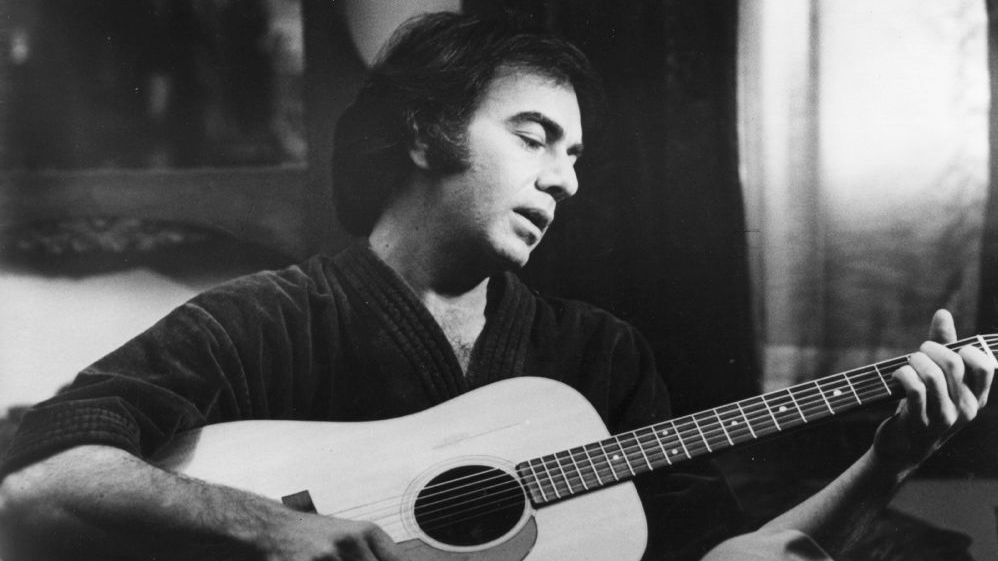
“Madrigal” is Neil Diamond’s brief, wordless pause in the middle of his most adventurous album—an instrumental breath that feels like moonlight between prayers, folklore, and drums.
On paper, “Madrigal” looks almost too small to matter: barely two minutes, no lyric to quote, no chorus to carry back to the radio. And yet, once you hear it in context, it becomes one of those tracks that quietly explains who Neil Diamond was becoming in 1970—an artist willing to stop chasing singles for a moment and build atmosphere, sequence, and emotional architecture.
“Madrigal” appears on Diamond’s sixth studio album Tap Root Manuscript, released October 15, 1970 on Uni Records, produced by Tom Catalano and Neil Diamond. The album peaked at No. 13 on the Billboard 200—a strong showing for a record that dared to be stranger than most pop albums of its era. This is the crucial “ranking” frame for “Madrigal” itself, because the track wasn’t released as a single and didn’t have its own chart peak; its impact is album-deep, the kind you discover by letting the needle keep traveling.
And that’s exactly how “Madrigal” is meant to be found—by staying with Side Two. Tap Root Manuscript famously pivots from pop-rock songs on Side One into a conceptual suite on Side Two, often referred to as “The African Trilogy.” In that suite, “Madrigal” arrives as track B3, credited as an instrumental and listed at about 1:55. Credits databases also document Diamond as the lyricist/composer (even though the track is instrumental, the credit reflects authorship of the piece), with Catalano and Diamond producing.
Why call it “Madrigal”? The word itself carries old-world perfume: Renaissance voices in braided harmony, courtly devotion, carefully measured beauty. Diamond borrows that classical hint, then filters it through the album’s larger experiment—rock instrumentation, orchestral color, and African-percussion textures sharing the same room. The title feels like a deliberate little contradiction: a “madrigal” without sung text, a piece that suggests choral elegance while speaking only in sound. It’s as if Diamond is tipping his hat to tradition while admitting he doesn’t want to be contained by it.
And emotionally, the track functions like a hinge. Tap Root Manuscript is full of movement—children’s voices framing the album (“Childsong”), storytelling (“I Am the Lion”), the rhythmic lift of “Soolaimon” (a song from the album that reached the Billboard Hot 100 Top 40, peaking at No. 30), and the ambitious African-themed suite that follows. In the middle of those bigger gestures, “Madrigal” doesn’t compete. It clears the air. It’s the moment when the record stops explaining itself and simply lets you feel the room it has built.
That’s the deeper meaning of “Madrigal”: not a “song” in the usual sense, but a small sanctuary—an interlude where the listener can breathe, remember, and drift. If Side One of Tap Root Manuscript is Diamond showing he can still deliver pop with authority (the era of “Cracklin’ Rosie” and other charting triumphs), Side Two is him chasing a bigger idea: identity, roots, myth, and the way music can travel across cultures in the imagination. “Madrigal” is where that imagination becomes most intimate. It doesn’t shout “concept.” It simply glows.
And maybe that’s why it feels so nostalgic now. Instrumentals like this used to be more common on major pop albums—little rooms set aside for reflection, where the artist trusted the listener not to be bored by quiet. Hearing “Madrigal” today can bring back the older ritual of listening: sitting still, letting Side Two begin, allowing an album to be a journey rather than a collection of “tracks.” It reminds you that sometimes the most memorable moments in music are not the lines you sing along with—but the moments that make you stop, stare out the window, and feel time soften.
In the end, “Madrigal” is brief—but it isn’t small. It’s Diamond’s delicate proof that boldness isn’t only volume or speed. Sometimes boldness is the courage to leave space.