
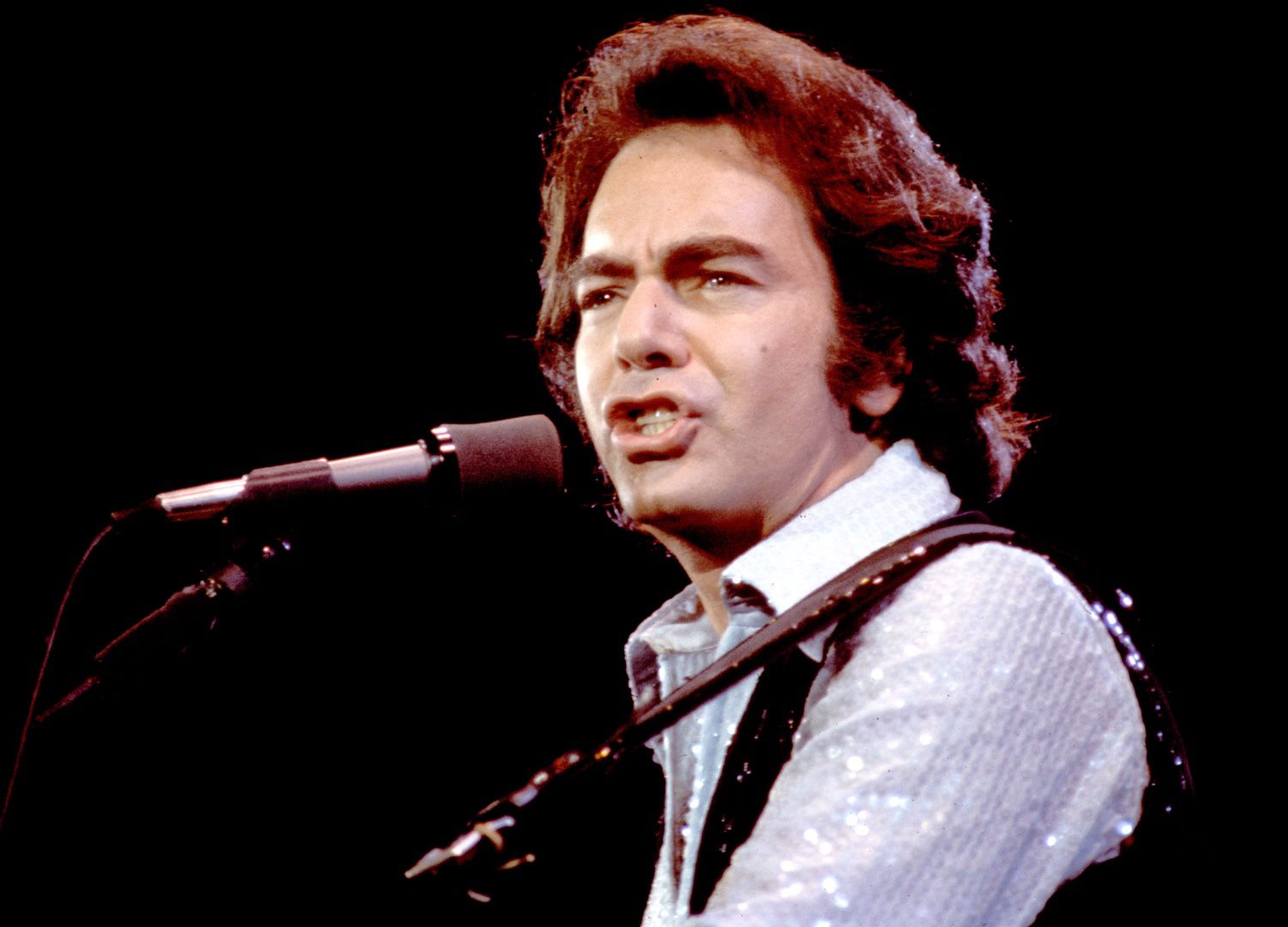
“Beautiful Noise” is Neil Diamond’s hymn to the city, to youth, and to the strange miracle by which everyday clamor turns into music inside a restless heart.
When “Beautiful Noise” arrived in 1976, it carried more weight than an ordinary album track. It gave its name to Neil Diamond’s album Beautiful Noise, which his official site lists as a 1976 release with the title song placed right at the front of the record, and that album went on to reach No. 4 on the Billboard 200. As a single, the song found especially clear chart success in Britain, where the Official Charts Company records “Beautiful Noise” peaking at No. 13, after first entering the UK chart on October 23, 1976. Those details matter because they remind us that this was not merely a beloved deep cut rediscovered later; it stood at the center of an important Neil Diamond moment from the very beginning.
But numbers alone cannot explain why the song still glows. The story behind “Beautiful Noise” is one of those small, almost domestic moments from which lasting songs are sometimes born. In later recollections circulated by Team Neil, Diamond said his children helped inspire the phrase, and another widely quoted account remembers his daughter Marjorie looking out at a parade and saying, “What a beautiful noise.” That line struck him immediately. He wrote it down at once, sensing that something larger was hiding inside those simple words. It is a lovely origin story because it feels so human: not grand inspiration from a mountaintop, but a father, a child, a window, a city in motion, and a phrase that suddenly opened a door.
The song’s meaning lives in that very contrast. On the surface, “Beautiful Noise” is about sound—street sound, crowd sound, urban sound, the rough orchestra of ordinary life. But beneath that, it is really about transformation. Neil Diamond does not hear noise as something ugly or intrusive. He hears it as raw material for feeling, memory, rhythm, and identity. The city does not merely surround the singer; it enters him. It becomes pulse, dream, and artistic fuel. When Diamond’s official team later described the song as one that “taps into his teenage years,” they pointed toward the deeper truth: “Beautiful Noise” is not just about what he hears outside, but about who he was when he first learned to hear the world musically. In that sense, the song feels almost autobiographical—a portrait of a young man discovering that the racket around him can become a kind of salvation.
That is why the song has always felt warmer than its title might suggest. The word noise usually carries complaint. In Neil Diamond’s hands, it becomes tenderness. He finds beauty where others might hear only confusion. He finds rhythm where others hear disorder. This is one of the most generous instincts in pop songwriting: the refusal to divide life too neatly into the lovely and the unpleasant. “Beautiful Noise” suggests that the world does not arrive to us in finished harmony. It arrives messy, loud, interrupted, imperfect—and the artist’s calling is to hear the hidden music inside it. That idea gives the song an almost spiritual dimension. It is about art, yes, but also about resilience, perception, and gratitude.
There is also something unmistakably New York about it, even when the lyrics speak broadly enough for anyone to enter. One can feel sidewalks in the song, summer air, radios playing from far-off windows, voices rising from the street, the old excitement of being young in a place too large to fully understand. For listeners who came of age when records still seemed to carry the weather of a whole era inside them, “Beautiful Noise” has that rare ability to bring back not only a melody, but a way of feeling alive. It does not traffic in heartbreak the way so many Diamond classics do. Instead, it celebrates alertness itself—the thrill of being open to the world, even when the world is overwhelming.
And perhaps that is why the title has lasted so well that it eventually became the name of A Beautiful Noise, the stage musical built around Diamond’s life and songbook. The phrase was always larger than one track. It carried a philosophy. It suggested that a life in music is not the search for silence, but the ability to shape experience into song. The 1976 album’s success, the single’s UK chart run, and the phrase’s later afterlife all point to the same truth: “Beautiful Noise” was never a minor thought in Neil Diamond’s catalogue. It was a declaration of artistic identity.
So when we return to “Beautiful Noise,” we are hearing more than a catchy title track from a successful Neil Diamond album. We are hearing a man turn the commotion of life into something almost luminous. We are hearing youth remembered not with bitterness, but with wonder. We are hearing the old, comforting lesson that beauty does not always arrive softly. Sometimes it comes in shouting streets, passing parades, children’s voices, crowded air, and the sudden recognition that what seemed like chaos was music all along.