
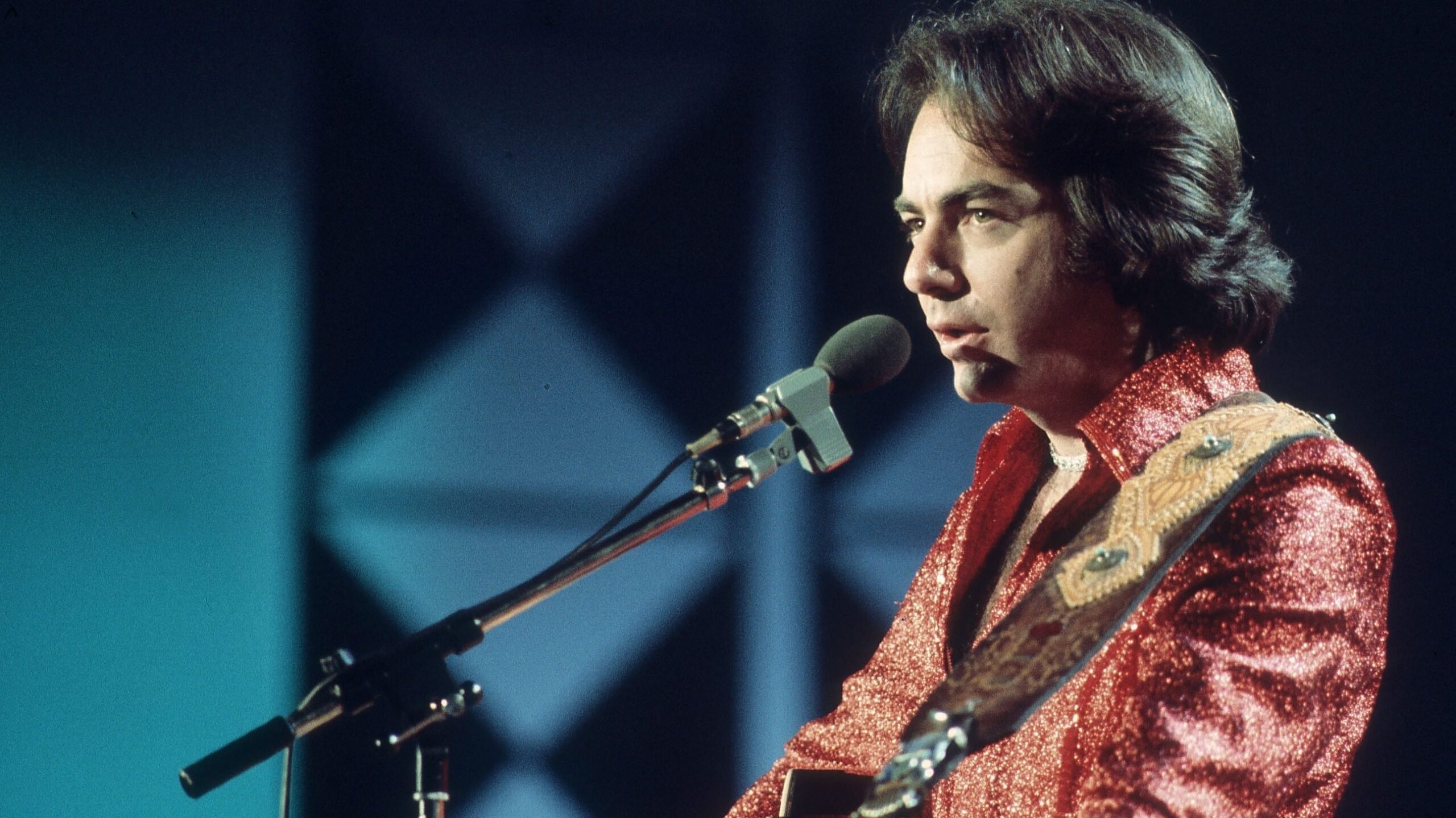
“Heartlight” is Neil Diamond turning wonder into a vow—a soft beam of hope held up against the dark, insisting that tenderness can still guide us home.
Released as a single in September 1982 on Columbia (US catalog 38-03219), “Heartlight” became one of Neil Diamond’s last great mainstream “shared moments”—the kind of song that seemed to drift out of radios and settle into living rooms like evening light. Commercially, it was a late-career triumph: No. 5 on the Billboard Hot 100, and—more telling for Diamond’s enduring adult audience—No. 1 on Billboard’s Adult Contemporary chart for four weeks in late 1982. It also crowned an album that still carried real weight in the early ’80s marketplace: Heartlight (released August 27, 1982) spent 34 weeks on the U.S. album chart, peaked at No. 9 on the Billboard 200, and was certified Platinum by the RIAA.
Those are the hard numbers. The softer truth—the one people remember—is the story behind the glow.
“Heartlight” was co-written by Neil Diamond with Carole Bayer Sager and Burt Bacharach, a collaboration that matters because you can hear the craftsmanship: Bacharach’s sense of lift and contour, Sager’s direct emotional phrasing, and Diamond’s gift for making a chorus feel like a personal pledge. And then there’s the famous spark: the song is widely reported to have been inspired by E.T. the Extra-Terrestrial (1982)—that peculiar, childlike ache of wanting to be found, understood, and safely brought home. The connection was strong enough to cause headaches: reporting has long noted a legal skirmish with MCA/Universal, with Diamond allegedly settling over the song’s perceived borrowing from the film’s ideas.
Yet the reason “Heartlight” survives isn’t controversy—it’s comfort. Diamond doesn’t write it like a novelty “movie song.” He writes it like a human instruction manual for the soul: when fear rises, when the world feels too sharp, turn on your heartlight—that inner lamp that keeps you kind. The phrase lands because it’s not complicated. It’s the kind of wisdom people arrive at only after life has tried to harden them: stay open anyway. Stay gentle anyway. Not because the world always deserves it, but because you do.
Musically, the record is pure early-’80s Adult Contemporary polish—rounded edges, bright keyboards, a chorus designed to bloom rather than punch. But it doesn’t feel cold. It feels curated, like a room lit deliberately. In that era, Neil Diamond was navigating a shifting pop landscape—new sounds, new stars, new radio rules—and “Heartlight” manages a small miracle: it sounds modern enough for its time, yet emotionally timeless. It invites you to believe that sincerity can still be stylish.
And there’s an extra ache, heard best now with distance: “Heartlight” is often noted as Diamond’s last Top 10 pop hit and his last No. 1 Adult Contemporary single. It’s a kind of late chapter where the narrator doesn’t pretend youth lasts forever—but still insists that wonder can. In that sense, the song carries a double nostalgia: nostalgia for childhood (the E.T. shadow of bicycles and moonlight), and nostalgia for adulthood when the heart still believed it could choose brightness on purpose.
So if you play “Heartlight” today, don’t be surprised if it hits deeper than you expect. Beneath the smooth production is a very old emotion: the desire to be better than your bitterness, the desire to keep a small flame alive. Some songs beg you to remember the past. “Heartlight” asks something braver: to remember your capacity for warmth—and to switch it on again, even now.