
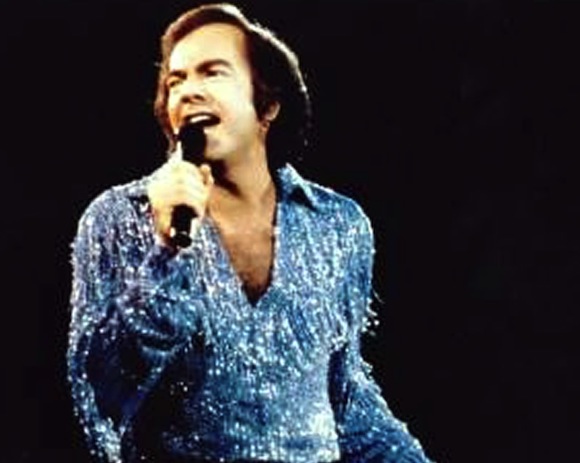
“River Runs, New Grown Plums” is Neil Diamond caught in a fleeting, sunlit snapshot—love described through nature’s certainty, as if the heart could learn steadiness from the way rivers keep moving.
If you’re looking for the “where and when” first: “River Runs, New Grown Plums” is track 3 on Neil Diamond’s 1969 album Brother Love’s Travelling Salvation Show, released April 4, 1969 on Uni Records, recorded across 1968–69, with production credited to Tom Catalano, Chips Moman, Tommy Cogbill, and Neil Diamond himself. The song is brief—about 2 minutes—more like a flash of feeling than a fully furnished room, and that compactness is part of its charm and its mystery.
In chart terms, this isn’t a single with a debut position to recite. It’s an album cut—one of those quiet corners where an artist’s private handwriting shows through. The album’s broader commercial footprint, though, helps explain the atmosphere around it: chart databases that track Billboard’s album runs list Brother Love’s Travelling Salvation Show entering the Billboard album chart at No. 173 and later rising to a peak of No. 82. Meanwhile, the era’s headline moments were happening elsewhere on the same record: the title song became a Hot 100 hit (peaking at No. 22), and “Sweet Caroline”—recorded and released after the album’s first issue—became so popular (Hot 100 peak No. 4) that it was added to later pressings.
So why does “River Runs, New Grown Plums” matter?
Because it reveals a side of Neil Diamond that gets overlooked when the conversation is dominated by grand choruses and arena-sized emotion. This is Diamond in miniature, sketching rather than painting—using the simplest objects in the world (river water, fruit on a branch, bare feet on the ground) to say something that feels oddly profound: love is natural, inevitable, and a little beyond argument. Even the title sounds like a line overheard rather than a slogan—messy, earthy, specific, like real life.
The lyric’s emotional engine is not drama, but acceptance. The narrator is with a woman who “wants everything,” yet what she truly needs is simply knowing he’s there. From that everyday tension—desire versus presence—Diamond jumps to images that don’t negotiate: a river runs where it’s bound to run; new plums grow blue because that’s what they do; and love, in its plainest form, just is. (He even repeats the refrain like a mantra, as if repeating it could make it truer.) You can feel the young songwriter reaching for something older than pop fashion—something almost folk-like in its trust that nature can explain the heart better than the heart can explain itself.
Interestingly, this song has long carried a reputation for being more “impression” than “statement.” In a retrospective assessment quoted in album documentation, critic William Ruhlmann noted that the album sometimes betrayed how quickly it was assembled, pointing to songs like “Dig In” and “River Runs, New Grown Plums” as closer to “unfinished sketches” than fully developed compositions. That could be read as criticism—and it is—but there’s another way to hear it: some sketches are precious precisely because they don’t over-explain themselves. They leave space for the listener’s own weather.
And there’s a deeper poignancy in where the song sits in the album sequence. Brother Love’s Travelling Salvation Show is full of Diamond’s cinematic instincts—tent revivals, Southern streets, big moral light and shadow—yet “River Runs, New Grown Plums” interrupts that wide-angle world with a close-up. It’s the camera turning from the crowd to the porch, from the sermon to the private glance. In the middle of an ambitious 1969 record, Diamond gives you two minutes of domestic truth: a barefoot girl, a baffled narrator, and the steady reassurance that some things—like rivers—continue even when we don’t fully understand why.
That, finally, is the song’s meaning: a modest hymn to inevitability. Not inevitability as fate, but as continuity—the reassurance that life keeps growing, running, ripening, even when people are complicated. Neil Diamond would later become famous for songs that declare and command. Here, he simply observes, and in that small observation there’s a kind of peace: Honey, it’s natural.