
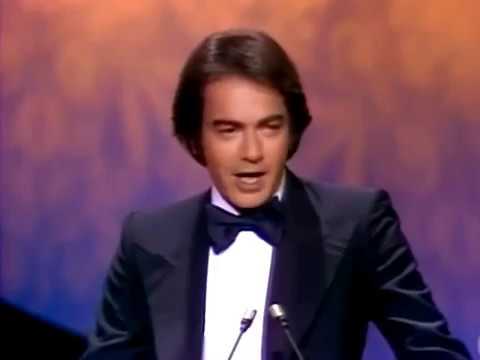
“Songs of Life” is Neil Diamond stepping back from the spotlight to listen to what endures—those melodies that outlive applause, and the hard-earned tenderness they leave behind.
If you’re coming to “Songs of Life” expecting a chart-topping headline, you may miss what it’s really offering. This song lives in a more intimate place in Neil Diamond’s catalogue: it’s track 4 on The Jazz Singer (soundtrack), released in November 1980 (often listed specifically as November 10, 1980). Rather than being pushed as a major single in its own right, “Songs of Life” found its widest public “launch” through proximity—serving as the B-side to Diamond’s hit single “America,” released in April 1981. That pairing matters, because “America” went on to reach No. 8 on the Billboard Hot 100 and No. 1 on the Adult Contemporary chart—big, outward-facing success—while “Songs of Life” sat on the flip side like a private note you discover only if you keep listening after the crowd noise fades.
The story behind the song is inseparable from the strange, bittersweet paradox of The Jazz Singer itself. The 1980 film drew negative reviews and even earned Diamond the first Razzie for Worst Actor, yet the soundtrack became an enormous triumph—Diamond’s biggest-selling U.S. album, selling over 5 million in the United States, peaking at No. 3 on the pop albums chart, and producing three Hot 100 Top 10 singles (“Love on the Rocks,” “Hello Again,” “America”). That contrast—public criticism on one side, private devotion from listeners on the other—feels like the emotional climate “Songs of Life” was born to inhabit.
And then there is the co-writer: Gilbert Bécaud. “Songs of Life” is credited to Neil Diamond and Gilbert Bécaud, one of several collaborations between them around this era. Bécaud—celebrated in France for songs like “Et Maintenant” (“What Now My Love”)—brought a certain continental elegance to Diamond’s phrasing and melodic instincts, and their partnership on The Jazz Singer extended beyond this track to include titles such as “Love on the Rocks,” “Hey Louise,” “Summerlove,” and more. In that light, “Songs of Life” doesn’t feel like a standard “soundtrack cut.” It feels like a meeting of two seasoned craftsmen, both of whom understood that the most lasting songs are rarely the loudest ones.
So what does “Songs of Life” mean—why does it linger?
It’s a meditation disguised as a melody: a reminder that music isn’t merely entertainment, it’s memory with a pulse. The title itself suggests that songs can be biography—chapters you don’t write with pen, but with repetition, with heartbreak, with the way a chorus returns at the exact moment you didn’t know you needed it. In the world of The Jazz Singer, where performance and identity are constantly rubbing against each other, “Songs of Life” feels like Diamond quietly separating what is true from what is merely visible. Fame is loud. But the inner life—the part that keeps score of love, loss, regret, gratitude—sings in a lower register.
There’s also something gently moving about how the song is presented on the album. The Jazz Singer is produced by Bob Gaudio, and its orchestral colors are part of its emotional architecture (with credits noting orchestral arranging/conducting roles in the project’s personnel). Diamond’s voice, so often associated with grand declarations, becomes here more reflective—less “I will,” more “I remember.” It’s the sound of a man acknowledging that we don’t really collect possessions as we age; we collect songs. We collect the music that played when we were brave, when we were foolish, when we were in love, when we pretended we weren’t.
That’s why “Songs of Life” remains a quietly treasured piece of Neil Diamond: it doesn’t demand attention the way the big singles do. It simply stays. Like an old record jacket that still smells faintly of the room where you first heard it, it reminds you that what matters most is not the noise outside—but the music that has followed you faithfully, all these years, from season to season, carrying your own story back to you.