
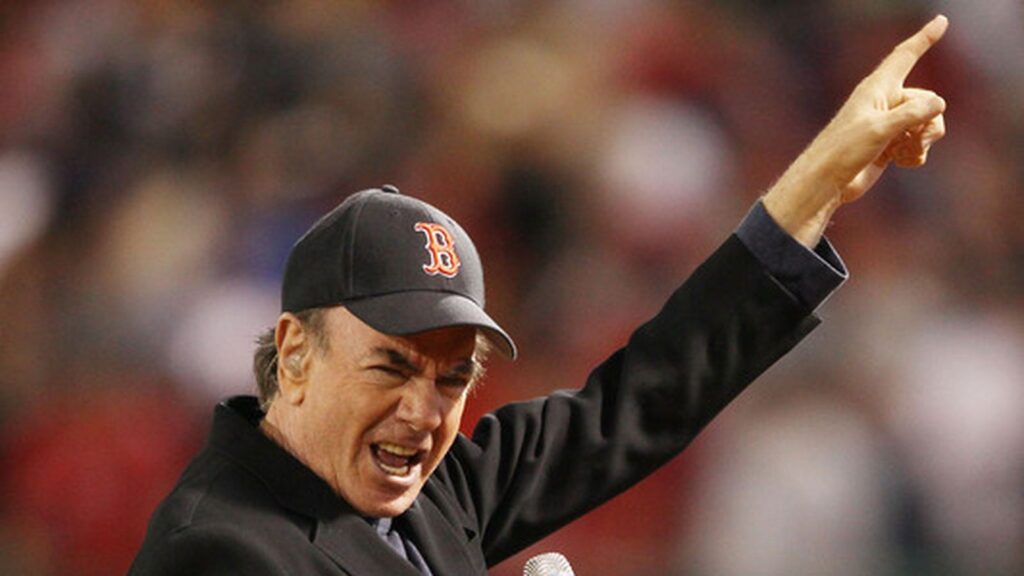
“We (Early Take)” feels like a lamp left on in a dark house—Neil Diamond stripping love down to its simplest truth: not you and me, but the fragile, hard-won miracle of we.
Neil Diamond’s “We (Early Take)” is best understood as a glimpse behind the curtain of one of his great late-career renewals. The song belongs to 12 Songs, Diamond’s 26th studio album, produced by Rick Rubin and originally released on November 8, 2005. The “Early Take” version surfaced much later, officially issued on June 28, 2024 as part of 12 Songs (Deluxe Edition), where it appears explicitly as “We (Early Take)” (running 4:11).
Those dates matter because they frame what you’re hearing. This isn’t a new song written to suit a new era; it’s a return to the moment when Rubin encouraged Diamond to step away from polish and pageantry and back toward the directness of his earliest records—lean arrangements, human edges left intact, the sense of a voice singing in a real room rather than a spotlighted arena. 12 Songs debuted at No. 4 on the Billboard 200, a striking chart arrival for an album built around restraint rather than spectacle.
On the original 2005 track list, “We” sits late—track 12—almost like the last word you say before turning off the lights. And that placement fits the song’s emotional stance. It doesn’t seduce. It doesn’t argue. It simply insists that love, at its most honest, is not an ego project. The lyric distills the whole philosophy into plain language—“It’s not about you, it’s not about me… love is all about we.” You can hear Diamond, the master of grand romantic architecture, choosing instead to build with simpler materials: pronouns, promises, the quiet humility of mutuality.
So what does “Early Take” add? Not a new meaning—more like a different temperature. An early take tends to carry the tremble of discovery: a singer still finding where the words pinch, where the melody exhales, where the heart wants to rush ahead but the song asks it to stay steady. Rubin’s whole approach with Diamond in this era was to prize authentic presence over glossy perfection, and the session timeline for 12 Songs—recorded from April 2004 to summer 2005—suggests a long, deliberate process of writing, refining, and then capturing something that still feels immediate. That’s why an “early take” can be so moving: it’s the sound of the song before it learns how to behave.
There’s also a tenderness in the very idea of “we” coming from Diamond at this stage. By 2005, he didn’t need to prove he could fill rooms or top charts—he’d already done it for decades. What he seemed to want, instead, was to speak more plainly about what lasts when applause fades: companionship, loyalty, the daily decision to be kind when it would be easier to be right. “We” is built from that mature understanding that love isn’t just a feeling you fall into—it’s a practice you return to. And sometimes it’s the simplest word that carries the heaviest weight: we, the word that means you’ve stopped standing alone.
Listening now—especially in this “Early Take” form released in 2024—there’s an extra layer of poignancy. The world keeps getting louder, more individualized, more addicted to sharp edges and quick exits. Yet here is Neil Diamond, calmly refusing the noise, repeating a truth that sounds almost old-fashioned because it’s so unfashionably sincere: love is a shared grammar. It’s what happens when the “I” softens enough to make room for another person without erasing either of you.
And that’s the quiet miracle of “We (Early Take)”: it doesn’t chase the high drama of heartbreak. It celebrates the harder, rarer achievement—staying human together. In the end, it feels less like a song you “discover” than a sentence you’ve been waiting to hear again, spoken slowly, in a voice that has lived long enough to mean it.