
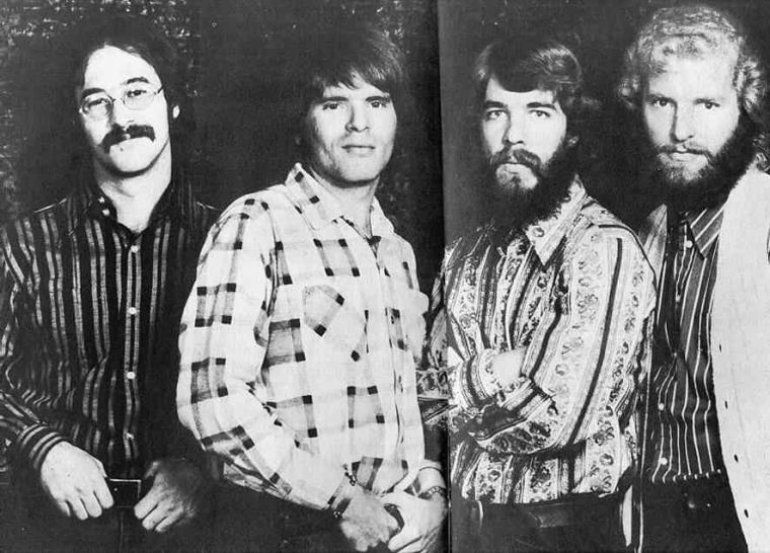
“Hello Mary Lou” captures a lighter, smiling side of Creedence Clearwater Revival—a farewell-era recording that turns a classic teenage rush into something warm, loose, and deeply human.
There is something quietly moving about hearing Creedence Clearwater Revival take on “Hello Mary Lou”. It is not one of the band’s towering protest songs, not one of those swamp-rock storms that changed American radio, and not one of the grand statements that made CCR legendary. But perhaps that is exactly why it lingers. In this performance, the band sounds relaxed, affectionate, and almost boyishly charmed, as if they are tipping their hat to the golden age of early rock and roll one more time before the curtain falls.
“Hello Mary Lou” appeared on CCR’s 1972 album Mardi Gras, the final studio album released by the band. That detail matters, because by then Creedence Clearwater Revival was no longer the fiercely united machine that had produced “Proud Mary,” “Bad Moon Rising,” “Green River,” and “Have You Ever Seen the Rain”. Tensions inside the group had grown serious, and Mardi Gras has long been heard through the shadow of that internal strain. Yet in the middle of that difficult chapter, “Hello Mary Lou” arrives like a shaft of sunlight—easy on its feet, full of melody, and refreshingly uncomplicated.
The song itself has a much older heartbeat. Written by Gene Pitney, “Hello Mary Lou” became famous through Ricky Nelson’s 1961 recording, which reached No. 9 on the Billboard Hot 100. Long before CCR touched it, the song already belonged to that treasured early-rock tradition: the quick glance, the sudden spark, the thrill of youthful recognition. It is a simple song on the surface, but simplicity in rock and roll can be deceptive. The best songs of that era carried entire emotional worlds in a few lines, and “Hello Mary Lou” does exactly that. It is about instant attraction, yes, but also about the electric way memory fixes certain moments forever.
When Creedence Clearwater Revival recorded it, they did not try to reinvent that feeling. They did something smarter: they honored it. Their version keeps the song’s directness intact while wrapping it in the band’s earthy, unpretentious style. The rhythm has a friendly roll to it, the guitars stay crisp and uncluttered, and the whole performance feels lived-in rather than polished for show. This is one of the reasons the recording remains so appealing. CCR never sounds like a band straining to be fashionable. Even in a cover, they sound like themselves—plainspoken, grounded, and allergic to unnecessary decoration.
There is also a certain poignancy in hearing “Hello Mary Lou” on Mardi Gras. By 1972, the story of CCR was approaching its end. The album is often discussed in terms of fracture and fatigue, and those discussions are understandable. But songs like this remind us that even near the finish line, the group still knew how to tap into something immediate and pleasurable. Not every legacy-defining moment has to arrive wrapped in thunder. Sometimes a band reveals itself just as clearly in the way it handles a song with grace, affection, and restraint.
The meaning of “Hello Mary Lou” has always rested in that flash of recognition—one of those moments when life seems to stop for a heartbeat because someone has suddenly entered the frame. In CCR’s hands, that feeling becomes slightly older, slightly wiser. The rush is still there, but it is touched by memory. You do not hear reckless teenage fantasy so much as a fond recollection of it. That may be why this version speaks so warmly across the years. It reminds listeners not only of young love, but of the whole emotional atmosphere surrounding old jukeboxes, summer drives, radio sing-alongs, and the kind of songs that once seemed to make the world feel wonderfully close.
Musically, the track shows one of Creedence Clearwater Revival’s enduring strengths: they understood the architecture of American popular song. Their greatness did not come only from writing classics of their own. It also came from knowing how country, rockabilly, rhythm and blues, and early rock all fit together in the same bloodstream. “Hello Mary Lou” sits comfortably inside that understanding. It is not treated as nostalgia for nostalgia’s sake. Instead, it feels like a continuation of a musical conversation that CCR had been having all along.
And that is why the song still matters. It may not be the first title named in any summary of the band’s career, and it may never carry the mythic weight of their biggest records. But it reveals something precious: even in a troubled final season, CCR could still sound joyful. They could still step into a well-loved song and make it feel natural, generous, and alive. In a catalog filled with urgency, warning, and social weather, “Hello Mary Lou” offers a different kind of truth—the truth of music made for the pleasure of playing, the pleasure of remembering, and the pleasure of falling under a melody’s spell all over again.
So when this track comes on, what remains is not just the charm of an old rock and roll favorite. What remains is the sound of Creedence Clearwater Revival pausing, however briefly, to smile. And sometimes that small, unguarded smile tells us as much about a band as any anthem ever could.