
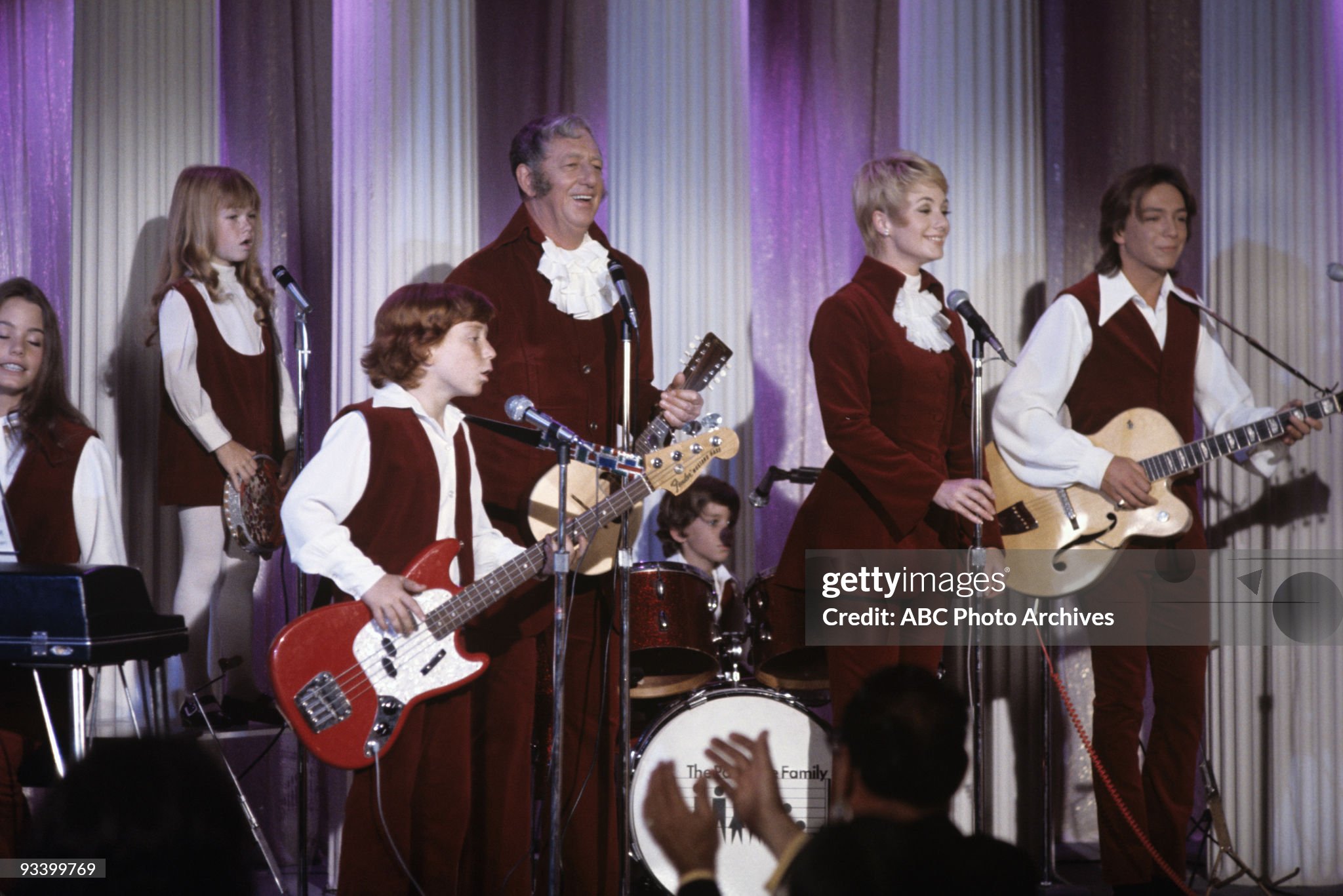
“The Christmas Song” in The Partridge Family universe is less a performance than a warm lamp in the window—Shirley Jones stepping forward to sing comfort itself.
In a catalogue built on TV-bright pep and youth-culture sparkle, The Partridge Family’s take on “The Christmas Song” (“Chestnuts Roasting on an Open Fire”) feels like a sudden hush—like someone turning down the chatter so the room can breathe. It’s the moment where the “family” myth becomes something unexpectedly intimate: the show’s on-screen mother, Shirley Jones, taking one of the most beloved seasonal standards and singing it with a kind of calm authority that doesn’t chase sentiment—it simply offers it. On A Partridge Family Christmas Card (released November 1971), this track is explicitly noted as one of the few Partridge recordings where Jones is the lead singer.
That detail matters, because it shapes the emotional center of the whole album. Most Partridge records orbit David Cassidy—his bright tone, his teen-idol immediacy. But “The Christmas Song” shifts the light. It’s not flirtation or longing; it’s reassurance. And in a season that can magnify loneliness as easily as it magnifies joy, reassurance is a serious gift.
Commercially, the Partridges’ Christmas moment was not a small side note. Billboard’s own special holiday-sales listings for the season show A Partridge Family Christmas Card sitting at No. 1 on the Christmas LPs chart for the issue dated December 4, 1971—a snapshot of just how present this record was in American living rooms at the time. The album’s Wikipedia summary also reflects its seasonal dominance, noting it as the best-selling Christmas album in the U.S. for that 1971 season and No. 1 on Billboard’s special Christmas Albums sales chart during the weeks it ran. In other words, when this song played, it wasn’t playing from the margins—it was playing from the center of the season.
Then there’s the “behind the scenes” texture, the kind of detail that makes old records feel touchable. According to the album’s documented session information, “The Christmas Song” was recorded on August 28, 1971—Christmas, carefully manufactured in late-summer Hollywood heat, so it could arrive right on time when the weather turned. That contrast—sun outside the studio, snow inside the lyric—feels almost poetic. Pop music has always done this: it builds memory ahead of the moment, so that when December finally comes, the soundtrack already knows what to say.
Of course, the song itself carries a history far older than the Partridge bus. “The Christmas Song” was written in 1945 by Mel Tormé and Robert Wells—a classic whose imagery (“chestnuts,” “Jack Frost,” “Yuletide carols”) has become a kind of shared seasonal language. That lineage is part of why it works so well here: the Partridges weren’t trying to invent Christmas; they were trying to join it.
And Shirley Jones’s presence is what makes their version feel like more than a TV tie-in. Her vocal doesn’t lean on theatricality; it leans on steadiness. She sings like someone who has seen enough seasons to know that the most meaningful celebration is often the quietest one—the one that says, without making a speech, you’re safe here for a while. Surrounded by an album largely carried by Cassidy’s lead, her performance becomes a kind of hearthstone at the center of the record.
That is the enduring charm of The Partridge Family’s “The Christmas Song”: it preserves a moment when popular culture—bright, mass-produced, unapologetically commercial—still found room for tenderness that feels oddly personal. The years move on, the fashions change, the old sitcom glow fades at the edges… and yet this track remains what it always was: a familiar melody, sung with a gentle seriousness, reminding you that the real luxury of the season was never silver or gold—it was warmth.