
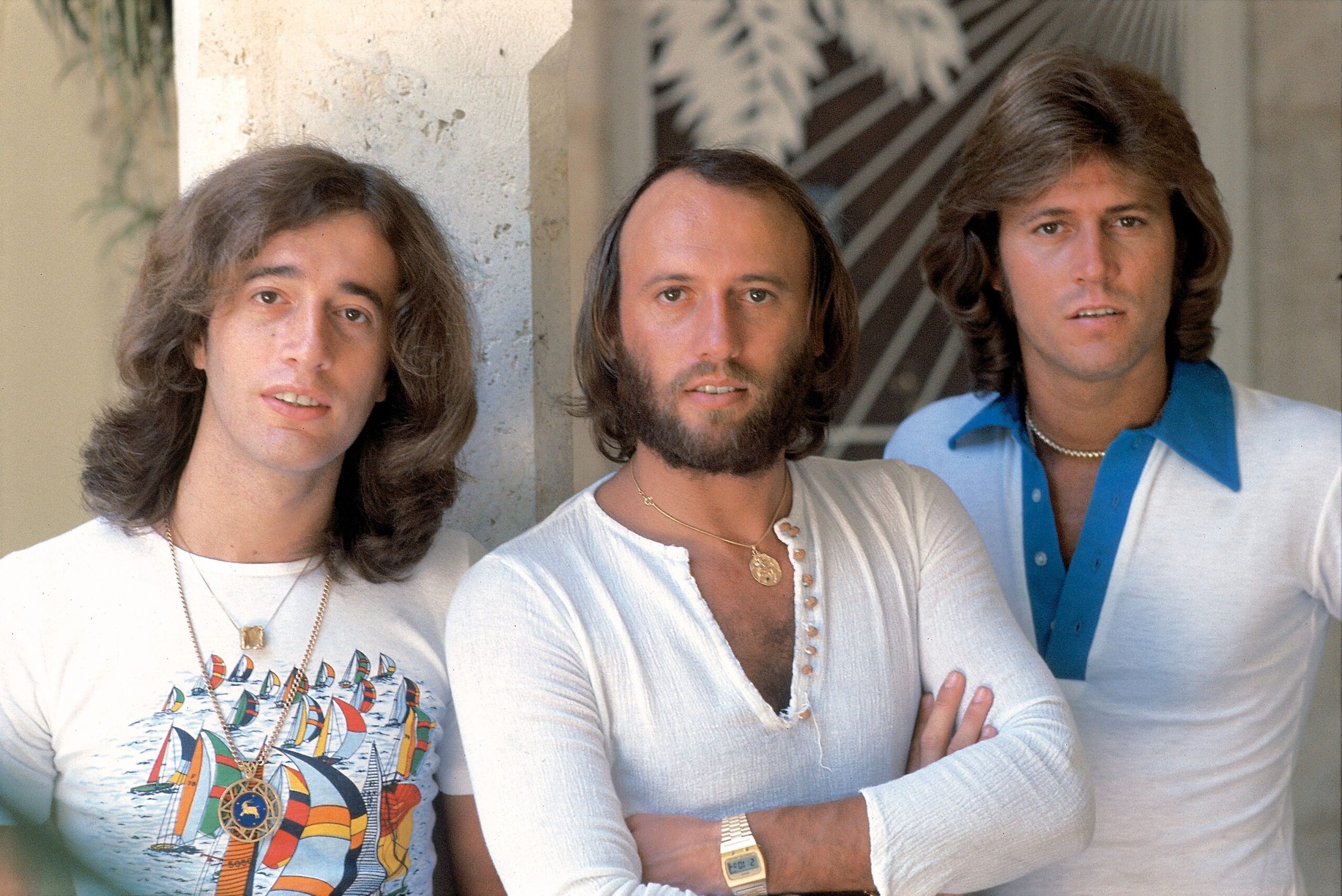
A lonely song born from a fractured brotherhood, “Saved by the Bell” turned heartbreak, separation, and quiet resilience into one of the most unforgettable chapters in the wider Bee Gees story.
There are songs that arrive like celebrations, and then there are songs that seem to drift in from a colder, quieter place — songs that carry the sound of someone standing at a crossroads, looking back at what was lost and ahead toward what cannot yet be named. “Saved by the Bell” belongs to that second kind. Though often mentioned in the orbit of the Bee Gees, it was in fact a Robin Gibb solo single, released in 1969 during one of the most painful and uncertain periods in the group’s history. That is precisely why it still carries such a peculiar ache. It is not merely a beautiful record. It is the sound of a family and a band coming apart in public, with one brother turning confusion into melody.
By the time “Saved by the Bell” was released, the original Bee Gees lineup had entered a period of deep internal strain. The late 1960s had already brought enormous success: songs of extraordinary elegance, close harmonies that seemed almost otherworldly, and a run of records that made the Gibbs feel not simply popular but essential. Yet success has a way of magnifying every insecurity. Tensions within the group grew, and in 1969 the split between the brothers briefly became real. Out of that rupture came this song — reflective, wounded, spiritual in mood, and marked by the unmistakable emotional tremor in Robin Gibb’s voice.
Commercially, the single proved that Robin’s artistry could command attention on its own. “Saved by the Bell” reached No. 2 on the UK Singles Chart in 1969, a remarkable achievement for a record born in the shadow of a breakup. It also performed strongly across Europe, reaching No. 1 in several countries, and confirming that listeners were hearing more than a side project. They were hearing a statement. In a season when the future of the Bee Gees seemed uncertain, the song offered evidence that their gift for melody, melancholy, and emotional precision had not vanished — it had simply taken a more solitary form.
What makes “Saved by the Bell” so moving is its atmosphere. The arrangement has a kind of drifting grandeur, with orchestral colors and a stately rhythm that feels almost ceremonial. But beneath that elegance is loneliness. Robin does not sing as a showman here; he sings as a man trying to make sense of spiritual exhaustion. The title itself suggests rescue, but not in a triumphant, chest-thumping way. This is rescue after confusion, after loss, after the collapse of certainty. One can hear a man reaching for meaning in the middle of emotional wreckage.
Lyrically, the song is elusive in the best possible way. It does not explain itself too neatly, and that mystery has long been part of its power. There are images of isolation, revelation, distance, and release. Many listeners have heard in it the emotional aftermath of the Bee Gees split, and that reading feels natural even if the song resists being reduced to a diary entry. Robin had a rare talent for making private feeling sound mythic. He could take hurt and elevate it into something almost dreamlike. In “Saved by the Bell”, that gift is everywhere. The song feels personal, yet it also feels universal — as though it belongs to anyone who has ever been left in the silence after something precious has broken.
It is also worth remembering how distinct Robin Gibb was as a vocalist. Within the Bee Gees, each brother brought a different emotional color. Barry Gibb often carried warmth, command, and melodic drive. Maurice Gibb added texture, musicianship, and balance. Robin brought vulnerability — a tremulous, quivering sincerity that could make even the most ornate pop song sound confessional. That quality is at the heart of “Saved by the Bell”. His voice does not dominate the arrangement so much as haunt it. It trembles, pleads, and lingers. Even now, decades later, it still sounds like someone singing from the far side of disappointment.
In the larger story of the Bee Gees, this song matters because it captures a moment before reinvention. Most casual listeners remember the group through their later triumphs — the disco era, the towering falsettos, the global phenomenon of “Saturday Night Fever”. But long before that comeback, there was this fragile interlude when the future was unclear and the brothers seemed to be moving on separate paths. “Saved by the Bell” preserves that uncertainty with uncommon grace. It reminds us that the Bee Gees story was never a straight line. It was full of departures, wounds, reconciliations, and astonishing returns.
There is something deeply affecting about hearing the song now. With time, it no longer feels like a temporary detour in the Gibbs’ career. It feels like an essential chapter — a document of fracture, yes, but also of survival. The title becomes more poignant with age. Robin may have been singing from a place of dislocation, yet the song itself became a form of salvation: proof that beauty could still be made when unity had failed, proof that sorrow could still sing.
For listeners who grew up with the Bee Gees, “Saved by the Bell” often lands with a special force. It carries the elegance of late-1960s pop, the introspection of an artist standing alone, and the emotional honesty that made the Gibbs so enduring in the first place. It is not as universally celebrated as the biggest Bee Gees hits, but perhaps that is part of its mystique. This is not the sound of a band conquering the world. It is the sound of one voice holding itself together long enough to tell the truth.
And that, in the end, may be why the song still resonates. Behind the polished arrangement and the chart success lies a simple human reality: even legends pass through seasons of doubt. Robin Gibb turned that season into art. In doing so, he gave the wider Bee Gees legacy one of its most tender and revealing moments — a song suspended between sorrow and grace, between ending and return.