
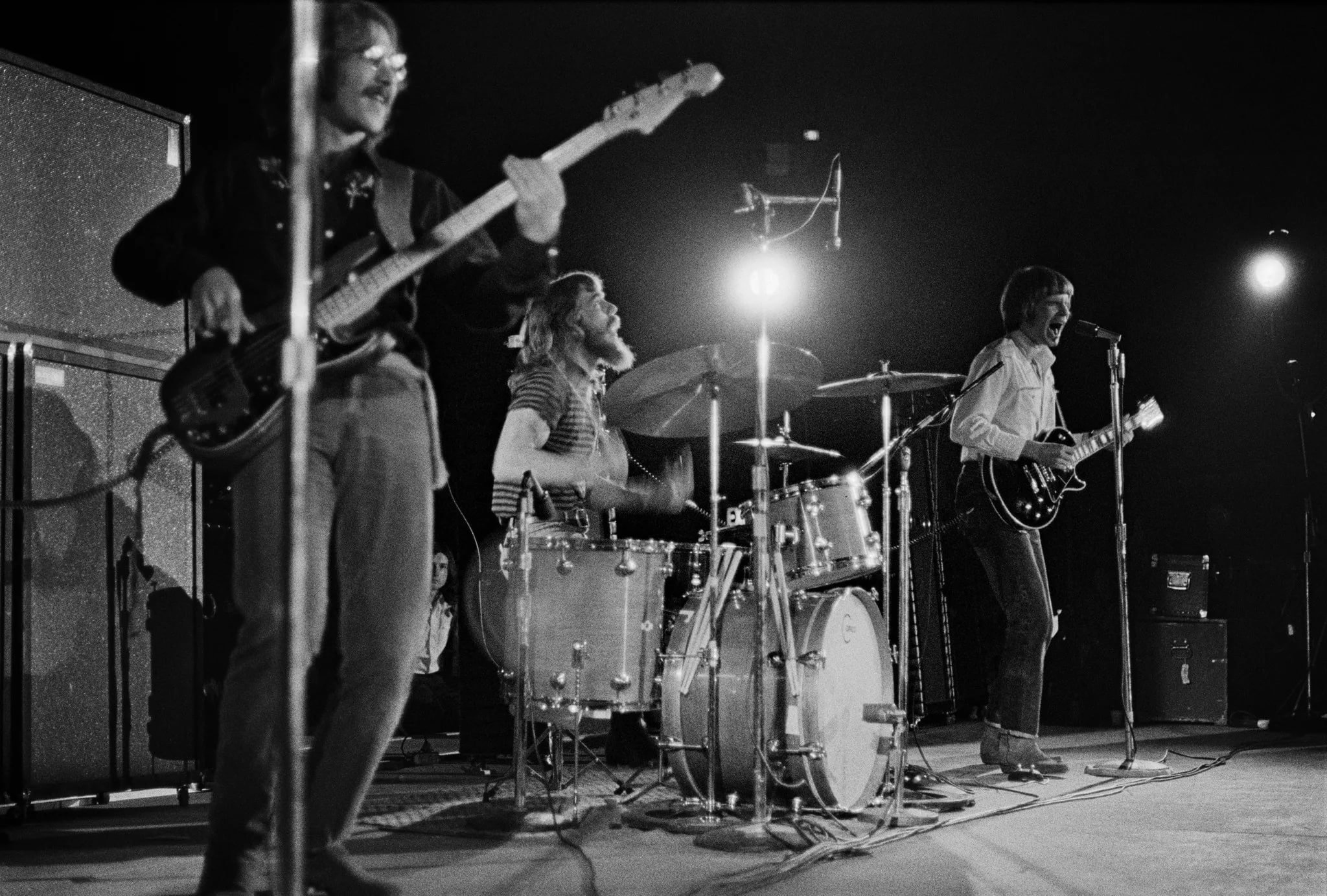
“Call It Pretending” is CCR before the legend—young voices disguising tenderness as toughness, trying to look unhurt while the heart keeps showing through.
Long before Creedence Clearwater Revival became the sound of storms on the horizon and truth shouted over a backbeat, there was “Call It Pretending”—a small, early record that feels like a note passed in class rather than a headline on the radio. It’s easy to overlook because it wasn’t born in CCR’s imperial hit era. In fact, it lived first as the B-side to “Porterville”, tied to the group’s last pre-CCR chapter and then carried forward into their first months under the new name. The band’s own early chronology places “Call It Pretending” as a John Fogerty song recorded in October 1967 at Coast Recorders (San Francisco), issued on the Scorpio 412 single and produced by Fogerty himself.
That’s the key “behind the curtain” truth: this song belongs to the moment before the myth fully formed—when the group was still stepping out of the Golliwogs skin and into the identity that would soon change American rock. The later CCR album documentation makes its afterlife even clearer: “Call It Pretending” eventually reappeared as a bonus track on the 40th Anniversary Edition of their 1968 debut album Creedence Clearwater Revival, explicitly labeled “(B-side of ‘Porterville’)” with a running time around 2:10.
So, what about “ranking at release”? Here the honest answer is also the most revealing. “Call It Pretending” was not a chart-making moment in the way CCR’s later singles were; it’s remembered as an early, non-charting release—one of those first steps that artists take before the world begins counting their footprints. Its significance isn’t in a Billboard peak position. It’s in what it tells you about the band’s emotional grammar before it became iconic.
And the grammar here is beautifully human: the title “Call It Pretending” sounds like a shrug, but it isn’t. It’s the kind of line someone uses when they don’t want to admit how much something matters. It suggests a narrator trying to control the story by controlling the label—if I call it pretending, then maybe it won’t hurt so much. That’s an old survival trick, and country and soul music have always understood it: pride is often just pain wearing a cleaner shirt.
What makes the song especially poignant in the CCR story is how different it feels from the later “Fogerty universe” most people know. Later CCR songs often sound like certainty—warnings, prophecies, hard decisions. “Call It Pretending” is earlier than that. It’s a young person’s mood: a little defensive, a little hopeful, and secretly pleading not to be seen too clearly. You can almost hear a band still learning how to be “tough” on record while their melodic instincts keep betraying them into tenderness.
Its afterlife as a bonus track is meaningful in a quiet, archival way. When a song is rescued decades later and placed alongside the debut album, it becomes a kind of time capsule—proof that CCR didn’t wake up one day fully formed as swamp-rock giants. They became that band through these smaller records: two-minute statements, half-hidden B-sides, songs that didn’t conquer the charts but taught the group how to hold a feeling in a tight frame.
And there’s a bittersweet irony in that. The title suggests fakery—pretending—yet the song’s very existence is evidence of sincerity. Nobody writes and records a B-side in 1967 with this much care unless they’re chasing something real: a sound, a future, a way out of being ordinary. This is CCR at the doorway, practicing the art of sounding like they don’t care… while caring enough to make the record in the first place.
So when you play “Call It Pretending” today, try not to measure it against the monuments—“Proud Mary,” “Bad Moon Rising,” “Have You Ever Seen the Rain.” Measure it against the feeling of an early evening when you’re still becoming yourself. It’s a small song, but it carries a familiar, lifelong truth: sometimes the heart protects itself by joking, by shrugging, by calling love a game. And sometimes, years later, you hear that old defense in the voice and recognize it immediately—because you’ve used it too.