
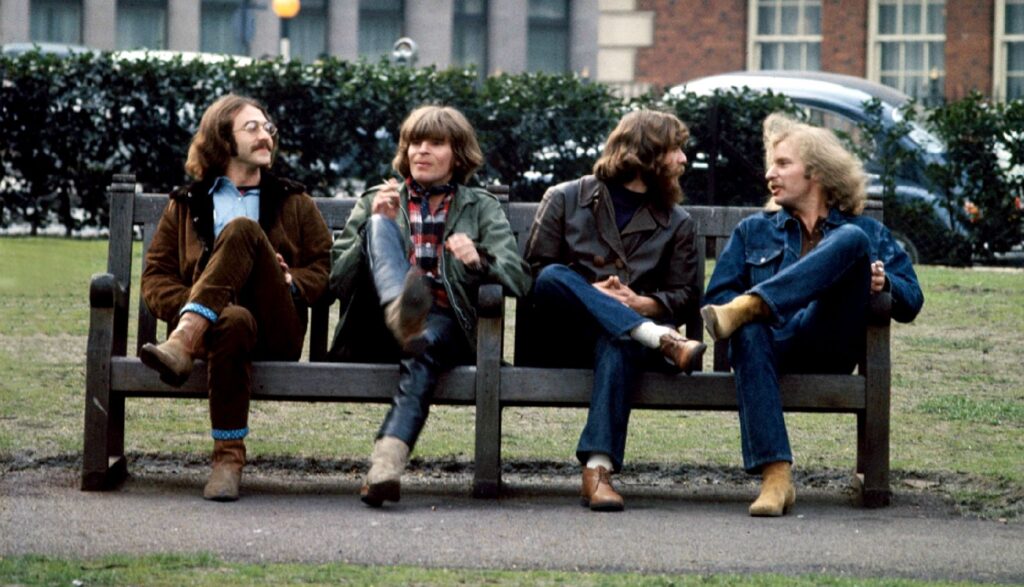
“Broken Spoke Shuffle” is Creedence Clearwater Revival caught in a candid, unfinished moment—an instrumental grin from the workshop floor, where the groove exists even before the “song” decides what it wants to become.
In the public story of Creedence Clearwater Revival, everything often feels carved in stone: the radio monuments, the three-minute novels, the swamp-rock certainty of John Fogerty’s voice. That’s why “Broken Spoke Shuffle” is such a quietly fascinating detour. It isn’t one of the canonical singles, and it never had a chart run of its own—because it didn’t enter the world as a 1969 A-side at all. Instead, it surfaced decades later as a rescued fragment: bonus material on Green River (40th Anniversary Edition), where Concord describes it as “the instrumental track to a song John Fogerty never finished.”
That one sentence is the key. “Broken Spoke Shuffle” isn’t trying to compete with “Bad Moon Rising” or “Green River.” It’s not a rival to the hits; it’s a glimpse behind them—proof that even a band famous for economy left sketches behind. You can hear it as an artifact of process: the band locking into motion, testing the feel, letting the tape roll, then moving on before a final lyric or melody ever “arrived.” Concord places it alongside another unfinished instrumental rarity, “Glory Be,” plus three 1971 live recordings that round out the expanded edition.
And the timing of that release matters for how the track feels. “Broken Spoke Shuffle” appeared publicly in the era of archival reevaluations—Apple Music lists it on September 30, 2008, in a digital CCR collection—meaning listeners first met it not as “new CCR,” but as a time capsule opened long after the band’s classic run had already become legend. That distance creates a special kind of listening: you don’t play it to learn what CCR “became.” You play it to hear what CCR was when no one was watching, when the pressure was off, when the groove could exist for its own sake.
To understand why that’s compelling, it helps to remember what Green River represented in the first place. The album—CCR’s third studio record, released August 7, 1969 and recorded March–June 1969 at Wally Heider Studios—arrived at the precise moment the band became unstoppable. And CCR’s own broader history notes that Green River was their first album to top the Billboard 200—a turning point where the group’s sound went from popular to defining. In other words, the era that produced “Broken Spoke Shuffle” was not a sleepy apprenticeship. It was the furnace.
So what does an “unfinished” instrumental mean in a catalog built on finished perfection?
It means you’re hearing CCR’s muscle memory: Doug Clifford and Stu Cook giving the rhythm that forward-leaning, road-dust momentum, while guitars circle the groove like they’re looking for the exact door to kick open. It’s a “shuffle,” yes—but not a sleepy one. More like the sound of wheels turning, a band moving as one unit, confident enough to be loose. The title image—a “broken spoke”—suggests motion that’s been damaged, travel that should wobble… and yet the track keeps rolling anyway. Even without lyrics, it carries that classic Creedence tension: the body wants to move, the mind can’t quite explain why.
And maybe that is the real emotional story behind “Broken Spoke Shuffle.” It reminds you that great bands aren’t only made of finished masterpieces. They’re made of the days that don’t “work,” the ideas that stay half-lit, the grooves that never find their final words—yet still contain the band’s character in pure form. Sometimes, hearing the sketch can feel more intimate than hearing the painting, because it proves the magic wasn’t only in the polish. It was in the instinct.
So if you come looking for a debut chart position, you won’t find one—“Broken Spoke Shuffle” wasn’t built for that race. Its reward is different. It’s the small pleasure of overhearing Creedence Clearwater Revival in the act of becoming themselves, one unfinished mile at a time.