
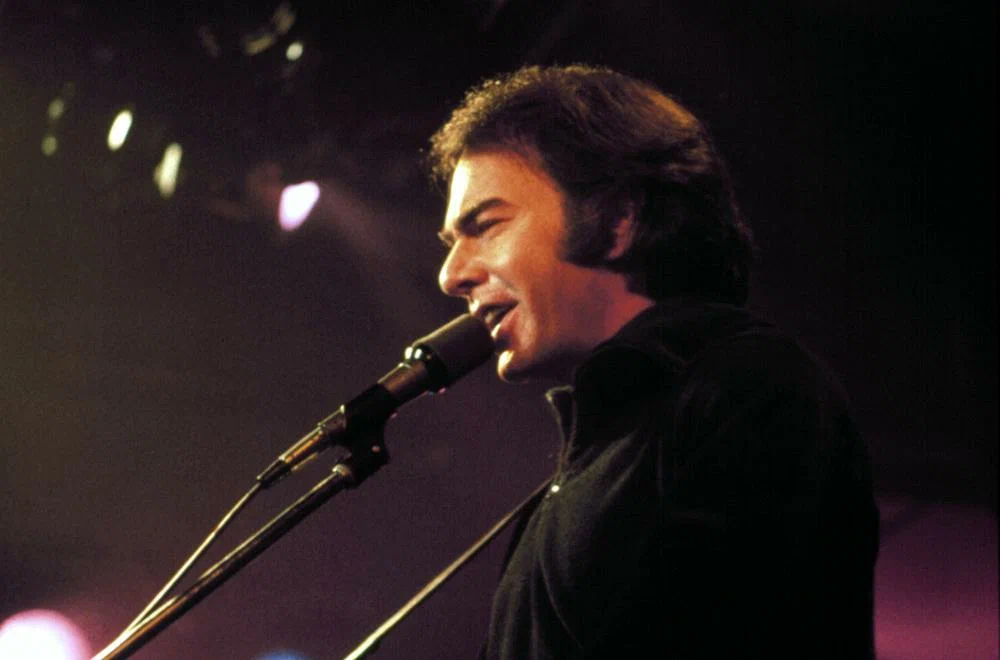
Long before reggae made it famous, “Red, Red Wine” was Neil Diamond at his most quietly desolate — a small, sorrowful song in which heartbreak did not cry out for attention, but sat alone with its glass and its memories.
The first truth should be placed right at the front, because so many listeners still approach “Red, Red Wine” backward through history. Neil Diamond wrote and first recorded “Red, Red Wine” in 1967, and it appeared on his second album, Just for You, released on August 25, 1967 by Bang Records. The song was later issued as a single and reached No. 62 on the Billboard Hot 100 in 1968. That is an important detail, because it tells us something essential about the song’s original life: this was not one of Diamond’s towering early smashes like “Girl, You’ll Be a Woman Soon” or “Thank the Lord for the Night Time.” It began instead as a more modest, more inward piece — a song whose reputation would take decades to grow, and would eventually be transformed by the immense success of later cover versions.
And yet that modest beginning is part of its beauty. In Neil Diamond’s hands, “Red, Red Wine” is not a party song, not a drinking song in the carefree sense, and certainly not the relaxed singalong many later generations came to associate with it. It is, at heart, a lonely song. The lyric speaks from the perspective of someone trying to use wine to dull the ache of lost love, to blur memory just enough to get through the night. Even in bare summary, the premise is painfully simple: the wine is not joy, but anesthesia. It does not celebrate feeling; it helps him survive it. That emotional angle makes the original recording feel very different from the version most of the world now knows best.
What makes Diamond’s version so affecting is precisely that it refuses to dramatize itself too much. He had already shown, even this early, that he could write songs with bold melodic hooks and memorable pop force. But “Red, Red Wine” reveals another side of him — the young songwriter who understood that sadness often lands harder when it is sung with restraint. There is no showy self-destruction in the song, no grand collapse into despair. Instead, there is a weary kind of self-awareness. The narrator knows exactly what he is doing and why he is doing it, and that knowledge gives the record its special ache. The wine does not heal him. It only postpones the full return of pain.
The album context deepens that feeling. Just for You was a rich early Neil Diamond record, full of original material and several songs that would go on to become cornerstones of his Bang-era reputation. But “Red, Red Wine” stands apart from the brighter confidence of some of those songs. It feels more shaded, more private, almost as though it had wandered in from another room after midnight. That may be one reason it has endured so strongly with serious listeners: it captures Neil Diamond before the grand arena persona, before the larger-than-life showmanship, in a more intimate emotional register. On Just for You, he still sounds very much like a young writer trying to turn inward weather into melody, and “Red, Red Wine” is one of the clearest examples of that gift.
There is also a quietly fascinating wrinkle in the song’s early history. After Neil Diamond left Bang Records in 1968, the label continued issuing material from his Bang-era recordings, sometimes altering tracks without his involvement. In the case of “Red, Red Wine,” later reporting notes that Bang added a background choir to the single version without Diamond’s permission. That detail may seem small, but it says something telling about the era and about the song. Even then, others seemed eager to reshape it into something slightly bigger or more commercially polished. Yet the core of the song resists that impulse. Its real power lies not in embellishment, but in its plainspoken sadness.
Of course, no discussion of “Red, Red Wine” can ignore the long shadow of its afterlife. UB40’s version turned the song into an international phenomenon, taking it to No. 1 in the UK in 1983 and then to No. 1 on the Billboard Hot 100 in 1988 after its reissue. That later success was so enormous that it permanently changed how the song lived in public memory. Even Neil Diamond himself eventually embraced that afterlife, and official and fan-facing materials note that he often performed the song live in a UB40-inspired reggae arrangement rather than in the somber style of his original recording. Yet if that later history tells us how adaptable the song was, the 1967 original tells us something deeper: that beneath all reinvention, the song was born in solitude.
That is why Neil Diamond’s “Red, Red Wine” remains so compelling when heard on its own terms. It reminds us that he was never only a writer of anthems or declarations. He could also write songs that lingered in the quiet aftermath of feeling. The title sounds simple, almost casual, but the emotion beneath it is not casual at all. It is the old human instinct to find something — anything — that might soften the absence of the one who is gone. No philosophy, no bravado, no grand lesson. Just a lonely man, a glass of red wine, and the wish to forget for a while.
In the end, that is what gives the original “Red, Red Wine” its lasting dignity. It was not his biggest hit. It was not the version that conquered the world. But it may be one of the clearest windows into Neil Diamond’s early gift for marrying melody to melancholy. Before the song became famous in another rhythm, it was already beautiful in this one: gentle, bruised, and quietly unforgettable.