
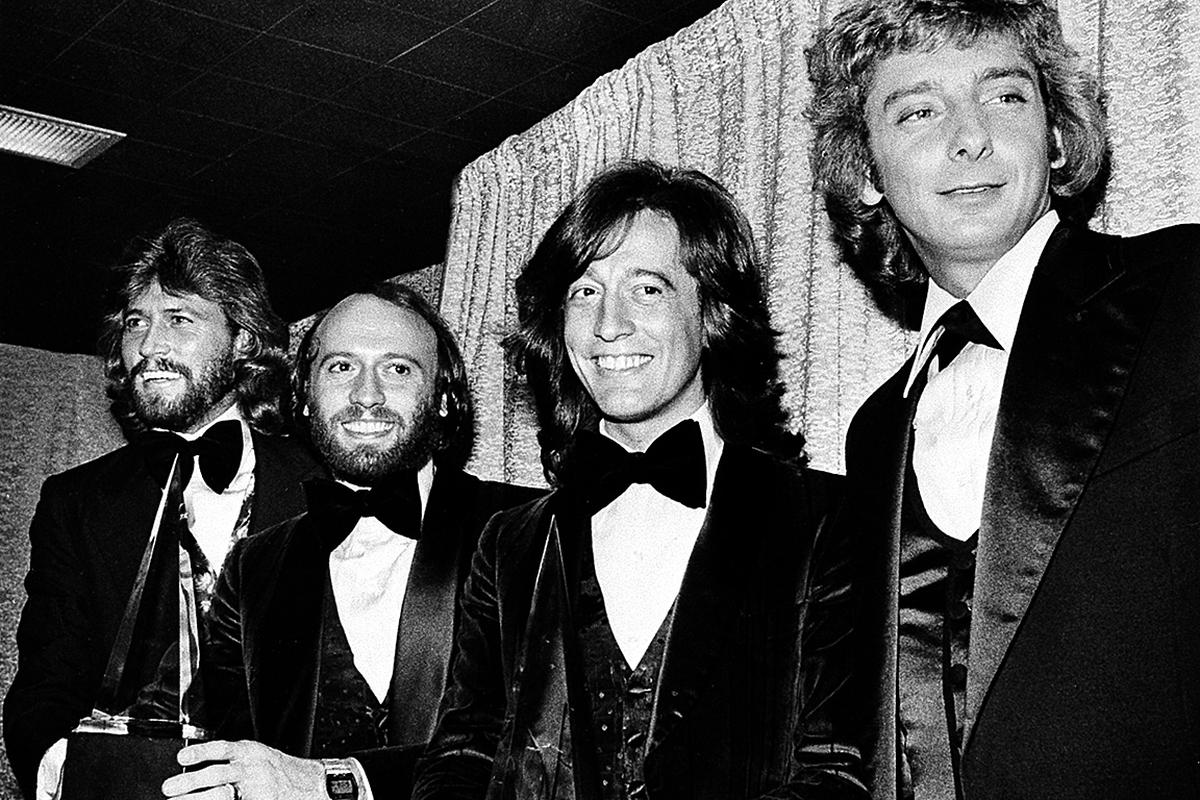
“I Laugh in Your Face” shows the Bee Gees in one of their least celebrated but most revealing moods — wounded, theatrical, and quietly defiant, as though private hurt had been dressed in velvet and set to melody.
When the subject is “I Laugh in Your Face” by the Bee Gees, the most important facts should be placed right at the front, because this is not one of the songs casual listeners usually know. “I Laugh in Your Face” was written by Barry, Robin, and Maurice Gibb, recorded on July 12, 1968 at IBC Studios in London, and finally released in March 1969 on the Bee Gees’ ambitious double album Odessa. It was not a single, and it had no chart life of its own, but it lived inside one of the group’s most artistically daring records — the red-velvet-sleeved Odessa, the Bee Gees’ first double album, a project the band’s official discography still describes as their most ambitious release of the 1960s.
That setting matters immensely. Odessa was not an ordinary pop album built around obvious commercial hooks. Released in March 1969, it came at a turbulent moment for the brothers Gibb, when their songwriting was becoming grander, stranger, and more emotionally complicated, even as tensions inside the group were beginning to deepen. The album was first conceived under other titles before settling on Odessa, and by the time it was finished it had become a sprawling statement of orchestration, melancholy, and private drama. Within that atmosphere, “I Laugh in Your Face” feels less like a minor filler track than like one of the album’s hidden emotional clues.
The song’s origins add another layer of fascination. It was recorded on the same day as “I’ve Gotta Get a Message to You,” the great 1968 Bee Gees single that would become a major international hit, reaching No. 1 in the UK and No. 8 on the Billboard Hot 100. Sources on the song’s release history note that “I Laugh in Your Face” was actually sent to Atlantic Records alongside “Message,” suggesting it may at first have been considered as a possible B-side before being replaced by “Kitty Can.” That detail tells us a great deal. This was not some forgotten scrap left in the vault by accident. At one point, it was close enough to the band’s active output to be paired with one of their most dramatic singles, before ultimately being held back and folded into the world of Odessa instead.
Musically, “I Laugh in Your Face” belongs to that rich late-60s Bee Gees style often called baroque pop — chamber-like, ornate, and emotionally theatrical without ever losing melodic grace. According to available session details, Barry Gibb handles most of the lead vocal, with a short central section sung by Robin Gibb, while Maurice Gibb plays bass, piano, and guitar, Colin Petersen plays drums, and Bill Shepherd provides the orchestral arrangement. That combination alone explains much of the song’s atmosphere. Barry gives it wounded authority, Robin adds a flicker of fragile contrast, and Shepherd’s arrangement places the whole thing in the Bee Gees’ most elegant late-60s tradition — the period when they could sound simultaneously intimate and faintly operatic.
What makes the song memorable, though, is not just arrangement but attitude. Even the title, “I Laugh in Your Face,” suggests confrontation, but the performance is not crude or swaggering. It is hurt made formal. The Bee Gees, especially in this era, had a remarkable gift for taking feelings that might have sounded petty in lesser hands — jealousy, bitterness, rejection, emotional pride — and turning them into something almost ceremonial. On this song, the laugh in question does not feel joyful at all. It feels defensive, brittle, perhaps even desperate. That is why the song lingers. Its defiance never quite hides the bruise underneath.
There is also a quietly revealing place for it in the broader Bee Gees story. By 1969, the brothers were writing on a larger canvas than ever, and Odessa became one of the records through which they tried to prove they were more than chart craftsmen. The official Bee Gees site still frames it as the band’s most ambitious 1960s release, while later critical reassessments have described it as a dramatic shift toward orchestral sophistication. In that company, “I Laugh in Your Face” may not be the album’s grand monument, but it is one of its character pieces — a song that shows how much psychological weather the Bee Gees could summon even away from the major titles.
And perhaps that is why songs like this matter so much to serious admirers of the group. The giant hits tell one story of the Bee Gees — brilliance, harmony, polish, unforgettable hooks. But the deeper album tracks tell another: that beneath the fame was a band capable of subtle emotional shading, capable of turning inward irritation or sadness into miniature theatre. “I Laugh in Your Face” is part of that hidden inheritance. It is not a chart triumph, not a radio memory for the masses, not one of the obvious titles from Odessa. Yet heard now, it feels like a small, finely cut stone from the Bee Gees’ most ornate early period — elegant, stung, and strangely beautiful in its refusal to pretend everything was tender. Sometimes the most revealing songs are not the ones that smile for the world, but the ones that let the hurt show through the style.