
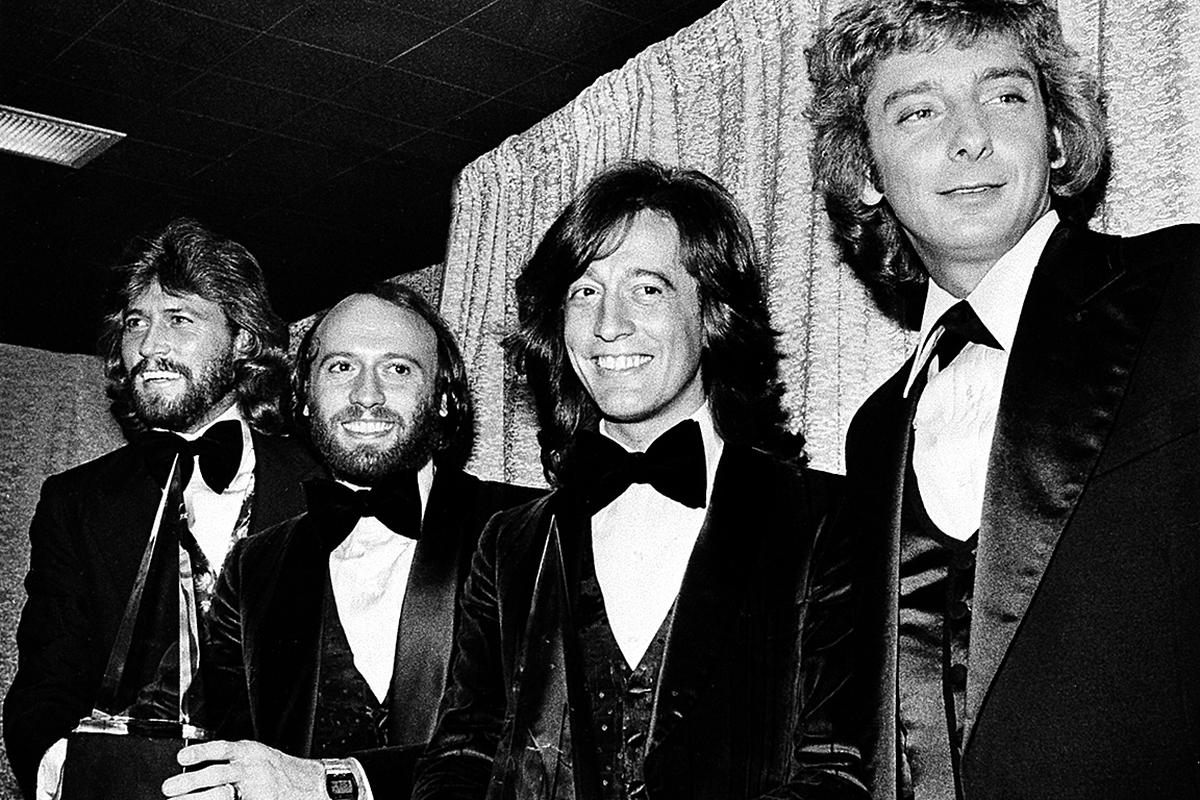
“Tears” is one of the Bee Gees’ most shadowed late ballads—a song that seems to stand in the dim light between grief and endurance, where sorrow is no longer dramatic, only deeply lived.
One of the most important things to say at once is that “Tears” was not released as a major hit single in the way so many classic Bee Gees songs were. Instead, it appeared as an album track on One, the group’s 1989 studio album, issued in April 1989 in the UK and later that year in the United States. The song is credited to Barry, Robin, and Maurice Gibb, and digital catalog listings place it firmly within that original One sequence. That matters, because “Tears” belongs not to the Bee Gees of bright chart spectacle, but to the Bee Gees of inward weather—older, bruised, and writing from a place where pain had become part of the family atmosphere.
The album that carried it, One, had a complicated commercial life. In Europe it performed respectably, reaching the top 10 in Germany and Switzerland and the top 30 in several other territories including the UK and Australia, while in North America it did not restore the Bee Gees to their old level of album success, even though the title track “One” became a U.S. Top 10 single. So “Tears” arrived in a chapter of their career that was neither comeback fantasy nor commercial collapse, but something more interesting: a mature phase in which the brothers were still writing beautifully, even when the spotlight had shifted elsewhere. That often produces some of the most revealing songs in a great catalogue, and “Tears” feels exactly like that kind of song—less famous, perhaps, but emotionally unguarded.
The deeper story around the song lies in the atmosphere of One itself. According to the album’s documented background, the Bee Gees had initially imagined this period in connection with their younger brother Andy Gibb, but Andy died in March 1988 before that possibility could become reality. The group then stepped away, returned later, and completed an album widely described as more melancholic than E.S.P., shaped by the shock of that loss. The record was dedicated to Andy, and “Wish You Were Here” was explicitly written as a tribute to him. It would be careless to label “Tears” itself a direct song for Andy without firmer evidence. But it would be equally careless not to hear the bereavement in the room. This is music made in the aftermath of family sorrow, and that sorrow hangs over the whole album like evening air.
That is why “Tears” feels so moving. It does not need a public legend attached to it. The title alone suggests a song stripped of ornament, and the Bee Gees, for all their brilliance with hooks and harmony, always knew how to handle vulnerability when they chose to do so. In a song like this, they are not chasing the sleek momentum of the disco years or the polished triumph of their grandest pop crossovers. They are allowing sadness to remain sadness. There is no rush to redeem it, no need to make it sparkle. The emotional meaning of “Tears” lies in that refusal. It sounds like the kind of song written after the noise has gone, when grief is no longer a headline, only a private weight carried from room to room.
The placement of the song on One also matters. This is an album often described by listeners and critics as darker and more serious than some of the Bee Gees’ more obviously commercial releases, and even a later retrospective on the record emphasizes its vulnerability and its unity in the wake of tragedy. In that setting, “Tears” becomes part of a larger emotional architecture. It is not simply a sad song among happier ones. It is one of the album’s expressions of a world that has been shaken and is trying, with dignity, to keep singing.
There is something especially haunting about hearing the Bee Gees in this mode. So much of their legend rests on brilliance, falsetto, rhythm, and the sheer elegance of their melodic craft. But beneath all that polish there was always an ache in the Gibb brothers’ music, an ache that surfaced again and again in different forms across the decades. “Tears” belongs to that tradition. It reminds us that the Bee Gees were never only craftsmen of immaculate pop. They were also chroniclers of emotional survival. Even when the song did not become a chart event in its own right, it preserved something essential about who they were: three brothers turning sorrow into harmony because harmony was the only language they had trusted all their lives.
So “Tears” deserves to be heard not as a footnote, but as one of those quieter Bee Gees recordings that reveals the heart beneath the legacy. It came from One, from a period of mourning, from a record dedicated to Andy Gibb, and from writers who understood that sadness does not always need explanation to be felt. Some songs announce themselves to the world. “Tears” does something more intimate. It remains in the shadows, and because of that, it often reaches even deeper.