
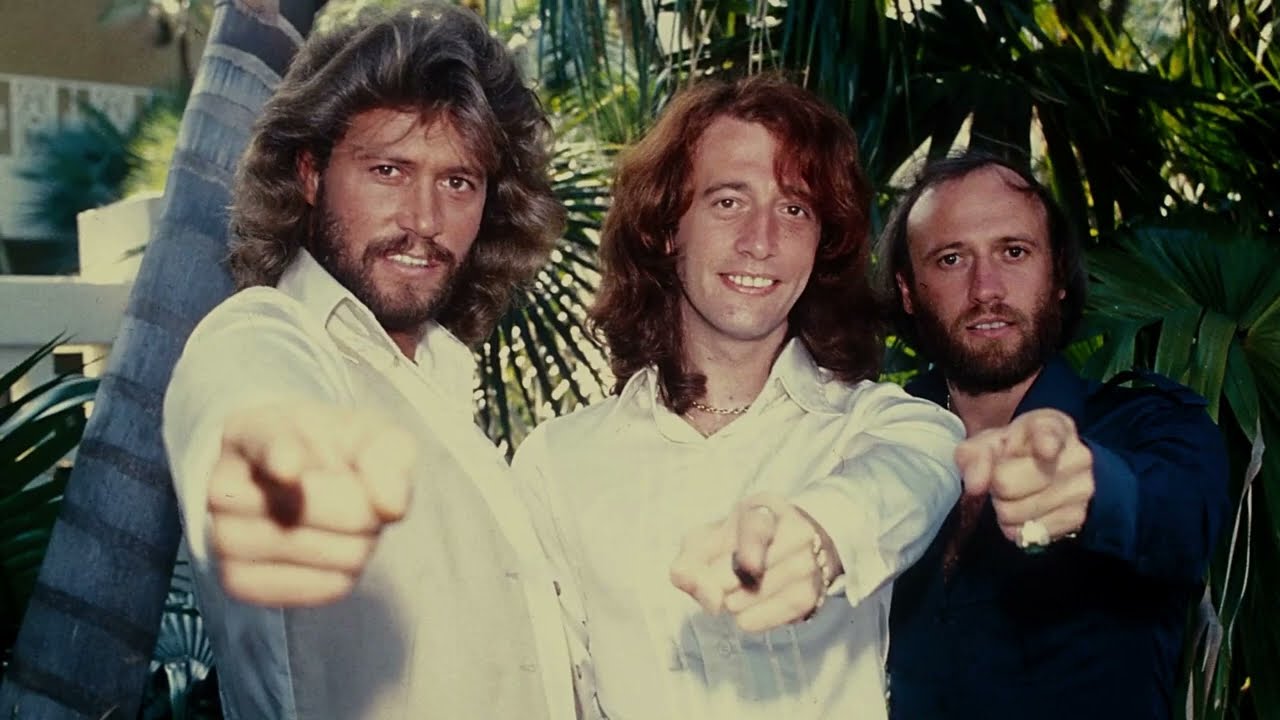
With Trafalgar, the Bee Gees stood at a strange and beautiful crossroads — not yet the glittering kings of the dance floor, but no longer merely gifted hitmakers, already learning how to turn heartbreak, history, and harmony into something grander than pop.
When people speak of the Bee Gees, memory often rushes first to the great late-70s blaze — the falsetto, the fever, the mirrored light. But Trafalgar, released in September 1971 in the U.S. and later in the U.K. in November 1971, belongs to an earlier, more inward chapter, and for many listeners it is one of the most revealing records they ever made. This was the group’s ninth studio album overall, recorded at IBC Studios in London between January and April 1971, and it arrived at a moment when the brothers were pulling themselves back into creative alignment after the fractures of the preceding years. It reached No. 34 on the Billboard 200, a respectable showing, but its deeper importance lies beyond numbers: this was the album that carried “How Can You Mend a Broken Heart,” the Bee Gees’ first U.S. No. 1 single, and it did so while preserving a mood far richer and sadder than a simple comeback story.
That is the essential fact to place near the top: Trafalgar was not just another Bee Gees release. It was a restoration of confidence. The official Bee Gees discography describes it as a “mature, ballad-heavy collection” of twelve songs, and that phrase suits it perfectly. The record takes its title from the Battle of Trafalgar, the famous 1805 naval victory in which the British fleet, though outnumbered, prevailed decisively. It was an evocative name for an album made by a band that had already known bruising conflict within its own ranks. The title suggested not only history, but survival — a battle endured, a flag still standing, a family voice still intact.
Musically, Trafalgar is full of the qualities that older Bee Gees admirers hold dear: stately melodies, aching harmonies, orchestral flourishes from Bill Shepherd, and that unmistakable sense that sorrow, in their hands, could become almost majestic. The album opens with “How Can You Mend a Broken Heart,” and what an opening it is — a song so immediately wounded, so exquisitely shaped, that it might have overshadowed a lesser record. Released as a single in May 1971, it rose to No. 1 on the Billboard Hot 100, remained there for four weeks, and later earned the group a Grammy nomination for Best Pop Performance by a Duo or Group with Vocals. Yet the album is more than its best-known hit. The official Bee Gees notes single out “Don’t Wanna Live Inside Myself,” “Lion in Winter,” “Israel,” “Trafalgar,” and “Walking Back to Waterloo” as key moments, and rightly so: this is a record whose atmosphere is cumulative, where melancholy does not sit in one corner but drifts through the whole house.
The title track, “Trafalgar,” deserves special attention, because it often lives in the long shadow of the famous opening single. According to Bee Gees historian Joseph Brennan, Maurice Gibb wrote the song, and in its earliest form he recorded it almost entirely by himself, with later additions from Alan Kendall and Geoff Bridgford. Brennan also notes that Maurice sang the lead vocal, which gives the piece an especially intimate place within the album. That matters, because “Trafalgar” does not sound like a grand public anthem despite its historical title. It is inward, moody, and faintly haunted — less a pageant of victory than a meditation on aftermath. That contrast is part of its fascination. The battle reference may suggest cannons and empire, but the music itself feels like fog, memory, and private reckoning.
There is also a quiet technical story behind the album’s sound. Brennan points out that by late 1970 the Bee Gees were working with two-inch 16-track tape, which allowed far greater separation of instruments and voices and made more refined stereo mixes possible. That may sound like studio detail, but on a record like Trafalgar it becomes part of the emotional effect. The harmonies seem to breathe more clearly; the arrangements have room to unfold; the melancholy has air around it. It is one reason the album has aged so gracefully. The songs do not feel trapped in production fashion. They feel carefully built, like rooms with high ceilings and dim light.
What makes Trafalgar endure, however, is not merely craftsmanship. It is the emotional weather of the album — that solemn, bruised, almost noble sadness that the Bee Gees could summon when they were writing at full depth. Even the official Bee Gees site, which naturally speaks in celebratory terms, emphasizes the record’s maturity and the rawness of the brothers’ voices. And when Rolling Stone’s Gary Von Tersch reviewed the album, he praised it warmly enough to hope the group would “stick together now for many years to come,” calling albums of this quality “faultless.” That response captures something real. Trafalgar is not flawless in the cold, modern sense of efficiency. It is flawless in feeling — a record that knows exactly what kind of sadness it wants to inhabit and never loses its poise.
So when the subject is “Bee Gees – Trafalgar,” the true story is larger than one song, though the title track is a crucial part of it. This album stands as one of the great transitional works in the Bee Gees catalogue: before disco grandeur, after internal upheaval, and already rich with the melodic intelligence that would carry them through every later reinvention. It gave them their first American chart-topper in “How Can You Mend a Broken Heart,” yet the album’s real legacy is gentler and deeper than commercial triumph. Trafalgar is the sound of the brothers Gibb learning, once again, how to stand together in the same emotional light. And heard now, after so many decades, it feels not dated but dignified — a melancholy, beautifully composed reminder that long before the Bee Gees became immortal in rhythm, they were already masters of heartbreak.