
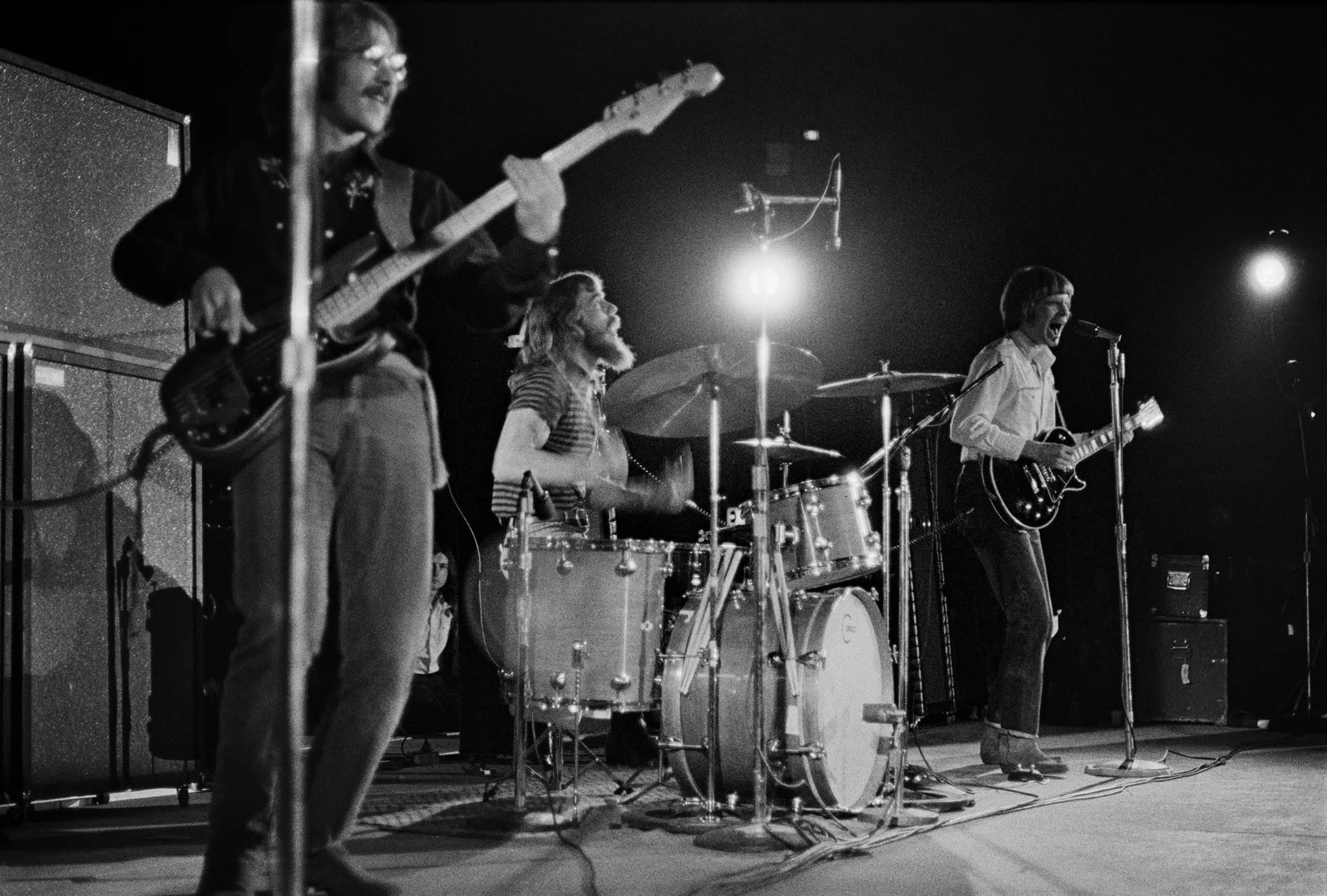
“Pagan Baby” captures Creedence Clearwater Revival at a turning point—still fierce, still swampy, yet already sounding like a band pushing against its own limits.
There is something striking about the way “Pagan Baby” begins. No hesitation, no soft welcome—just a hard, charging groove that announces Creedence Clearwater Revival with the kind of authority only they could summon. Released in late 1970 as the opening track on Pendulum, the song did not arrive as a hit single in the usual sense, but it carried a different kind of importance. It introduced an album that would reach No. 5 on the Billboard album chart in the United States and become one of the final major statements from a band that had already changed the sound of American rock in just a few short years.
By the time Pendulum appeared in December 1970, CCR were no longer simply the unstoppable hit machine behind “Bad Moon Rising,” “Proud Mary,” “Down on the Corner,” and “Who’ll Stop the Rain.” They were entering a more complicated season. The pace had been relentless. Between 1968 and 1970, the group released a remarkable run of albums and singles, all while building one of the most recognizable sounds in rock music. But on Pendulum, listeners could hear subtle changes: richer arrangements, more keyboards, less dependence on the old concise hit-single formula, and a sense that John Fogerty was searching for new shapes inside the band’s rugged framework.
“Pagan Baby” is one of the clearest examples of that shift. Built around a muscular riff, a rolling rhythm section, and a loose, almost feverish energy, the track feels raw even when the arrangement is carefully controlled. It has the familiar swamp-rock pulse that made Creedence Clearwater Revival so distinctive, yet it also stretches outward, allowing groove and texture to matter as much as melody. There is a jam-like quality to the performance, and that matters. The song reportedly grew in part from an instrumental idea before John Fogerty shaped it into a finished composition, and that origin still seems audible in the final version. You can hear a band leaning into motion, repetition, and physical force.
Lyrically, “Pagan Baby” is not one of Fogerty’s most literal story songs. That is part of its fascination. Instead of delivering a clear narrative in the manner of “Lodi” or “Lookin’ Out My Back Door,” the song works through mood, heat, appetite, and restless pursuit. The title itself suggests something primal, untamed, perhaps even forbidden. In the world of CCR, which often drew strength from Southern imagery, river-road mystique, and working-man tension, “Pagan Baby” feels like a burst of instinct—earthy, sweaty, and a little mysterious. It is less about explanation than sensation.
That may be one reason the track has aged so well among devoted listeners. It does not depend on a radio hook alone. It depends on feel. And Creedence Clearwater Revival understood feel better than almost anyone of their era. Doug Clifford and Stu Cook lock into a groove that sounds stubborn and alive, while John Fogerty sings and plays with that familiar urgency—as if every line has to break through weather, memory, and machine noise just to reach you. The result is a performance that feels both tightly wound and gloriously unbuttoned.
There is also a deeper historical poignancy in hearing “Pagan Baby” now. Pendulum would be the last CCR album recorded before Tom Fogerty left the band. That fact gives the opening track an unintended emotional weight. No, the song was not written as a farewell. It is far too forceful and too alive for that kind of backward-looking sentiment. But in retrospect, it sounds like one last great surge from the classic lineup—a reminder that even when the internal strain was growing, the band could still open a record with thunder.
In many ways, the brilliance of “Pagan Baby” lies in how completely it represents the tension inside Pendulum. This was not the lean, almost ruthless simplicity of earlier records like Green River or Willy and the Poor Boys, but neither was it a band abandoning itself. Instead, it was Creedence Clearwater Revival testing how far their sound could travel without losing its center. The organ textures on the album, the broader arrangements, and the willingness to let songs breathe all point toward change. Yet the heartbeat of “Pagan Baby” remains unmistakably theirs: gritty, direct, American, and full of motion.
What gives the song its lasting emotional force is that it sounds bigger than its place in the catalog might suggest. It may not be the first title casual listeners remember, but it reveals something essential about CCR. This was never just a singles band. Beneath the famous anthems was a group capable of atmosphere, pressure, and musical storytelling without neat conclusions. “Pagan Baby” does not ask to be admired politely. It barrels forward, grabs hold, and leaves behind the feeling of dust, heat, and unresolved desire.
And perhaps that is why it still speaks so strongly. Some songs comfort us with familiarity; others remind us that great bands are often most revealing at the edges, when confidence meets uncertainty and instinct outruns polish. Creedence Clearwater Revival found that space on “Pagan Baby”. Heard today, it feels like the sound of a mighty engine still running hot, even as the road ahead is beginning to split.