
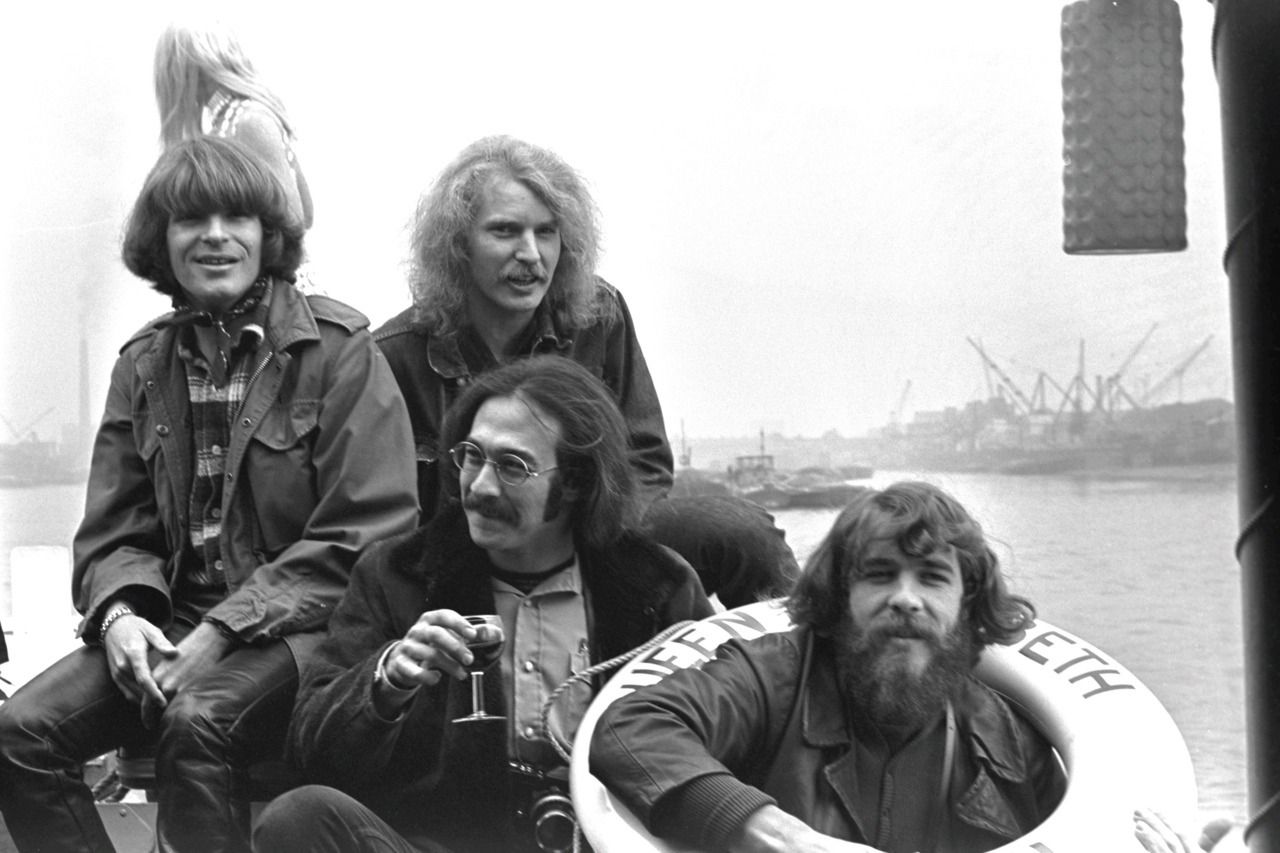
“Tearin’ Up the Country” captures Creedence Clearwater Revival in a rare, rough-edged grin—an earthy little burst of momentum that feels like driving faster than your worries can follow.
“Tearin’ Up the Country” is one of those CCR tracks that doesn’t arrive with the fanfare of a radio immortal—yet its placement in history is quietly significant. It sits on Mardi Gras, the seventh and final studio album by Creedence Clearwater Revival, released on April 11, 1972 by Fantasy Records. That alone gives the song a particular glow: you’re hearing the band at the end of its road, still capable of groove and grit, even as the seams were coming apart.
The most important credit is also the most revealing. “Tearin’ Up the Country” was written by Doug Clifford, and Clifford also sings lead on the track. Its running time is a brisk 2:15—no wasted motion, no scenic route, just a tight burst of country-rock propulsion. In a catalog often defined by John Fogerty’s authorship and voice, this is a different spotlight—brief, bright, and a little bittersweet because it exists inside an album born from a band under strain.
And the strain was real. Mardi Gras was recorded after the departure of guitarist Tom Fogerty, making it CCR’s only studio album as a trio—and, crucially, it featured songs written, sung, and produced by each of the remaining members rather than being overwhelmingly Fogerty-led. That experiment wasn’t just artistic; it was also a symptom of internal tensions. The record’s sessions are widely described as marred by personal and creative conflict, and CCR would soon disband after a short U.S. tour. When you listen to “Tearin’ Up the Country” with that in mind, the song’s cheerful stomp takes on a second meaning: sometimes the brightest-sounding tracks are the ones that refuse to admit how heavy the room has become.
There’s also a small, telling chart-adjacent detail that anchors “Tearin’ Up the Country” in the public timeline: it was used as the B-side to “Someday Never Comes,” released as a U.S. single in May 1972—a pairing that feels almost like a conversation between two moods. One side contemplative and aching, the other side kicking dust into the air, determined to stay in motion. That’s part of the charm here: “Tearin’ Up the Country” isn’t trying to be profound. It’s trying to be alive.
Musically, it carries the country rock character that Wikipedia even assigns to the album’s genre—a natural fit for CCR’s plainspoken, American-rooted vocabulary. The track feels built for back roads and open windows: a straightforward rhythm, a guitar bite that doesn’t polish itself, and a vocal delivery that sounds more like a buddy leaning in than a frontman delivering prophecy. Doug Clifford doesn’t sing as if he’s carving a myth; he sings as if he’s trying to shake the walls a little—maybe to prove the band can still rattle, still roll, still laugh in the face of whatever’s closing in.
And that’s where the deeper meaning sneaks in, almost unnoticed. The phrase “tearin’ up the country” can sound like bragging—raising a ruckus, leaving tire tracks, playing loud enough to be remembered. But on Mardi Gras, it can also read like a kind of defiance: if the end is near, then let the last pages move fast. Let the song burn quick and clean. Let the band, for two minutes and fifteen seconds, be nothing but momentum.
So no, “Tearin’ Up the Country” wasn’t the chart-climbing face of CCR in 1972—its “public role” was more modest, living as an album cut and a B-side. But it remains a fascinating little artifact: Creedence Clearwater Revival sounding both familiar and unfamiliar at once—still rooted in the same sturdy soil, yet sung through a different voice, from a later, lonelier chapter. In that way, it doesn’t just tear up the country. It tears open the curtain for a moment, and lets you glimpse the band’s final season—raw, complicated, and still moving.