
“Dear Father” is a wounded prayer in motion—a man (and a seagull) asking why suffering exists, and whether love still answers when the sky goes silent.
If you know Neil Diamond mostly through the big radio monuments—“Sweet Caroline,” “I Am… I Said,” the arena-sized choruses—it can be startling to meet “Dear Father” in its natural habitat: the 1973 film soundtrack Jonathan Livingston Seagull, released by Columbia Records on October 19, 1973, produced by Tom Catalano. This isn’t a standalone hit single with a neat chart peak of its own; it’s a scene in a larger spiritual narrative. Yet the album behind it was a genuine commercial heavyweight—widely noted as Diamond’s closest brush with a U.S. No. 1 album, reaching No. 2 on the Billboard 200. And it won the 1974 Grammy Award for Best Original Score Written for a Motion Picture or a Television Special, an unusual honor in Diamond’s catalog precisely because it recognizes him not only as a pop songwriter, but as a composer building a world.
Within that world, “Dear Father” is positioned like a turning point. On the original track listing, it appears as side one, track 4, running 5:12, with liner-notes that read like a cracked-open diary: “Battered, and near death, Jonathan asks for reasons.” Later on side two, a brief reprise—often labeled “Dear Father (Rebuked)” in modern listings—returns for 1:14, described as Jonathan being “rebuked again by the elders” as he tries to rally the flock. Even before you hear a note, you understand the emotional terrain: the song is not about winning; it’s about pleading, and then being told “no” by the powers that claim authority.
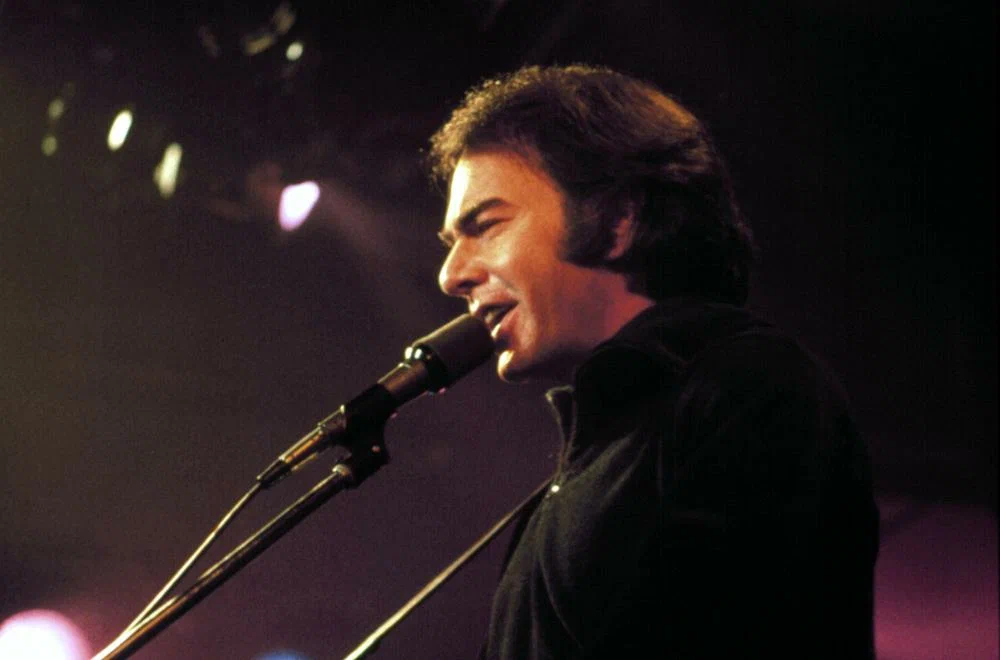
That is the story behind “Dear Father” in the clearest sense: it’s written to serve the film’s central conflict—aspiration versus conformity, the lonely cost of becoming your truest self, and the way “the elders” (whether literal or symbolic) often punish the one who dares to fly differently. But there is also a second, more human story behind it—one that lives in Diamond’s performance history. The Wikipedia record notes that Diamond often included a Jonathan Livingston Seagull suite in concert—specifically mentioning Love at the Greek in 1976 and performances in Las Vegas—with “Dear Father” nestled among pieces like “Be,” “Lonely Looking Sky,” “Sanctus,” and “Skybird.” In other words, he didn’t treat this material as a one-off soundtrack job. He carried it onto the stage, as if it belonged to his own autobiography of the spirit.
Musically, “Dear Father” stands out because it asks Diamond to sing not like a showman, but like a man alone with the biggest question he can form. The soundtrack’s reception notes praise Catalano’s direction and Lee Holdridge’s orchestral arrangements, and that orchestral weight is crucial here: it frames the voice as something small inside something vast—one human throat speaking up into an indifferent sky. You feel the tension between tenderness and scale, between a personal address (“Father”) and a cosmic silence that may or may not answer back.
That is the song’s meaning, and it’s why it lands so differently than Diamond’s love songs. “Dear Father” isn’t romantic longing; it’s existential longing. It’s the ache of a being who has been hurt by trying—hurt not because he was cruel, but because he was brave. When the lyric turns upward, it doesn’t do so with easy certainty. It sounds like someone who has already lost the argument with life and is still asking anyway, because asking is the last form of hope he can manage. Even the placement of the longer track (a near-five-minute prayer) followed by the short “rebuked” return later feels psychologically accurate: we often pour out our whole soul, and what comes back can be… a sentence. A shrug. A judgment. A door closing.
And yet—this is the quiet miracle—Diamond doesn’t let the piece sink into bitterness. The wider Jonathan Livingston Seagull project is built on striving, transcendence, return; “Dear Father” is the valley that makes the later lift believable. It acknowledges what glossy inspiration stories often skip: that faith is not a straight line, and that “becoming” can feel like punishment before it feels like freedom.
So if you’re listening to “Dear Father” today, the nostalgia it triggers may not be for 1973 radio or a particular dancehall memory. It’s a different kind of nostalgia—the longing for a time when mainstream artists were allowed to be openly spiritual and openly uncertain in the same breath, when a pop star could write a suite about flight and loneliness and still move millions. And perhaps that’s the most enduring gift of Neil Diamond here: he makes the most private sentence in the human vocabulary—why?—sound worthy of music.