
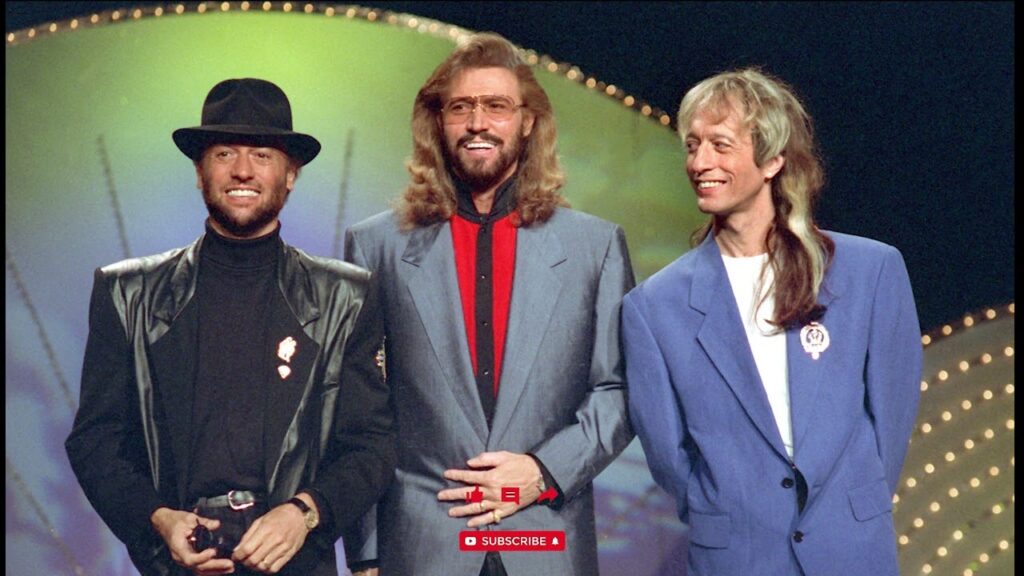
“Turn of the Century” was the sound of the young Bee Gees standing at a threshold—part memory, part ambition, and already touched by the melancholy that would make their early work unforgettable.
When “Turn of the Century” appeared in 1967 as the opening track of Bee Gees’ 1st, it was not pushed as a stand-alone single, so it never earned its own individual chart placing. But that fact tells only a small part of the story. The album that carried it became the international breakthrough for the Bee Gees, reaching the Top 10 in both the UK and the US and announcing that Barry Gibb, Robin Gibb, and Maurice Gibb were not simply another promising group from the pop boom. They were already writing songs with a strange old-soul depth, full of memory, atmosphere, and emotional shading. “Turn of the Century” may not have been the hit that radio held onto, but as an album opener it was a statement of identity—quiet, elegant, and far more revealing than a chart number alone could ever be.
The timing matters. In early 1967, the brothers had returned from Australia to Britain with an extraordinary stockpile of songs and the crucial support of manager Robert Stigwood. The London music world was changing quickly. Psychedelia was blooming, the album was becoming an artistic statement, and ambitious young writers were no longer satisfied with simple love-song formulas. Into that atmosphere came Bee Gees’ 1st, a record whose title sounded almost modest but whose music was anything but. Alongside future standards like “To Love Somebody” and memorable singles such as “New York Mining Disaster 1941” and “Holiday”, “Turn of the Century” served as the curtain rising on the group’s first great act.
What makes the song so moving is the way it immediately places the listener in an older emotional world. Even the title suggests not modern futurism, but a glance backward—toward the turn of an earlier century, toward faded rooms, old portraits, and a time already slipping into myth. That was one of the early Bee Gees gifts: they could sound young and ancient at the same time. Their harmonies carried the vulnerability of boys becoming men, yet their writing often reached toward subjects usually associated with age—time passing, lost innocence, longing, and the uneasy feeling that life is moving faster than the heart can accept.
Musically, “Turn of the Century” belongs to the baroque-pop side of the group’s early catalogue, the side that made so many listeners think of chamber music, music hall echoes, and the theatrical storytelling that set the band apart from more straightforward beat groups. The arrangement has a poised, almost literary feeling, and the album around it was shaped beautifully by the lush sensibility that Bill Shepherd helped bring to the Bee Gees sound. This was not brute-force rock and roll. It was atmosphere, suggestion, and emotional precision. The song does not shout for attention. It invites you into its mood, and that invitation is exactly why it still lingers.
There is also something quietly prophetic about it. Long before the white suits, the falsetto anthems, and the feverish pulse of the dance era, the Bee Gees were artists deeply interested in fragility. Listening to “Turn of the Century” now, one can hear the brothers searching not only for melody but for emotional texture. They were already fascinated by the place where beauty and sadness meet. That quality would never really leave them, even as their style evolved through dramatic reinventions. Fans who know only the late-1970s triumphs can be startled by how inward, poetic, and wistful these early recordings were.
The story behind the song is, in many ways, the story behind the early Bee Gees themselves. They were still very young, but they wrote as if they had been carrying old memories for years. Their songs from this period often felt like half-remembered films: characters in shadow, emotional weather, fragments of longing. “Turn of the Century” fits that world perfectly. It is less a literal narrative than an atmosphere of transition. The title alone suggests a moment when one age gives way to another, and that idea mirrors what the group themselves were living through. They were leaving one chapter of life behind, stepping into international fame, and trying to define who they were before the world defined them for them.
That is why the song remains so meaningful, even without the commercial profile of the group’s biggest singles. It opens Bee Gees’ 1st with grace and mystery. It tells the listener, almost immediately, that this record will not be shallow. It will be thoughtful. It will be melodic. It will carry an unusual emotional intelligence. In the space of one opening track, the Bee Gees announce a seriousness of purpose that still feels remarkable. Many first albums introduce a band. This one introduced a sensibility.
And perhaps that is the deepest meaning of “Turn of the Century”: it captures the ache of standing between worlds. It is about time, but also about identity. It is about looking backward even as life pushes forward. That feeling never goes out of style. For anyone who has ever heard an old song and felt a whole vanished season of life return in an instant, this track speaks in a language beyond trends. It reminds us that the early Bee Gees were not merely successful songwriters in the making. They were already chroniclers of memory, and “Turn of the Century” was one of their first truly haunting invitations into that world.